
 Kenneth Glad
Political communication is increasingly shaped by synthetic images as well as speeches and official statements. Their influence may depend less on whether they look real than on the attention they generate.

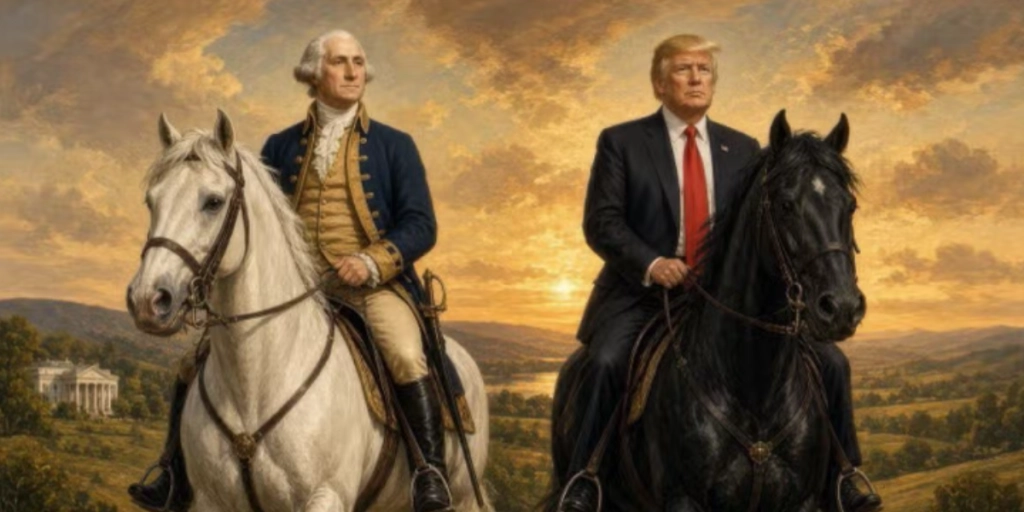
One of Donald Trump’s recent AI videos placed the U.S. president beside George Washington inside a visualization of the proposed White House ballroom.
According to HuffPost, the post appeared while the administration was asking the Supreme Court to allow construction on the project to continue. Other synthetic scenes showed Trump and Washington riding horses and signing a map.
The images turn a familiar political practice into something different. Presidents have long surrounded themselves with portraits and symbols of earlier leaders, but AI allows historical figures to be inserted directly into fictional scenes with a living president.
History becomes interactive
Cara Finnegan, a University of Illinois professor who studies visual political rhetoric, told HuffPost that the imagery presents Trump as more than an admirer of Washington. Her assessment was that it visually places the two presidents on similar ground.


“He’s almost positioning himself as a peer of Washington,” Finnegan said.
The ballroom setting also gives the synthetic scene an immediate political connection. Finnegan said the Washington imagery could help frame support for the project as patriotic, although she doubted every Trump post emerged from a coordinated communications strategy.
Trump’s use of obviously artificial material may matter even when viewers recognize that nothing depicted actually happened. Such posts can still circulate widely because supporters, critics and commentators all have reasons to share them.
Attention follows spectacle
Renee Hobbs, a communication professor at the University of Rhode Island, told HuffPost that the posts may reflect Trump’s “preoccupation with his legacy.” She also argued that their timing was worth noting.
HuffPost connected the Washington posts with continuing coverage of poor conditions aboard the USS Abraham Lincoln during its Middle East deployment. Hobbs argued that highly shareable social content can compete with harder news for public attention.
Michael Spikes of Northwestern University told HuffPost that the novelty of Trump’s AI posts may eventually wear off. As such images become a regular feature of his social media presence, they could simply become part of what audiences expect from the administration.
Repeated use could therefore make fabricated presidential scenes feel increasingly routine, even when their political purpose remains open to interpretation.
Sources: HuffPost



