
 Asger Risom
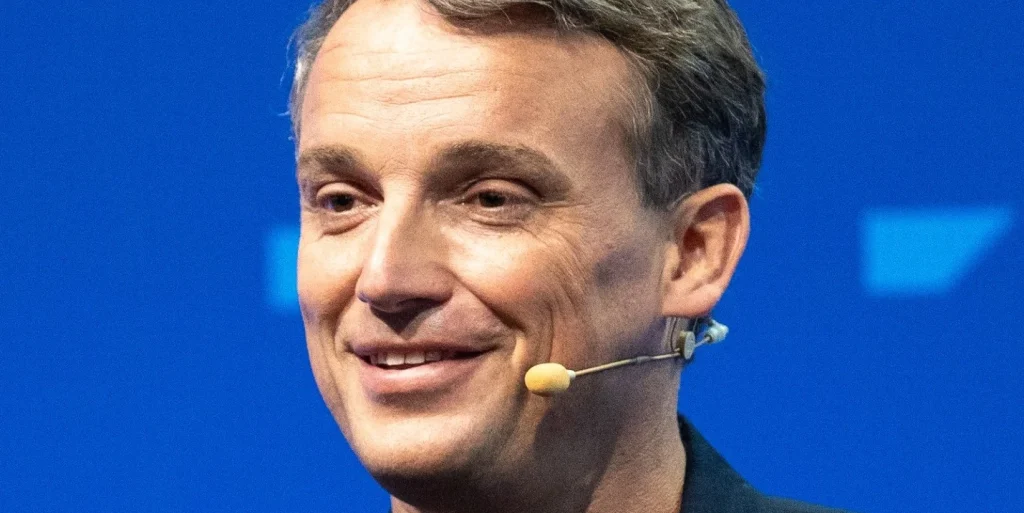
SAP CEO Christian Klein predicts that AI voice translation will kill off the keyboard within three years, using a recent Bloomberg Talk to explain how conversational AI will actively manage global supply chains.

Three centuries after an English engineer patented the first typewriter prototype, the CEO of Europe’s largest software company is officially calling a time of death on the physical keyboard. During a recent interview with Fortune, SAP chief executive Christian Klein casually predicted that the era of manually typing data into enterprise systems will be completely over in the next two to three years. Instead of watching middle managers hunched over laptops grinding through spreadsheets, employees will simply talk to their software to trigger workflows and run financial analyses.
But to understand how that voice-driven future actually works—and why it isn’t just corporate vaporware—you have to look at what Klein recently unpacked on the Bloomberg Talks podcast. Speaking with Bloomberg’s Anna Edwards and Guy Johnson, Klein explained that the real battle in enterprise AI isn’t about building the smartest generative chatbot. It is entirely about the “context layer.” An AI agent can perfectly understand your voice, but if it doesn’t possess the deep, proprietary logic of your company’s core business systems, it cannot actually execute a task.
By building AI agents directly on top of the company’s enterprise resource planning (ERP) software, SAP is essentially giving the AI the keys to the entire corporate nervous system. Klein noted on Bloomberg that businesses can swap in whatever large language model they want—including cheaper open-source models—because the true value lies in how that model interacts with a company’s secure, mission-critical data. Once that voice-to-data translation layer is perfected, you can log pipeline entries or adjust supply chains just by speaking out loud.
Moving past the vertical “efficiency hack”
The problem with how most Fortune 500 companies are currently using artificial intelligence is that they treat it like a cheap parlor trick. A business will dump millions of dollars into an AI platform, deploy it in a single vertical like the marketing department, and then complain about a low return on investment. As Klein explained to Fortune, this siloed approach is completely backwards. To actually justify the massive “token consumption” and rising R&D costs he discussed on Bloomberg, AI has to operate horizontally across the entire organization.


He pointed to a massive consumer goods company SAP is currently working with as the blueprint. The company deployed an AI agent that was brilliant at predicting customer demand, vastly outperforming human forecasters. But because that predictive agent wasn’t actually talking to the procurement or manufacturing departments, it still took months to adjust the physical warehouse inventory.
By building out end-to-end agents that connect those wildly different departments, the company managed to optimize its total inventory by a staggering 20 percent. That is not just a cute efficiency hack; that is a massive, structural overhaul of how a company handles its physical supply chain. The software industry is finally moving past the theoretical “what if” phase of generative AI and straight into the brutal reality of applied, autonomous enterprise tools that actually execute multi-step workflows.
Preparing for the geopolitical kill-switch
While software executives love to wax poetic about a utopian, frictionless future of work, the actual global business environment is fracturing fast. In his conversations, Klein has been incredibly blunt about the reality of the “G4” economy—the United States, China, Europe, and India. The era of unchecked globalization is dead, replaced by a hyper-fragmented landscape of export controls, digital sovereignty laws, and outright trade wars.
Because enterprise software is the literal nervous system of a modern multinational corporation, a sudden geopolitical spat can turn into an extinction-level event. If a country suddenly demands that its cloud servers be geographically fenced off or physically disconnected from a global network, a business cannot just shrug and take its systems offline. SAP is actively building infrastructure designed to be ported over to local cloud providers in a matter of days, ensuring companies survive sudden geopolitical sanctions or regulatory kill-switches.
Klein also took a remarkably sharp jab at his home turf regarding this new global reality. While the US and China continue to aggressively flex their economic muscle, he noted that Europe is only a superpower in one specific category: regulation. Without a unified banking, trade, or digital union, Europe is busy debating digital taxes while its rivals are busy building the actual future. If you want a seat at the table in the AI era, you need pure economic leverage—and endless red tape simply doesn’t cut it.



