
 Kenneth Glad
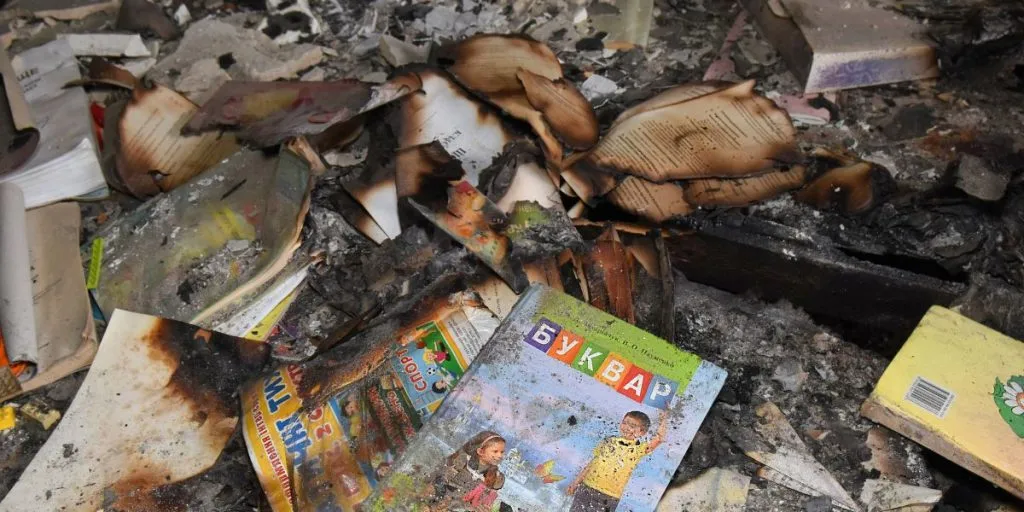
Books do more than tell stories. They hold the shared memory and identity of an entire nation. When those pages turn to ash, the loss cuts far deeper than just ruined paper and ink.


A single warehouse fire wiped out eight million books in Kharkiv, Ukraine, this summer. It was a devastating blow. The blazing inferno swallowed hundreds of thousands of textbooks meant for students returning to school.
Viktor Kruglov runs the publishing house Ranok. He was standing on the warehouse floor with his team when the attack happened in August.
Jet-powered drones struck the building with terrifying speed. Fire crews fought the resulting blaze for a full week, according to The Guardian.
“Fifty people were on shift that day, and I don’t know how to explain how nobody was injured,” Kruglov told the British newspaper.


A deliberate campaign
The devastation in Kharkiv fits into a much larger, grim pattern. Russian strikes have destroyed roughly 13 million books across Ukraine over the summer months.
Government officials estimate this accounts for a third of all volumes printed in Ukraine this year. The targeted sites sit far away from military bases.
Many leaders view these attacks as a direct assault on the nation’s cultural identity. They know exactly what is happening. Deputy culture minister Bohdana Laiuk pointed out that invading forces always target local literature first:
“When the Russians occupy, the first thing they do … is to go to the libraries, take the Ukrainian language books out, and destroy them.”
Dreams wiped out
The crisis has been especially hard on small, independent businesses. Artem and Kateryna Sova started their tiny publishing company called Krapky just last year.
The couple recently secured a deal with a postal service to distribute their carefully translated novels. Then a missile hit their storage facility near Kyiv.
The strike destroyed every single copy they had ready for sale. Now they rely entirely on preorders and support from their readers to keep the dream alive.
Looking straight ahead
Despite the massive financial losses, publishers refuse to stop printing. Readers have shown huge support for local authors since the full invasion began in 2022.
The industry is adapting by splitting its stock across smaller, scattered locations. Fast deliveries might disappear, but the books will survive.
Kruglov recently walked through the stinking, blackened remains of his life’s work to assess the true scale of the damage. Yet he remains completely defiant.
“I think that we will rebuild everything. And I even know how to do it better,” he told The Guardian.
Source: The Guardian



