
 Asger Risom
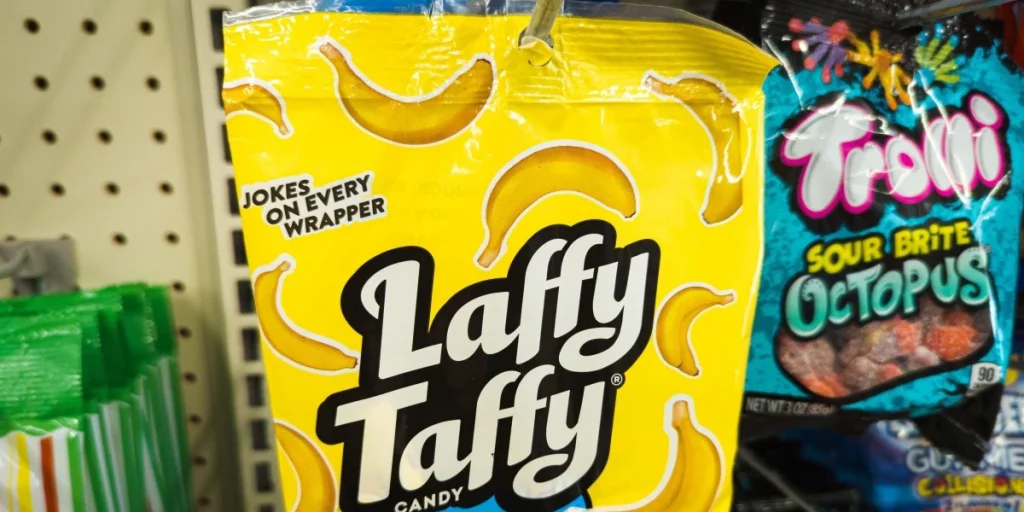
Artificial banana candy doesn’t taste like the bananas in your fruit bowl because it isn’t supposed to. The chemical flavoring happens to be a highly accurate match for the Gros Michel, a sweeter variety of banana that dominated the global fruit trade until it was functionally wiped out by a fungal pandemic in the 1950s.


If you have ever eaten a piece of banana-flavored Laffy Taffy, you know the truth: it tastes absolutely nothing like a real banana. It is overly sweet, chemically pungent, and vaguely cartoonish.
For a long time, most people just wrote this off as candy being candy, or assumed confectioners simply had a bizarre interpretation of what fruit actually tastes like. But the truth is much stranger. That artificial flavoring isn’t a bad copy of the bananas sitting in your kitchen. It just happens to perfectly mimic a fruit that essentially no longer exists.
The artificial banana flavor you recognize today is the chemical ghost of the Gros Michel, a sweeter, hardier breed of banana that was effectively wiped off the face of the Earth in the 1950s by a devastating global pandemic.
The rise and fall of “Big Mike”
If you walked into an American grocery store anytime between 1870 and 1950, you wouldn’t find the Cavendish banana that we all eat today. You would find the Gros Michel (often affectionately called “Big Mike”). It was the undisputed king of the global fruit trade. It had a thicker peel, lasted longer on cargo ships without refrigeration, and boasted a much richer, sweeter flavor profile than modern bananas.


But the global agricultural system made a fatal mistake: they grew the Gros Michel as a massive monoculture. Millions of genetically identical banana trees were planted across Central America with zero genetic diversity to protect them.
When a soil-borne fungus called Fusarium oxysporum—commonly known as Panama disease—arrived on the scene, it triggered an agricultural apocalypse. The fungus choked off the plant’s vascular system, rotting it from the inside out. Because every Gros Michel tree was a genetic clone, the disease tore through global plantations. By the 1960s, the Gros Michel was functionally extinct as a commercial export. The industry panicked, pivoted entirely to the blander, disease-resistant Cavendish, and never looked back.
The chemistry of a coincidence
So how did the Gros Michel get trapped in our candy?
It actually comes down to a chemical coincidence involving a compound called isoamyl acetate. It is a persistent myth that scientists explicitly designed banana flavoring to copy the Gros Michel. What actually happened is that in the late 19th and early 20th centuries, chemists realized that if they synthesized pure isoamyl acetate, it smelled and tasted remarkably like a banana.
Because the Gros Michel naturally contained a much higher concentration of isoamyl acetate than the modern Cavendish, that cheap, easily synthesized chemical compound was a highly accurate match for the bananas people were actually eating at the time.
When the Gros Michel was wiped out, the candy industry didn’t bother to update their recipes to match the new, more complex flavor profile of the Cavendish bananas. They just kept pumping out pure isoamyl acetate. Today, every time you unwrap a piece of artificial banana candy, you are experiencing a flavor profile that heavily resembles a fruit eradicated by a fungus more than sixty years ago.



