
 Jens Asbjørn Bøgen

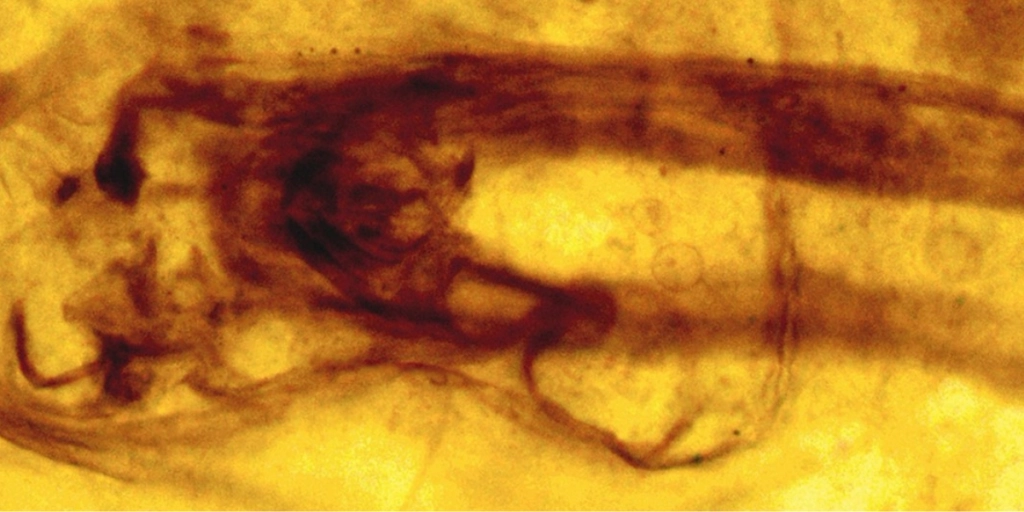
It was named the world’s oldest insect back in 2004.


For a century a tiny speck in Scottish rock has puzzled scientists trying to pin down when insects first took wing.
The specimen, barely a millimeter across, has sat in the drawers of London’s Natural History Museum since 1926. For most of that time it was treated as a curiosity.
Then, in 2004, two paleontologists looked at its jaws under a microscope and announced that it was the oldest known insect, and probably one with wings.
That identification has anchored two decades of textbook timelines for when flight first evolved in insects. A new study published in Scientific Reports now concludes that the fossil cannot be placed with winged insects at all, and that the minimum age of winged insects should be pulled forward by roughly 80 million years.


The fossil, Rhyniognatha hirsti, comes from the Rhynie Chert in Aberdeenshire, a bed of silica-rich rock radiometrically dated to about 407 million years ago in the Early Devonian. The chert preserves one of the oldest known land ecosystems on Earth.
What the new scans show
The reanalysis was led by Dr. Emma Long and Dr. Gregory Edgecombe at the Natural History Museum in London. The team used confocal laser scanning microscopy, a technique that uses focused lasers to digitally slice through a specimen layer by layer and build a three-dimensional model of structures a conventional light microscope cannot resolve.
Those scans showed that the fossil’s jaw hinges do not match the joints seen in modern flying insects, nor those of modern centipedes. In 2017, a reanalysis by Carolin and Joachim Haug in PeerJ had already argued the mouthparts looked more like those of a myriapod, the group that includes centipedes and millipedes, than an insect.
The new paper closes neither case. It argues the fossil is not diagnosable as an insect or a myriapod on the evidence that survives, and should not be used to calibrate molecular clocks for insect evolution until its identity is settled.
Why 80 million years
The 2004 Nature paper by Michael Engel and David Grimaldi treated Rhyniognatha as a winged insect and used it to argue that insects, and the origin of flight, had to extend back into the Silurian or Early Devonian. Pulling that calibration point out of the record shifts the oldest hard evidence for winged insects to much younger fossils in the Carboniferous. The authors put the resulting shift at up to about 80 million years.
Rhyniognatha remains in the museum’s collection. Any future reclassification will depend on new specimens, or on techniques that can extract more detail from the fragment that has been examined for a hundred years.



