
 Asger Risom

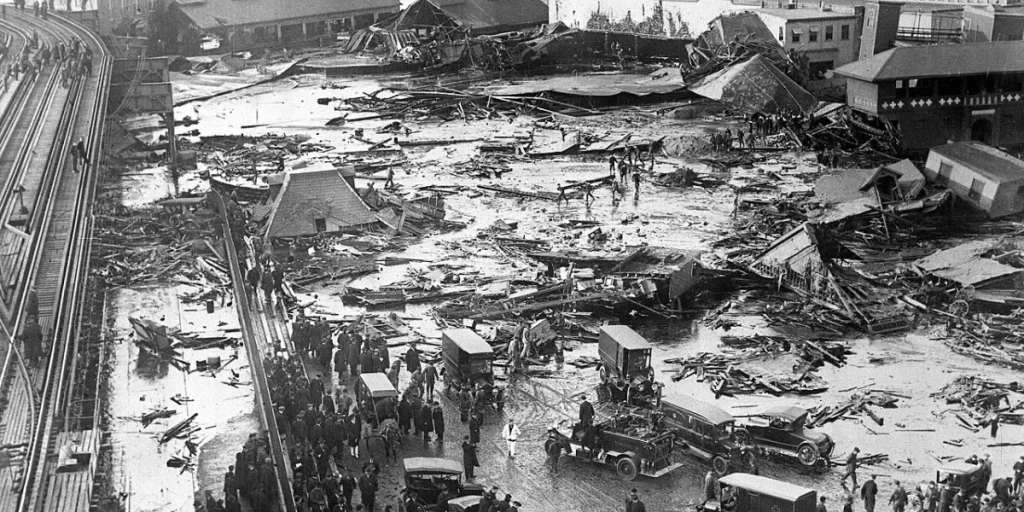
In January 1919, a ruptured storage tank sent 2.3 million gallons of molasses surging through Boston at 35 miles per hour. Fluid dynamics research shows how winter temperatures rapidly transformed a fast-moving wave into a suffocating, glue-like trap.


“Slow as molasses in January” is supposed to be a joke about things that barely move. On January 15, 1919, in Boston’s crowded North End neighborhood, a ruptured storage tank proved that winter syrup can actually barrel down a city street at thirty-five miles per hour. Understanding how a thick baking ingredient became a lethal, fast-moving tsunami—and then thickened into a glue-like trap—comes down to a brutal quirk of cold-weather fluid dynamics.
A fifty-foot tank built on corners cut
At the center of the disaster stood a massive steel tank owned by the Purity Distilling Company, a subsidiary of United States Industrial Alcohol. Towering fifty feet high and ninety feet wide along Commercial Street, the structure held roughly 2.3 million gallons of raw molasses destined to be fermented into industrial alcohol for munitions and liquor.
As detailed by Britannica, the tank had been thrown together hastily during World War I with thin steel plates and almost no engineering oversight. It leaked so badly from the day it was filled that company workers painted the exterior brown to disguise the seeping syrup, while local children routinely collected drippings in buckets to take home.
Shortly after lunchtime on January 15, warm Caribbean molasses had just been pumped into the tank atop colder existing stock, triggering fermentation gases that pushed the strained steel past its breaking point. Around 12:30 p.m., rivets popped like gunfire and the tank split wide open, unleashing roughly fourteen thousand tons of syrup onto the waterfront.


Why the first wave moved faster than a sprinter
For nearly a century, historians struggled to explain how a substance famous for oozing could flatten buildings, buckle elevated railway girders, and outrun fleeing pedestrians. In 2016, Harvard fluid dynamicists Nicole Sharp, Jordan Kennedy, and Shmuel Rubinstein modeled the disaster to reconstruct the physics behind the surge.
As reported by the American Physical Society, the initial speed came down to basic hydrostatics. A fifty-foot-tall column of heavy liquid creates immense downward pressure at its base, converting potential energy into a violent gravity current the instant the wall fails. Driven by its own weight, a brown wave more than fifteen feet high blasted outward at thirty-five miles per hour, faster than any human can sprint.
The syrup’s molecular behavior amplified that momentum. Molasses is a shear-thinning non-Newtonian fluid, meaning its resistance to flow drops when subjected to sudden physical stress. Because the molasses inside the tank had been kept warm enough to pump—and thinned further by the violent shear forces of the rupture—it behaved far more like surging floodwater than table syrup during the first chaotic minute.
The temperature drop that turned a flood into a trap
Once the wave spread across the neighborhood and lost its initial height, the physics flipped from high-speed impact to suffocating paralysis. Although January 15 was unusually mild for a Boston winter—hovering around forty degrees Fahrenheit after a bitter cold snap—the outdoor air and stone streets were still far colder than the warm syrup pouring out of the tank.
According to Smithsonian Magazine, spreading across the cold ground caused the shallow layer of molasses to shed heat rapidly. As its temperature plunged, the fluid’s viscosity skyrocketed, turning a fast-moving surge into a stiffening, glue-like paste within seconds.
Victims knocked off their feet found themselves pinned in waist-deep syrup that hardened the more they thrashed. Rescuers wading into the streets sank up to their knees, unable to pull trapped neighbors free before the heavy goo cut off their air.
Rewriting the rules of American construction
By the time cleanup crews finished washing the streets with saltwater from fireboats, twenty-one people were dead and roughly one hundred and fifty were injured. As Smithsonian Magazine notes, rescue workers and sightseers tracked syrup onto streetcars, payphones, and subway platforms across Greater Boston, leaving the city sticky for weeks.
In the courtroom aftermath, investigators concluded that the tank failed simply because its steel walls were too thin and its safety margins virtually nonexistent. The ruling prompted Massachusetts—and eventually states across the country—to overhaul building regulations, requiring licensed engineers and architects to sign off on major structural plans so no company could ever build a ticking time bomb on a city street again.



