
 Kenneth Glad
False information can acquire extraordinary power when institutions, governments or influential figures give it credibility. Sometimes the truth emerges only after decisions made in its shadow have become irreversible.


Documents, staged incidents and official denials have repeatedly influenced history. Their purposes differed, from securing authority to confusing an enemy, but each depended on persuading an audience that something manufactured was real.
The Donation of Constantine, a document that emerged sometime between AD 750 and 800, illustrates how long a fabrication can survive. Medieval popes cited it, according to Historienet, as evidence that Roman emperor Constantine the Great had granted them extensive political authority over Rome and parts of Western Europe.
Around 1440, Renaissance scholar Lorenzo Valla demonstrated through linguistic analysis that the text could not have originated in Constantine’s fourth-century reign, exposing it as a medieval forgery.
In 1912, another forgery unsettled the scientific world. The Piltdown remains, presented by amateur archaeologist Charles Dawson, appeared to provide important evidence about human evolution.


In 1953, researchers established that the specimen had been assembled from modern human remains and an orangutan jaw, exposing one of the most notorious scientific frauds of the twentieth century. London’s Natural History Museum describes Piltdown as one of Britain’s most notorious scientific frauds.
A fabricated text also became an enduring vehicle for hatred. The Protocols of the Elders of Zion, which appeared in the Russian Empire in the early twentieth century, falsely described a Jewish conspiracy for global control. The United States Holocaust Memorial Museum records that Nazi propagandists promoted the forgery even though leading Nazis knew it was false.
War created useful fiction
In 1931, Japanese military personnel engineered an explosion near the South Manchurian Railway and blamed Chinese forces for the damage. The incident, later known as the Mukden Incident, gave Japan a pretext for expanding its military presence in Manchuria and accelerating its occupation of the region.
Nazi Germany later relied on a similar tactic. On August 31, 1939, SS personnel staged an assault on the Gleiwitz radio station and presented it as an act of Polish aggression. The United States Holocaust Memorial Museum notes that the incident formed part of a wider propaganda campaign designed to portray Germany’s already planned invasion of Poland as a defensive response rather than an act of aggression.
Not every wartime deception was aimed at misleading the public. In 1943, Britain’s Operation Mincemeat was designed to confuse German military planners ahead of the Allied invasion of southern Europe. British intelligence planted false invasion documents on a corpse given the fictional identity Major William Martin, creating the impression that Greece and Sardinia, rather than Sicily, were the principal targets. German commanders believed the documents were genuine and adjusted their expectations accordingly, helping the Allies conceal Sicily as their true invasion target.
Institutions protected falsehoods
French army officer Alfred Dreyfus was convicted of treason in 1894 amid antisemitism, questionable handwriting evidence and secret material withheld from his defense. Later evidence identified French Army Major Ferdinand Walsin Esterhazy as the officer who had actually written the incriminating memorandum, and Dreyfus was formally exonerated in 1906, according to the United States Holocaust Memorial Museum.
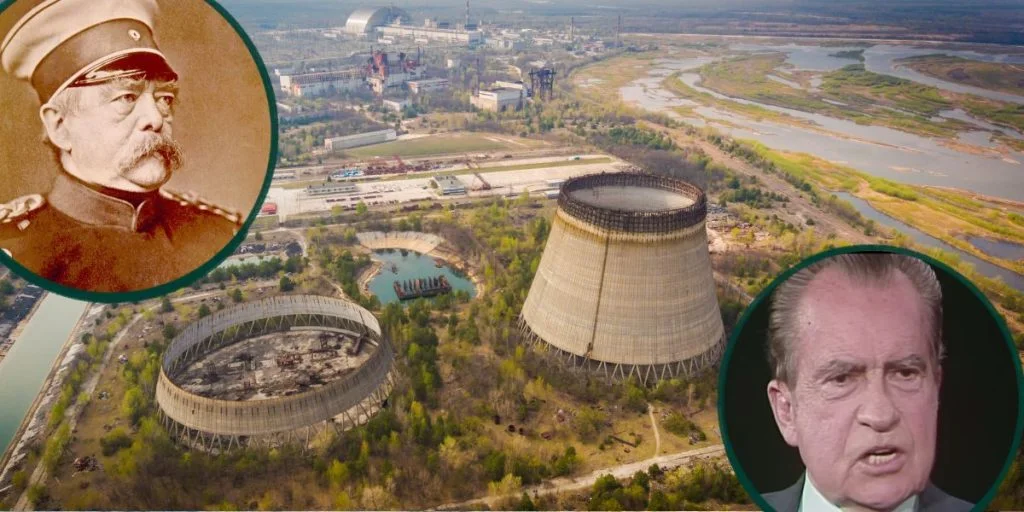
Political manipulation did not always depend on outright forgery. In 1870, Prussian chancellor Otto von Bismarck edited the Ems Dispatch, a report describing an encounter between King Wilhelm I of Prussia and the French ambassador. Bismarck shortened the account before releasing it to the press, making the exchange appear considerably more insulting than it had been. The publication inflamed nationalist anger in France and Prussia and contributed to the tensions that preceded the Franco-Prussian War.
More than a century later, the Soviet response to the Chernobyl nuclear disaster demonstrated a different form of manipulation. After a reactor exploded at the Ukrainian power plant on April 26, 1986, Soviet authorities initially restricted information about the severity of the accident and delayed the evacuation of nearby Pripyat. The disaster could not remain concealed for long. Two days later, unusually high radiation levels detected at Sweden’s Forsmark nuclear plant alerted the outside world that a major nuclear accident had occurred somewhere in the Soviet Union.
Denial met reality
Watergate offered a modern lesson in the limits of political denial. As pressure mounted over the break-in at the Democratic National Committee headquarters and the subsequent cover-up, US President Richard Nixon defended himself publicly. During a televised appearance in November 1973, he declared, “I am not a crook,” insisting that he had not personally profited from public office or acted improperly.
The denial became increasingly difficult to sustain as investigators gained access to secret White House recordings. The tapes showed Nixon’s involvement in efforts to obstruct the Watergate investigation, including attempts to limit the FBI inquiry. Facing almost certain impeachment, Nixon announced his resignation on August 8, 1974, and left office the following day. He remains the only US president to have resigned from the presidency.
These episodes were separated by centuries and arose from very different circumstances, but they shared one crucial feature: The deception worked because people, institutions or governments treated it as truth. By the time the falsehood was exposed, the consequences were often already impossible to undo.
Sources: Historienet, Natural History Museum, United States Holocaust Memorial Museum, Britannica



