Daniel Wolfram


Criticism mounts after the president invokes a centuries-old anti-Jewish trope to push back against attacks on Senator Roger Marshall.
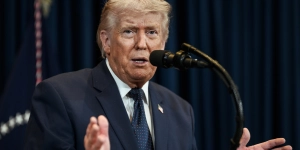

On Monday, President Trump took the stage in Kansas to support Republican Senator Roger Marshall, who faces a competitive race against Democrat Adam Hamilton.
With election forecasters giving Marshall roughly a 65 percent chance of winning, Trump advocated aggressively for his ally during the speech.
That effort drew immediate backlash after the president uttered an antisemitic slur to dismiss criticism of Marshall’s record.
Defending Marshall
The battle between Marshall and Hamilton has grown increasingly tense as the midterms approach.


Marshall recently drew public criticism following news reports that revealed his past legal actions against patients over unpaid medical bills. Eager to push back, Trump defended the senator.
“He was mandated by law to request, strongly, money owed from patients. You’re not allowed not to do it, you have to by law go after those people,” the president told the crowd, according to The Hill. “And they made it like, ‘Oh, he was some kind of a Shylock-type guy.’ I don’t know if I should be saying it.”
Click to display external content from x,
- You can always enable and disable third-party content.

You agree to display external third-party content. Personal data may be sent to the provider of the content and other third-party services.
Shakespeare and backlash
The derogatory term traces back to William Shakespeare’s “The Merchant of Venice,” which features a Jewish moneylender demanding a pound of human flesh. According to the Anti-Defamation League (ADL), the expression revives a centuries-old trope about Jewish greed that remains deeply offensive and dangerous.
Senate Minority Leader Chuck Schumer, who is Jewish, branded the language “disgusting,” writing on social media that it must be universally condemned by anyone seeking to root out bigotry. The White House did not respond to requests for comment, according to The Hill.
This was not the first time that the president had used the antisemitic slur. Trump previously used the exact same slur in July 2025 during a rally in Des Moines, Iowa, later claiming he “never heard it that way.”
Toeing the line
The ADL said in a statement that the slur is very offensive and “can reinforce harmful tropes about Jews and normalize language that has long been used to target the Jewish community.”
The response marked a noticeable shift from the group’s communication strategy in 2025: The ADL did not mention Trump by name in the new statement, nor did it call on the president or the White House to issue an apology.
The controversy comes at a crucial time for Trump and the GOP. The party has spent months courting Jewish voters by hammering Democrats over its newfound criticism toward Israel.