
 Kenneth Glad
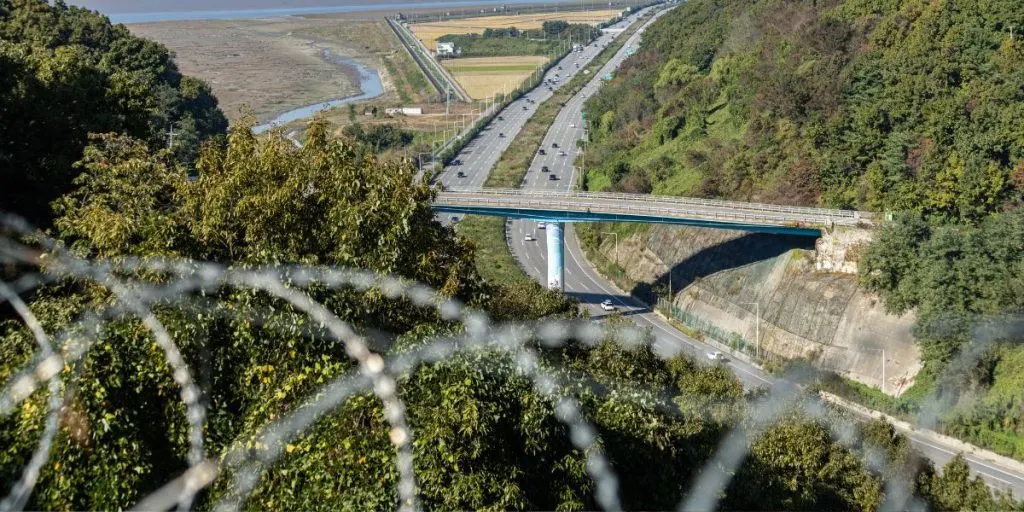
The Korean War ended in a military truce, not a political settlement. More than 70 years later, the division it froze continues to shape security on the Korean Peninsula.
At dawn on 25 June 1950, North Korean troops and Soviet-supplied T-34 tanks crossed the 38th parallel. Within three days, Seoul had fallen.
The invasion began the Korean War, though the division behind it had existed for five years. Before 1945, no border separated the Korean Peninsula, which Japan had governed as a single colonial territory since 1910.
After Japan surrendered in August 1945, Soviet forces occupied the north and American troops entered the south. Officials in Washington proposed the 38th parallel as a temporary line for accepting the Japanese capitulation. Koreans had little influence over the decision.
As relations between the United States and the Soviet Union deteriorated, writes history site Historienet, the temporary arrangement hardened. Attempts to create a unified administration failed, and the occupation authorities supported incompatible political systems.


In 1948, the Republic of Korea was proclaimed in the south under Syngman Rhee, an anti-communist nationalist. The Democratic People’s Republic of Korea followed in the north under Kim Il Sung, a former guerrilla leader backed by Moscow.
Both governments claimed the entire peninsula. Each regarded the other as an unlawful regime sustained by a foreign power.
Political violence came before war
Both governments used force against domestic opponents before their armies fought a full-scale conflict.
In South Korea, resistance came from labor organizations, left-wing groups and communities that opposed the creation of a separate southern state. Anger was intensified by the continued influence of officials and police officers associated with Japanese colonial rule.
The violence on Jeju Island became the most destructive example. An uprising began in April 1948, followed by a counterinsurgency campaign in which villages were burned and civilians were detained, displaced or killed.
The Jeju April Third Peace Foundation estimates that between 25,000 and 30,000 people were killed or otherwise became casualties of the violence. More than 14,000 victims have been individually identified in official records, though incomplete documentation makes the precise death toll uncertain.
North Korea was also consolidating authoritarian rule. Kim Il Sung and his allies restricted opposition, weakened rival communist factions and brought political organizations under centralized control.
Border clashes became increasingly frequent during 1949 and early 1950. Soldiers crossed the dividing line, raided positions and exchanged artillery fire. After securing Soviet weapons and approval, Kim launched a full invasion.
Seoul fell as the war became international
The Korean People’s Army attacked at approximately four in the morning on 25 June 1950, directing its main advance toward Seoul.
South Korea’s army had no comparable armored force. Defensive positions collapsed, communications failed and roads filled with retreating troops and civilians.
President Rhee and senior officials left the capital before the attacking army arrived. During the withdrawal, South Korean forces destroyed a bridge across the Han River to slow the advance. The explosion killed people on the bridge and stranded many others on the northern bank.
North Korean troops entered Seoul on 28 June.
US President Harry Truman decided to intervene, presenting the invasion as a challenge to the international order established after the Second World War. The United Nations Security Council condemned the attack and recommended military assistance. The Soviet Union, which could have vetoed the resolutions, was boycotting the council.
American troops sent from occupation duties in Japan were poorly prepared. They and the South Korean army retreated toward Busan, where they formed the Pusan Perimeter.
Control of the port allowed reinforcements and supplies to reach the defenders. Allied aircraft controlled the skies, but conditions on the ground remained desperate. Refugees moved along military roads, and fear of infiltrators led to forced evacuations and attacks on civilians.
An attempt by one Korean government to destroy the other had become an international war.
Inchon reversed the invasion
In September 1950, General Douglas MacArthur launched an amphibious assault at Inchon, far behind North Korean lines.
United Nations forces moved toward Seoul, according to Historienet, while troops broke out of the Pusan Perimeter. North Korea’s army, caught between the two advances, retreated or disintegrated.
The original international objective had been to preserve South Korea. With that achieved, American leaders decided to continue north.
United Nations and South Korean troops crossed the 38th parallel, captured Pyongyang and advanced toward the Yalu River on China’s frontier.
Beijing had warned that it would not accept hostile forces near its border. Mao Zedong’s government was only a year old, and the disappearance of North Korea would have placed a US-allied state beside an important Chinese industrial region.
Chinese formations secretly crossed into Korea under the name Chinese People’s Volunteers. In late October and November, they attacked overstretched United Nations units.
The advance became a retreat. Seoul changed hands again in January 1951.
MacArthur demanded greater freedom to attack Chinese territory and publicly challenged the Truman administration. Truman dismissed him in April, affirming civilian control over military command.
United Nations forces had already retaken Seoul. Further Chinese offensives failed to achieve a decisive breakthrough, and the front stabilized near the region where the war had begun.
Bombing and terror devastated civilians
As movement on the ground slowed, air attacks and political violence continued.
The United States and its allies possessed overwhelming air superiority. Aircraft struck factories, railways, bridges, supply routes, towns and cities across North Korea. Napalm created fires capable of consuming buildings and wide areas of land.
Historian Charles K. Armstrong cited figures of approximately 635,000 tons of bombs and 32,557 tons of napalm dropped by American aircraft during the war in the Asia-Pacific Journal. The totals describe bombing across the Korean theater rather than attacks limited to civilian settlements, though the campaign was concentrated in the north.
Later operations targeted dams and irrigation infrastructure. Military planners argued that these facilities supported North Korea’s economy and war effort. Their destruction also endangered crops and food supplies.
The bombing became central to North Korea’s memory of the war and to its portrayal of the United States as a permanent threat.
Violence against civilians occurred on both sides of the front. South Korean security forces and anti-communist organizations executed prisoners and suspected leftists. North Korean forces killed officials, religious figures, landowners, prisoners and people accused of resisting communist control.
Records were destroyed, crimes were concealed and many victims were buried without identification. Political classification could be lethal: family background, accusation or residence in enemy-held territory could determine a person’s fate.
Prisoners delayed the armistice
Armistice negotiations began in July 1951 but lasted two years and 17 days, requiring 158 formal meetings.
The position of the dividing line caused disagreement, but the treatment of prisoners became the greatest obstacle.
Communist negotiators demanded the return of all captured personnel. The United Nations Command argued that prisoners should not be repatriated against their wishes. Thousands of Chinese and North Korean captives said they did not want to return.
Some feared punishment, while others had political or family ties outside communist territory. Violence inside prisoner camps made it difficult to determine how freely every decision was made.
Rhee opposed any settlement that left North Korea intact. Shortly before the armistice, his government released thousands of anti-communist North Korean prisoners without consulting its allies, threatening to derail the talks.
The Eisenhower administration also considered military and diplomatic measures to increase pressure on China and North Korea. American officials later claimed that warnings about expanding the conflict, possibly with nuclear weapons, helped produce an agreement.
Historians remain divided over their significance. Stalin’s death, changing Soviet policy, military exhaustion and progress on prisoner arrangements also contributed.
The armistice created a lasting frontier
On 27 July 1953, representatives of the Korean People’s Army, the Chinese People’s Volunteers and the United Nations Command signed the Korean Armistice Agreement.
South Korea was not a signatory.
The agreement was a military instrument rather than a peace treaty. It suspended organized hostilities, established rules for handling prisoners and created a Demilitarized Zone between the opposing forces.
The Military Demarcation Line followed the final front rather than the original occupation boundary. It remained near the 38th parallel but crossed it in several places.
A political conference was expected to produce a permanent settlement. Delegates met in Geneva in 1954 but failed to agree on elections, foreign troop withdrawals or reunification.
A temporary arrangement therefore became the main framework governing relations across the peninsula.
South Korea and the United States signed a mutual defense treaty, creating the basis for a continuing American military presence. North Korea retained the support of China and the Soviet Union.
The border also divided families. People separated by the postwar division, flight or wartime displacement could not visit or communicate with relatives on the other side. Temporary separation became permanent for generations.
The confrontation still shapes security policy
Estimates of the Korean War’s death toll vary, but historians generally place it in the millions. Korean civilians accounted for the largest share. US records list more than 36,000 American military deaths associated with the conflict.
South Korea’s alliance with the United States developed around the threat of another invasion. North Korea organized its state around military preparedness, resistance to foreign pressure and loyalty to the ruling Kim family.
Pyongyang has also cited the unresolved conflict, the American military presence and joint US-South Korean exercises as reasons for possessing nuclear weapons.
In an address to the United Nations General Assembly on 30 September 2024, North Korean Vice Foreign Minister Kim Son Gyong argued that US hostility and nuclear threats had compelled the country to build its arsenal. That remains North Korea’s stated rationale, not an internationally accepted legal justification for its weapons program.
The armistice has survived border shootings, naval clashes, infiltration missions and repeated diplomatic crises. It has restrained large-scale combat for decades without reconciling the two governments or establishing normal relations.
The guns largely stopped firing in July 1953. The political struggle that placed the armies on opposite sides of the peninsula did not.
Sources: Historienet, The Asia-Pacific Journal, Jeju April Third Peace Foundation, Korean Armistice Agreement, Kim Son Gyong’s address to the 79th United Nations General Assembly, 30 September 2024



