
 Kenneth Glad
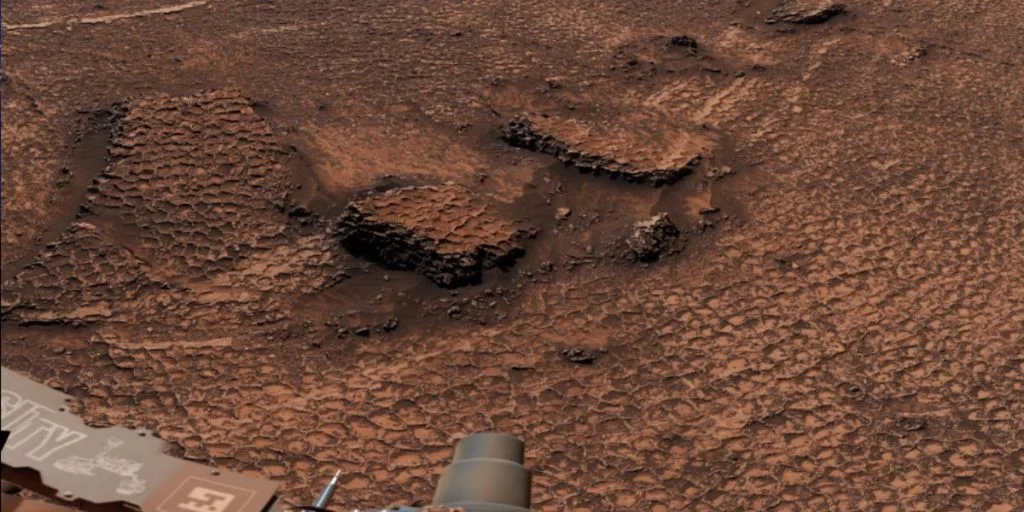
Images taken during a recent climb show geometric fractures stretching across a Martian valley. NASA scientists are studying their shape and chemistry to work out how the terrain formed.


NASA’s Curiosity rover has photographed a large concentration of polygonal fractures in Valle Grande, an area the spacecraft is now exploring on Mars.
NASA said the panorama came from images captured on June 19 and 20, 2026. Each polygon measures about 1.5 to 3 inches, or 4 to 8 centimetres, across.
The rover has encountered comparable formations before, but not across an area this extensive. The pattern continues around Miraflores, a nearby butte standing roughly 20 feet high.
“We’ve seen a lot of fascinating landscapes through Curiosity’s eyes, but this sea of polygons took our breath away,” project scientist Ashwin Vasavada of NASA’s Jet Propulsion Laboratory said. “We measured their shapes and chemistry carefully and are hopeful there are clues in the data as to how these features formed.”


Scientists test several explanations
NASA has not identified a single cause for the formations. Some polygons seen earlier in the mission were created by drying mud, while similar textures can also develop through temperature cycles or pressure acting on buried sediment.
Those mechanisms can leave different geological and chemical signatures. Scientists are comparing the Valle Grande measurements with earlier observations to determine which process best fits the new site.
Curiosity has spent 14 years examining environments around Mount Sharp since landing on August 5, 2012. NASA’s previous findings show that lakes and streams once existed in the region.
The mission has also found evidence that ancient Mars contained water, suitable chemistry and nutrients associated with conditions that could support microbial life.
Organic chemistry remains unresolved
Curiosity has detected carbon-based molecules during its exploration of Mars. NASA says scientists still cannot determine whether those compounds were produced through biological activity or geological processes.
Their discovery is not evidence that life existed. It does, however, show that ancient environments on Mars included some of the chemical conditions associated with habitability.
Researchers are now concentrating on the Valle Grande data. The immediate question is whether the polygons were shaped mainly by drying, temperature changes, pressure within sediment or another process not yet identified.
Sources: NASA



