
 Kenneth Glad
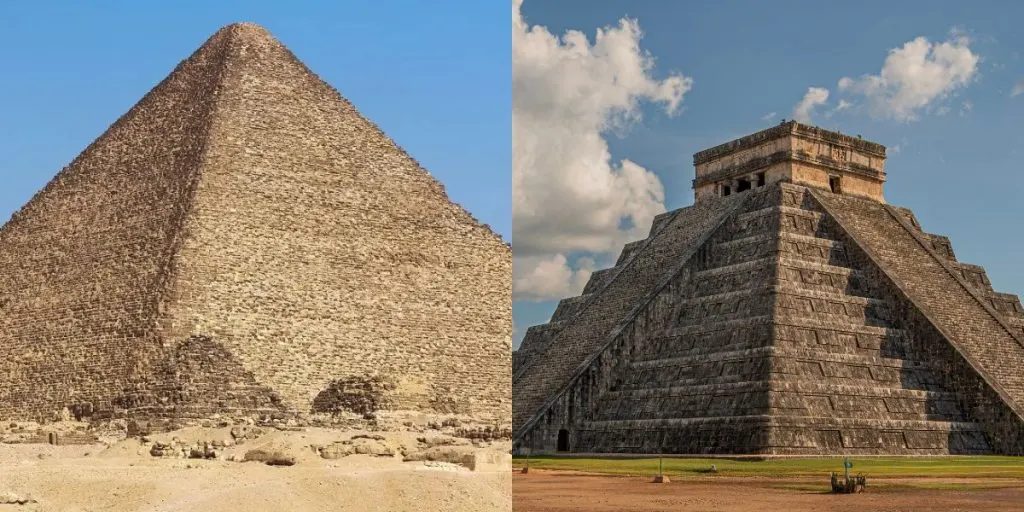
Monumental buildings appeared in societies separated by oceans and long stretches of time. Their surviving forms offer only one part of a much larger archaeological story.


Egypt’s pyramid tradition was already ancient by the time major pyramidal monuments were developing in Mesoamerica. The Metropolitan Museum of Art identifies Djoser’s Step Pyramid at Saqqara as Egypt’s earliest pyramid and places the height of Egyptian pyramid construction in the early Fourth Dynasty.
Egyptian pyramids were part of larger complexes. Temples stood near the pyramid and farther down in the valley, often linked by a long causeway. These surrounding buildings were used in ceremonies connected with the pharaoh’s burial and the cult that continued after his death.
La Venta developed in a very different setting. Mexico’s National Institute of Anthropology and History, known as INAH, dates the Olmec center broadly to 1200–400 BCE. Its main pyramidal base reached about 30 meters, with the final construction phase dating to around 400 BCE.
Unlike Egypt’s stone pyramids, much of La Venta was built from packed earth. Stone was harder to obtain locally and had to be brought in from elsewhere, which shaped the materials used across the site.


Many later Mesoamerican pyramidal monuments also served a different purpose from Egyptian royal tombs. Stairways often led to temples or ceremonial areas at the top, where rituals could take place. That makes the shared pyramid shape less revealing than the way each structure was actually used.
Materials were only one difference. Many Mesoamerican pyramidal monuments incorporated prominent stairways leading upward to temples or ceremonial spaces. In such settings, the elevated platform supported ritual activity rather than functioning primarily as the sealed core of a royal tomb.
The contrast also illustrates why the word “pyramid” can hide important distinctions. Archaeologists use broader evidence, including construction methods, associated buildings, inscriptions, burials and ritual spaces, to understand how each monument functioned within its own society.
Different purposes shaped design
At Chichen Itza, INAH dates El Castillo to the Terminal Classic and identifies the structure as a temple associated with Kukulkan. The monument is also connected with solar and calendrical symbolism, making it one of the best-known examples of astronomy being interpreted through monumental architecture.
INAH records show that parts of El Castillo were reconstructed during archaeological work in the 20th century. Some of the stairways and other features visitors see today therefore include modern restoration work, which can complicate attempts to interpret every numerical detail as part of the original Maya design.
A visit described by Psychology Today brought Maya specialist and archaeologist Yolanda Ruanova together with Egyptologist Manal Saad at several Mexican sites. As they examined monuments, carvings and religious imagery, they noted a number of similarities with ancient Egypt.
Neither saw those parallels as proof that the two cultures had been in contact. “But there is no proof for contact,” they said
Historienet points to a straightforward structural reason why pyramid-like forms could emerge independently. A broad foundation carrying progressively less weight toward the top provides an effective way to build a large, stable monument.
That engineering logic explains the shape without making the structures equivalent. Egyptian royal tomb complexes, Olmec earthen monuments and later Maya temple pyramids were created at different times, with different materials and for different religious and political settings.
Sources: Historienet, Psychology Today, Metropolitan Museum of Art, INAH



