
 Kenneth Glad
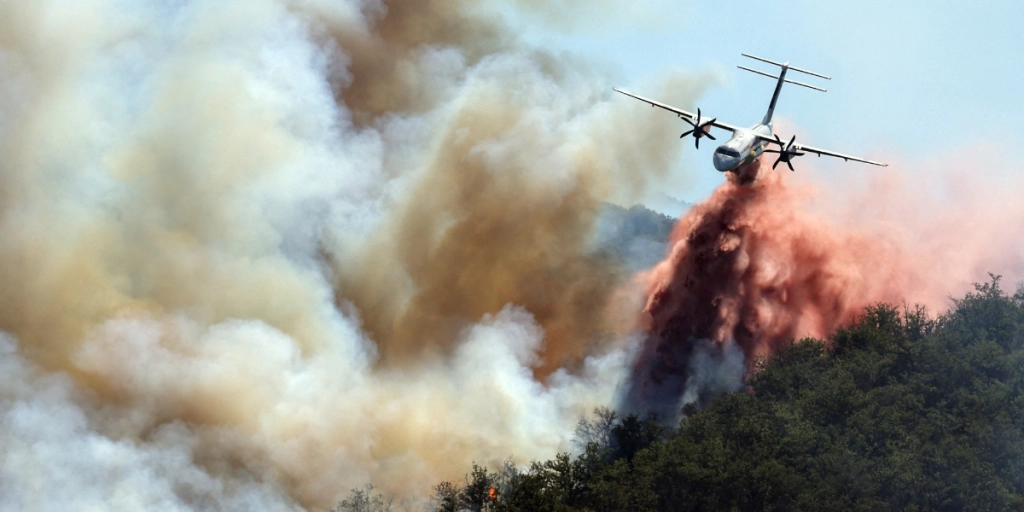
Annual burned area could rise about 39 percent even under the lower-emissions pathway examined by researchers. Under much stronger warming, the modeled increase approaches 192 percent.

Europe could see substantially more land burned by wildfire before the century ends, according to research published in Global Change Biology.
The researchers compared a modeled 2000 to 2030 baseline with projections for 2070 to 2100, examining how climate conditions, vegetation and human influences could reshape fire activity across the continent.
Using outputs from five climate models, they ran two wildfire systems, SPITFIRE and BASE, linked to the LPJmL vegetation model. Under SSP1-2.6, SPITFIRE projected annual burned area rising from about 1.8 million to 2.6 million hectares, an increase of roughly 39 percent. Under the higher-emissions SSP3-7.0 pathway, the total climbed to around 5.3 million hectares, about 192 percent above the modeled baseline.
Worsening weather drives more fire
Fire weather emerged as the dominant large-scale driver of increasing burned area. Conditions worsened moderately across many regions under SSP1-2.6, while some areas experienced relatively little change.


Under the higher-emissions pathway, however, the models showed deteriorating fire-weather conditions across virtually all of Europe, increasing the likelihood that dry vegetation could ignite and fires could spread more easily.
“Investments into fire management could help to a certain limit, but if we go on a path of high emissions … we still see strong increases in burnt area,” Billing told The Guardian. He added: “Fire management cannot replace climate mitigation.”
The BASE model also incorporated the Human Development Index as an indicator of potential fire-management capacity. The measure was used to represent the broader institutional and socioeconomic conditions that can support prevention, early detection and suppression efforts.
When HDI changed in line with the future scenarios, late-century burned area was 92 percent lower under SSP1-2.6 and 72 percent lower under SSP3-7.0 than in simulations where HDI remained fixed at its 2000 level.
The 92 percent and 72 percent figures compare different modeling scenarios, not projected reductions from today’s fire levels.
Management capacity has limits
HDI does not directly measure firefighting budgets, equipment or staffing. In the study, it serves as a broader indicator of whether societies have the institutions and resources needed to support prevention, early detection and suppression. That means a higher HDI does not automatically translate into fewer fires.
Under SSP3-7.0, about 55 percent of modeled fire-prone territory still showed an increase in burned area even as socioeconomic conditions improved.
The results also differed sharply from place to place, depending on population density, vegetation and land use. In southern Spain and the Wallachian Plain, for example, changes in land cover altered the amount of vegetation available to burn.
The models suggest that better fire management can still make a substantial difference, especially under more moderate warming. But as fire weather becomes hotter and drier, those gains become harder to maintain.
The study therefore points to two parallel needs: Limiting future warming while continuing to strengthen prevention and fire-response capacity.
Sources: Global Change Biology, The Guardian.



