
 Kenneth Glad
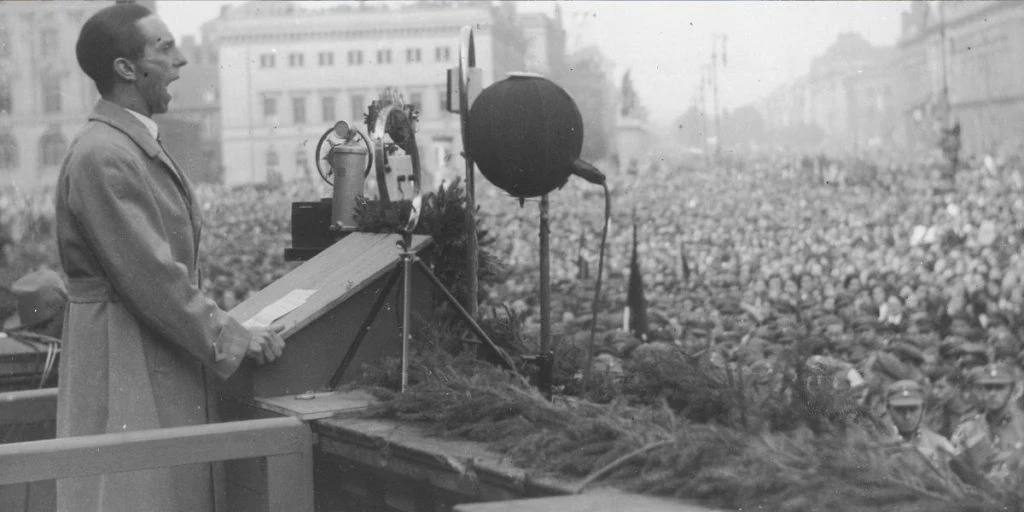
In Nazi Germany, political persuasion spread far beyond speeches and election posters. The regime used broadcasting, censorship, public events and ordinary institutions to surround citizens with its version of reality.


Before the Nazi movement controlled Germany, Adolf Hitler and Joseph Goebbels had already recognized the political value of fear, resentment and hope.
Goebbels, who held a doctorate in literature, became one of the party’s most important propagandists.
Complicated problems were reduced to easily understood stories. Germany’s defeat in the First World War, the Treaty of Versailles, economic hardship and political instability were presented as proof that the country had been humiliated and betrayed.
Nazi speeches supplied convenient enemies. Jewish people were falsely blamed for national problems, while communists and democratic politicians were portrayed as dangerous opponents of national recovery.


Rather than offering a detailed political argument, the Nazis presented an emotional narrative: Germany was suffering, enemies were responsible, and Hitler offered a route back to strength, writes HistorieNet.
Goebbels also changed his emphasis according to his audience. Workers might hear economic grievances, while nationalist listeners were more likely to encounter themes of military defeat, lost prestige and national unity. The ideology remained consistent, but the sales pitch could shift.
Speeches, party newspapers and public meetings ensured that the same central claims appeared repeatedly across German political life.
Crisis gave the campaign momentum
The economic collapse after 1929 dramatically enlarged the potential audience for radical politics. Unemployment rose, businesses failed and millions of Germans became increasingly disillusioned with established parties.
The Nazis exploited that insecurity with promises of jobs, order and national renewal. The postwar settlement, parliamentary politicians and supposed internal enemies were blamed for problems with much more complicated causes.
Public rallies turned those claims into spectacle. Uniforms, flags, marches, music and carefully staged appearances gave Nazi gatherings a sense of discipline and momentum. Large crowds suggested that the movement represented Germany’s political future.
Violence accompanied the campaigning. Nazi storm troopers disrupted rival meetings, fought opponents and contributed to an increasingly threatening political atmosphere.
The party also made energetic use of posters, newspapers, recordings and film. By the July 1932 election, the Nazis had received about 37 percent of the vote and become the largest party in the German parliament, although they remained well short of a majority.
Hitler was appointed chancellor in January 1933. The methods previously used to win attention could now be backed by state power.
State power silenced competing voices
Political competition rapidly disappeared after the Nazi takeover. Opposition newspapers were banned, rival organizations were dismantled and the press was subjected to extensive government control.
Goebbels became propaganda minister, placing him at the center of efforts to shape newspapers, radio, cinema and culture.
The government celebrated successes while suppressing information that contradicted its preferred version of events.
Falling unemployment, public works and military expansion became evidence of national recovery. Repression, persecution and the destruction of democratic institutions did not receive comparable treatment.
Radio was particularly valuable because political messages could enter homes throughout the country. Important speeches and announcements reached mass audiences, while government control over broadcasting sharply restricted competing political voices.
Cinema, newsreels, theater and other cultural forms were also supervised. Material considered hostile to the regime could be excluded, while approved productions reinforced the picture of a confident and unified Germany.
Propaganda consequently depended as much on restricting what citizens could encounter publicly as on producing new messages.
Ideology became part of everyday life
Children encountered Nazi politics far beyond formal speeches. Schools, youth organizations, toys and public celebrations could all carry ideological messages.
Education increasingly promoted racial ideas, obedience and national duty. Youth organizations encouraged discipline and loyalty to Hitler, extending political influence into children’s social lives and leisure.
Adults encountered the same ideology through newspapers, radio, cinema, posters and ceremonies. Themes of leadership, national unity and recovery appeared in settings that had little to do with conventional election campaigning.
As HistorieNet notes, the regime sought to shape citizens rather than merely persuade them at the ballot box.
Repeated exposure made Nazi ideas part of ordinary public life, while censorship and coercion, according to the United States Holocaust Memorial Museum, made opposing views harder to express openly.
The propaganda never won over everyone. Some Germans embraced the regime, others simply went along with it, while some remained skeptical or resisted.
But as censorship tightened and dissent became more dangerous, openly challenging the government’s version of events became increasingly difficult.
The Olympics offered a polished illusion
Foreign visitors saw the regime’s skill at managing its image during the 1936 Olympic Games in Berlin.
Jewish citizens and political opponents were already facing persecution, but some of its most visible signs were temporarily concealed or removed from prominent public view.
Berlin was prepared for international guests, and the regime showcased major sporting facilities while presenting Germany as orderly, modern and peaceful.
The spectacle also served domestic propaganda. Impressive organization, mass audiences and international attention could be used to support the claim that German prestige had returned.
The Games continued to serve that purpose after the crowds had gone home. Filmmaker Leni Riefenstahl, already closely associated with Nazi spectacle, turned the event into Olympia, a two-part film released in 1938.
Its striking images of athletes, monumental architecture and mass ceremony helped preserve an idealized vision of the Games and further linked physical beauty, discipline and national strength with the regime’s public image.
The Olympics were therefore part of a much wider system. Nazi propaganda worked alongside censorship, intimidation, nationalism, antisemitism, economic insecurity and the destruction of democratic institutions. The regime used these forces to promote a simplified picture of Germany’s problems and its supposed recovery.
Its influence reached far beyond political speeches. Propaganda appeared in entertainment, education, ceremonies and ordinary routines, making the Nazi worldview increasingly difficult to avoid in German public life.
Sources: HistorieNet, United States Holocaust Memorial Museum, Leni Riefenstahl’s Olympia / YouTube



