
 Kenneth Glad
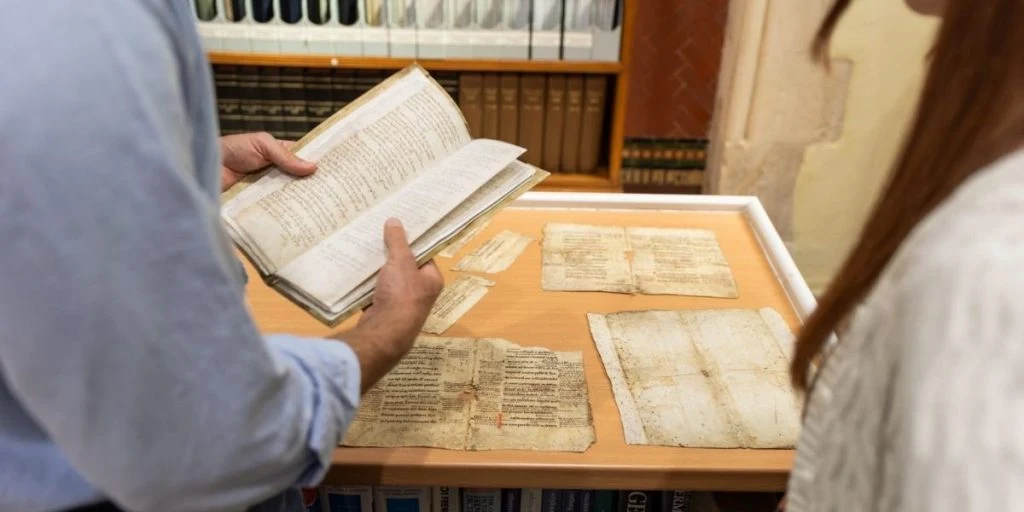
Old documents can preserve evidence far beyond their original purpose. In this case, material reused centuries ago has provided unusually rare clues about an island community.


A fragment of L’Estoire de Griseldis is among 17 medieval manuscript pieces now being studied on Guernsey. According to Phys.org, the dramatic poem, attributed to Philippe de Mézières around 1395, survives in only one other known manuscript and two sixteenth-century printed editions.
The work belongs to the wider Griselda tradition, a story made famous in medieval Europe through Giovanni Boccaccio’s Decameron. Versions of the tale circulated widely, but the form represented by the Guernsey fragment is exceptionally rare.
Its presence on the Channel Island shows that this version of the story reached readers beyond the French courtly circles where scholars believe it initially circulated. That makes the fragment useful not only as a surviving piece of literature, but also as evidence of how texts moved between regions and audiences.
The wider collection ranges from the twelfth to the fifteenth centuries and includes material in both Latin and French. Together, the fragments provide evidence from a period for which Guernsey has left very few surviving traces of books, reading habits and literary culture.


A routine search changed course
Callum Tostevin-Hall, an archival assistant at Guernsey’s Island Archives, came across one of the fragments while carrying out a very different task: locating a sixteenth-century copy of Edward III’s 1331 Extente of Guernsey.
While checking the relevant catalogue entry, he noticed a reference to a vellum cover carrying Latin text. The cover had been removed from the notebook during an earlier round of conservation, but the notation was enough to prompt a closer look.
When the detached material was examined, it became clear that the vellum had once belonged to a medieval manuscript and had later been cut down and reused as a practical binding for another document.
That initial discovery led to a broader investigation of surviving archival material. The work eventually established a group of 17 medieval fragments preserved both in the Island Archives and among records kept in His Majesty’s Greffier’s Strongroom.
According to Phys.org, some of the fragments had been noted by archivists before, while others were only identified during the recent investigation. Their importance became clearer once the material was studied as a group.
French remained important here
According to HistorieNet, the surviving material includes biblical passages, travel writing, Latin commentary, poetry by the Roman author Ovid and several works in French.
The fragments offer a rare glimpse of what was being read on medieval Guernsey. Researchers say the French texts are especially important because so little evidence of the island’s literary life from the period has survived.
The material ranges across several subjects, including religion and literature, suggesting that readers had access to more than one kind of text.
David Rundle, a medieval manuscript specialist at the University of Kent who has helped study the material, told Phys.org: “This collection is exciting in its variety of subjects and dates, and hints at a culture that has not even been imagined.”
Researchers also suspect that more fragments could still be sitting unidentified in Guernsey’s archives. Island Archives is due to hold an academic study day on September 10, 2026.
Sources: HistorieNet, Phys.org



