
 Asger Risom
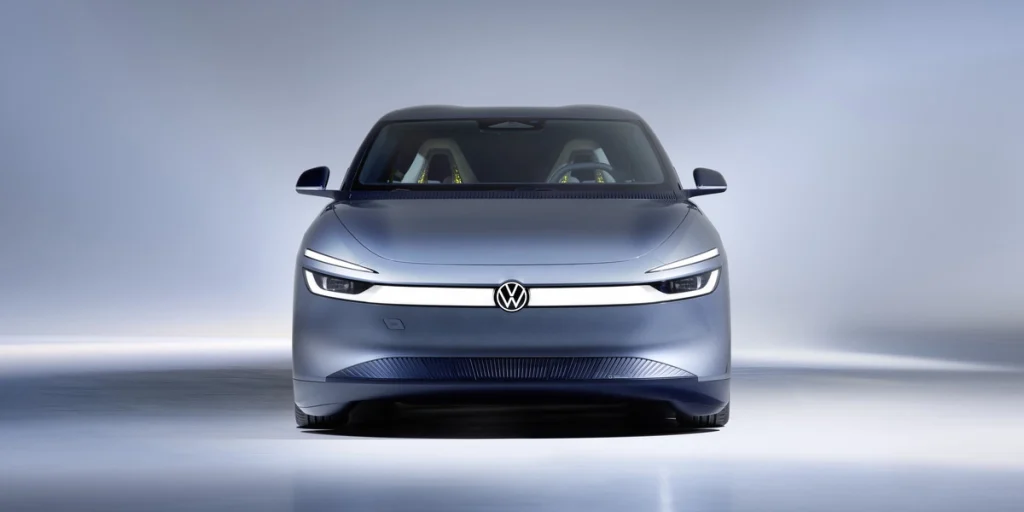
Volkswagen built the most aerodynamic road-legal car in history, proving that extreme engineering can squeeze an astonishing 870 miles of range out of a standard budget EV battery.


Volkswagen is out to prove that the current electric vehicle arms race is entirely backwards. Instead of stuffing heavier and more expensive battery packs into massive SUVs to cure range anxiety, the German automaker took a totally different approach. According to reporting by InsideEVs, the company recently unveiled the Mission Efficiency—a radical, teardrop-shaped concept vehicle that just set three world records for electric vehicle endurance.
The most astonishing part of this engineering exercise is what sits under the aggressively sloped hood. Rather than relying on exotic, million-dollar hypercar hardware, the engineering team built this record-breaker using the exact same standard components found in the budget-friendly ID. Polo hatchback. By mating a completely standard 54.9-kilowatt-hour battery to a wildly aerodynamic shell, Volkswagen completely shattered the physical limits of electric range.
To prove this wasn’t just theoretical math, the automaker drove the experimental car on a grueling real-world road trip across Europe. The engineering team piloted the vehicle from their development headquarters in Wolfsburg, Germany, all the way to Vienna, Austria. After covering nearly 800 miles on a single charge through regular traffic, the tiny battery still held enough juice for another 100 miles of driving—pushing the total theoretical range well past 870 miles.
The brutal science of extreme aerodynamics
That staggering highway performance is entirely dictated by the vehicle’s record-breaking drag coefficient of 0.158, making it officially the most aerodynamic road-legal car in history. To achieve that hyper-slick profile, designers severely narrowed the rear axle by nearly seven inches, allowing the bodywork to taper into a perfect aerodynamic teardrop. Up front, three active cooling flaps remain entirely sealed during normal driving to force incoming air completely around the microscopic 22-square-foot frontal area.


Because spinning wheels act like massive parachutes at highway speeds, the engineering team had to completely rethink how the car rolled down the pavement. They developed a set of patented rim deflectors that actively prevent air from getting sucked into the wheel wells and generating violent turbulence. Those flush-mounted aerodynamic hubcaps are wrapped in custom Continental tires engineered specifically to eliminate rolling resistance on the asphalt.
The payoff for all this obsessive wind-tunnel tuning becomes obvious the moment the car reaches highway speeds. Once the vehicle crosses 50 miles per hour, standard electric vehicles bleed massive amounts of energy just fighting through the atmosphere. Thanks to its slippery shell, the Mission Efficiency requires roughly 30 percent less power to cruise at highway speeds than the standard ID. Polo, allowing the tiny front-mounted motor to sip electricity at a record-setting pace.
Stripping weight to save the battery
Aerodynamics only solve half the efficiency equation, so the interior team ruthlessly stripped out every unnecessary pound from the cabin. You will not find a massive digital infotainment screen bolted to the dashboard; instead, drivers simply mount their own smartphone or tablet to act as the vehicle’s central brain. Even the traditional fixed audio system was thrown out in favor of a lightweight, removable Bluetooth speaker.
Despite the aggressive diet and extreme exterior proportions, the cabin is not a cramped, single-seat science experiment. The vehicle comfortably seats four passengers in a traditional 2+2 layout and still features a massive rear tailgate that swallows 17 cubic feet of cargo. To further squeeze every last drop of free energy out of the environment, a 370-watt solar array is baked directly into the glass roof, trickling up to 18 miles of daily range straight into the electrical system.
While the Mission Efficiency is technically certified as a near-production vehicle, it will likely remain a highly publicized concept car rather than a dealership staple. However, the true value of this project is proving that legacy automakers do not need breakthrough, next-generation solid-state batteries to achieve massive driving ranges. If Volkswagen can successfully adapt these aerodynamic lessons to its standard consumer lineup, it could fundamentally alter the economics of daily electric driving.



