
 Nicolai Haugsted
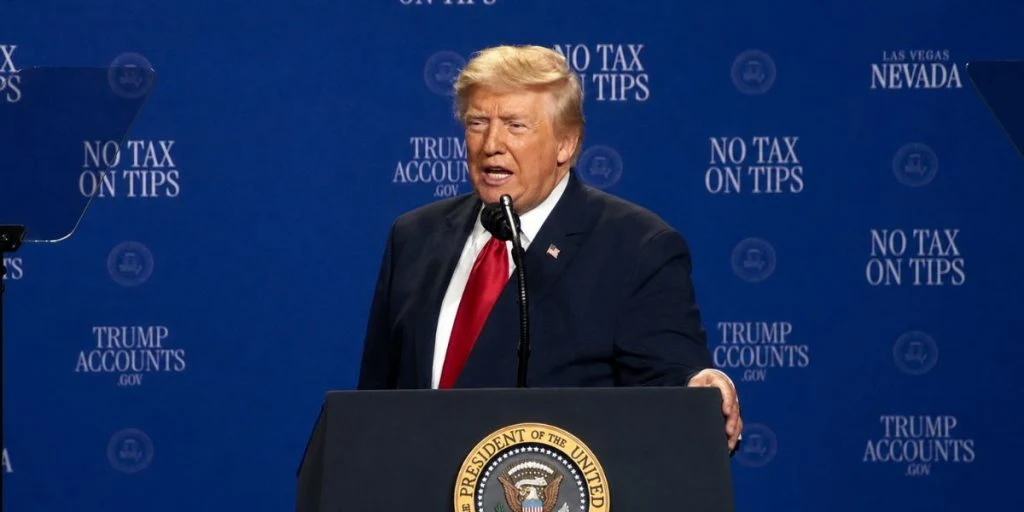
Taxpayer-funded Trump ads face fresh scrutiny over striking similarities to campaign material.


American taxpayers are accustomed to funding government messages about public programs, safety campaigns and federal services. Seeing the sitting president declare a new “golden age of America” on television is raising a rather different question in Washington: where does government communication end and political advertising begin?
That question has become more urgent with the November midterm elections just five weeks away.
Democratic Representatives Jamie Raskin and George Whitesides called Thursday for independent investigations into nationally broadcast advertisements featuring President Donald Trump, asking federal watchdogs to determine whether taxpayer money has been used illegally for political promotion.
Their request follows claims from Democratic lawmakers that $20 million in Department of Homeland Security funds was transferred to pay for the advertising campaign.


Trump says the spots are legitimate government advertisements and rejects accusations that he is using public money to campaign.
Democrats want federal watchdogs involved
Raskin, the ranking Democrat on the House Judiciary Committee, joined Whitesides in asking the Government Accountability Office and Office of Special Counsel to examine the spending.
Central to their complaint is the resemblance between the new government-funded material and Trump’s previous political advertising.
“These ads constitute an illegal use of taxpayer funds, perhaps best demonstrated by the fact that they are virtually identical to the ones Donald Trump used during his 2024 presidential campaign, and in fact use the same footage and the same inept ideological messaging,” the lawmakers wrote in a letter reviewed by Reuters.
Raskin and Whitesides described the advertisements as “desperate pre-election propaganda.”
Their characterization remains an allegation rather than a legal finding. Federal investigators would have to determine whether the spending violated restrictions governing propaganda, political activity or the permissible use of appropriated government funds.
Outside watchdog Public Citizen has separately filed complaints concerning the advertisements, arguing that they appear to violate federal restrictions on taxpayer-funded propaganda and the Hatch Act.
Trump says he is not campaigning
Trump offered a straightforward defense Wednesday: he is not on the ballot.
“I’m not running for office,” Trump said.
“If somebody said that that’s wrong, I’ll gladly pay the money. But, but these are ads for the country … I’m not promoting a candidate. I’m not promoting myself because I’m not running for office.”
His argument addresses one of the unusual features of the dispute.
Trump cannot win or lose a congressional seat in November, but his Republican Party will be fighting to retain political power on Capitol Hill. Critics therefore argue that advertisements celebrating Trump and his administration shortly before voting begins could still carry an electoral benefit for Republican candidates.
Public Citizen says the advertisements began appearing in late September and include the disclaimer “Paid for by the U.S. government.” Its complaints argue that the spots promote Trump’s political image rather than explaining a specific federal program.
One ad looks very familiar
Perhaps the most awkward detail for the White House involves an advertisement called “The Final Battle.”
Footage used in the government-funded spot closely resembles material from Trump’s 2024 presidential campaign.
Trump appears walking through a corridor while promising to fight the “deep state” and remove “warmongers” from government. Public Citizen says the advertisement is nearly identical to a version previously financed by Trump’s campaign organization.
Another advertisement features Trump declaring that “America will never be a communist country,” alongside messages highlighting tax cuts, manufacturing and law enforcement.
Public Citizen says that spot does not focus on a particular government service or initiative, which forms part of the organization’s argument that taxpayers are instead funding political image-building.
A separate advertisement combines imagery of Mount Rushmore with Trump promoting what he calls a “golden age of America.”
All three arrive during the final stretch before voters decide control of Congress.
Critics are not limited to Democrats
Questions surrounding the advertisements have crossed party lines.
Public Citizen has pointed to criticism from Republican Representative Thomas Massie, while Democratic lawmakers have pursued their own demands for investigations.
Public Citizen has gone further by asking the Federal Communications Commission and Federal Trade Commission, as well as individual broadcasters, to stop the advertisements from airing.
Its September 29 FCC complaint argues that the spots should be treated as political advertisements rather than public service announcements and says taxpayer funds cannot legally be used for partisan promotion.
FCC Chairman Brendan Carr, a Republican appointed to lead the commission by Trump, has defended the advertisements as appropriate, according to Reuters.
No federal watchdog has yet established that the advertisements cited by Raskin and Whitesides violate the law.



