
 Asger Risom
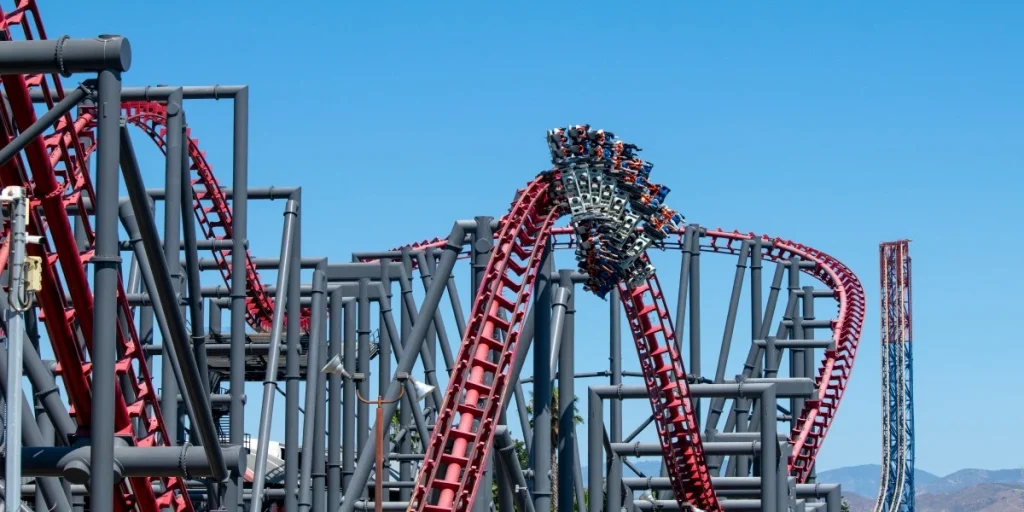
With over 100 riders alleging they suffered severe brain hemorrhages after riding the X2 rollercoaster at Six Flags, the amusement park industry is facing a brutal reality: modern extreme coasters have pushed past the limits of the human body.


The theme park industry has spent the last two decades locked in a relentless arms race, building increasingly extreme machines designed to push human physiology to its absolute limit. For years, the metric for success was simply going faster, dropping steeper, and subjecting riders to more intense G-forces.
Now, the bill for that extreme engineering is coming due in court.
Six Flags Magic Mountain in California has abruptly shut down X2, its flagship “4th Dimension” rollercoaster, amidst an avalanche of litigation. According to a recent CNN investigation, legal representation for affected riders has ballooned. While an initial wave of lawsuits was announced on September 22, attorneys now represent more than 100 individuals who claim to have suffered severe traumatic brain injuries—including catastrophic hemorrhaging—after riding X2 within the past two years.
Click to display external content from twitter,
– You can always enable and disable third-party content.

You agree to display external third-party content. Personal data may be sent to the provider of the content and other third-party services.


The devastating toll of a two-minute ride
X2 was designed to disorient. Unlike a traditional rollercoaster, the seats on X2 rotate independently on a separate axis, aggressively flipping riders forward and backward while the train navigates a 60-meter drop and speeds in excess of 75 miles per hour.
As reported by Welltica, the physical consequences of this violent, multi-axis rotation have been life-altering. Los Angeles-based attorney Michael Wilk alleges that a single ride in February resulted in a brain bleed that required multiple surgeries and effectively ended his legal career. Another rider, Naomi Greer Wilkinson, reportedly collapsed immediately after exiting the ride. She was rushed to the hospital, diagnosed with a brain hemorrhage, and placed into a medically induced coma following emergency surgery.
Six Flags has declined to officially comment on the pending litigation and has offered no public explanation for the ongoing closure of the ride.
Click to display external content from youtube,
– You can always enable and disable third-party content.

You agree to display external third-party content. Personal data may be sent to the provider of the content and other third-party services.
A broader pattern of biomechanical failure
The crisis surrounding X2 is not an isolated incident. It is the latest escalation in a structural problem facing the entire amusement park industry: engineering capabilities have officially outpaced the structural integrity of the human body.
When you strap a human being into a machine capable of rapid multi-directional acceleration, you are exposing the brain—suspended in cerebrospinal fluid inside the skull—to violent shearing forces. We have seen this exact dynamic force ride closures before.
In 2021, the Fuji-Q Highland amusement park in Japan was forced to shut down its record-breaking Do-Dodonpa rollercoaster after a cluster of riders suffered broken necks and fractured spines. The ride utilized a compressed air launch system that fired trains from zero to 112 mph in just 1.56 seconds. The sheer G-force of the acceleration was enough to snap cervical vertebrae. After remaining closed during a multi-year investigation, the park officially announced its permanent permanent closure in 2024.
Similarly, the infamous Son of Beast at Kings Island—once the tallest and fastest wooden rollercoaster in the world—was shut down permanently after a rider suffered a ruptured blood vessel in her brain, echoing the exact type of neurological trauma now being alleged against Six Flags.
For years, regulatory bodies and theme parks have relied on standard G-force limits to determine ride safety. But the sheer volume of brain bleed allegations stemming from X2 suggests that those legacy safety models are fundamentally flawed when applied to modern, multi-axis ride vehicles. When over 100 people allege they walked off a commercial amusement park ride with bleeding in their brains, the industry is no longer selling thrills; it is generating mass casualties.



