
 Nicolai Haugsted
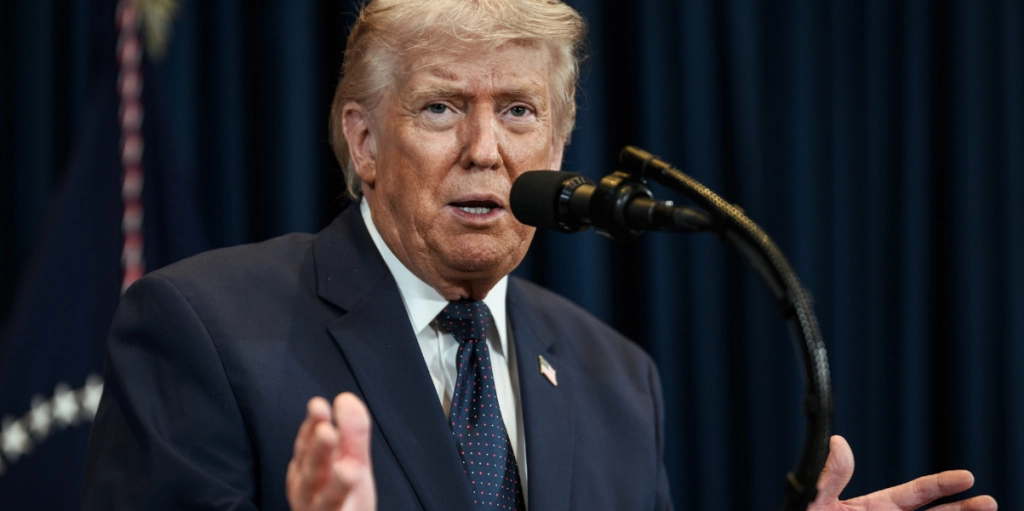
The president appeared delighted with his own arithmetic skills, but social media users were considerably less impressed.

Donald Trump has never been particularly shy about celebrating his own intelligence. Whether discussing political negotiations, economic achievements or his personal accomplishments, the president rarely misses an opportunity to remind audiences of his abilities.
His latest display of self-confidence, however, involved something considerably less complicated than running the United States.
During a campaign rally in Arizona, Trump proudly recalled how he had worked out that adding one dollar to $1,775 would produce $1,776.
The president described himself as a genius while recounting the discovery, prompting a wave of ridicule on social media, where critics were quick to point out that the calculation hardly required extraordinary mathematical talent.


Trump celebrates his mathematical discovery
Speaking to supporters in Bullhead City, Trump explained how he had arrived at the amount for a special payment to American military personnel.
According to the president, he had initially been presented with a figure of $1,775 before noticing its connection to a significant year in American history.
“They said sir you can do $1,775. So I wrote it down, and I am a genius. I wrote it down, and I said, ‘that’s a weird number,’ because to the best of my knowledge, if I add $1 to it, it becomes 1776. Quite an important number. Quite an important American number, right?”
The number 1776 carries enormous historical significance in the United States, marking the year the country declared independence from Britain.
But while Trump appeared pleased with the patriotic symbolism, his description of the calculation quickly attracted attention for entirely different reasons.
Click to display external content from x,
- You can always enable and disable third-party content.

You agree to display external third-party content. Personal data may be sent to the provider of the content and other third-party services.
Social media users have a field day
Clips of the president’s remarks circulated on X, where users questioned whether adding one to a four-digit number was really something worth boasting about.
“He didn’t even think of it but came up with a whole fake story about it,” one user wrote.
Another took a more openly political approach.
“Dementia Trump is kicking in. Vote Blue,” the user posted, making an unsupported claim about the president’s health.
Others preferred to respond with mathematical jokes.
“Here’s one that would totally stump him… 1775 + 2,” another user commented.
The reaction turned Trump’s self-congratulatory anecdote into an opportunity for critics to mock his intelligence, although the president has told the story about the $1,776 figure on previous occasions.
The money was already approved
Behind the president’s remarks is a payment program his administration has promoted as the “warrior dividend.”
The initiative provides $1,776 payments to American service members, with the amount chosen to reflect the country’s founding year.
However, the money was not an entirely new financial benefit created specifically for the occasion.
According to the reporting, the payments are being funded through a housing supplement that Congress had already approved.
The funding formed part of a broader legislative package extending and expanding tax cuts, which Trump signed into law in July.
That distinction has complicated the administration’s presentation of the payments as a special reward for military personnel.
The patriotic figure may have been carefully chosen, but the underlying funding had already been authorized.
Trump campaigns in a Republican stronghold
The remarks came during a campaign appearance in Bullhead City, Arizona, as Republicans worked to mobilize supporters ahead of the midterm elections.
Trump used the event to promote Republican candidates, including Marty O’Donnell, who is challenging Democratic Representative Susie Lee in Nevada’s third congressional district.
The district includes Laughlin, located just across the state border from Bullhead City.
Arizona itself is also attracting considerable political attention, with closely contested congressional races and several statewide offices on the ballot.
Mohave County, where Bullhead City is located, has traditionally been a Republican stronghold.
Trump carried the county by almost 56 percentage points in the 2024 presidential election, making the area a favorable location for rallying his political base.
The president’s previous Arizona visit took place in April, when he attended a Turning Point USA event in Phoenix.
Democrats seize on Trump’s visit
While Trump attempted to energize Republican voters, Democrats used his appearance to criticize GOP candidates in Arizona.
The Democratic Congressional Campaign Committee targeted Republicans Juan Ciscomani and Jay Feely, accusing them of supporting the president’s economic agenda.
The organization argued that the candidates could not distance themselves from their association with Trump or policies Democrats blame for increasing household costs.
“Arizonans are fed up with Trump and they’ll kick his lackeys Feely, Ciscomani, and (Eli) Crane to the curb this November,” the committee said in a statement.
The political stakes surrounding the president’s visit extend far beyond his comments about the military payments.
Republicans are fighting to maintain their congressional influence, while Democrats are attempting to capitalize on dissatisfaction with the administration.
Yet amid the competing campaign messages, it was Trump’s enthusiasm for a remarkably simple calculation that captured attention online.
His critics, at least, appeared considerably less impressed by the mathematical achievement than the president himself.



