Nicolai Haugsted

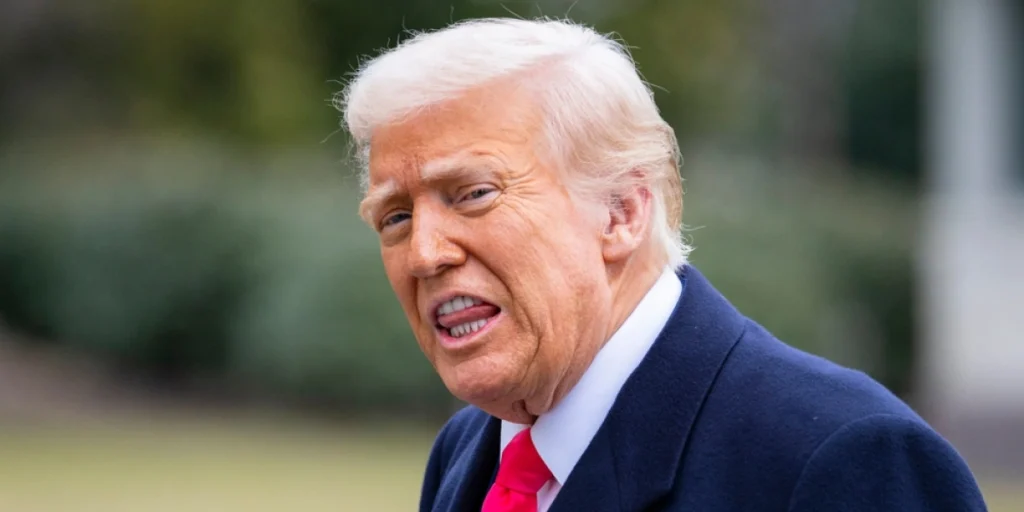
A television montage exposes the contradiction between Trump’s latest claim and his history of personal attacks.


Donald Trump has spent much of his political career cultivating a communication style that few American politicians could mistake for traditional diplomacy.
His speeches frequently feature pointed criticism of opponents, while his preference for memorable nicknames has become a recognizable feature of his political identity.
Supporters often regard the approach as evidence of his willingness to speak without the usual political filters. Critics, meanwhile, argue that his personal attacks undermine the seriousness of public debate.
But the president’s latest remarks about his own behavior have prompted an especially lively reaction, according to RadarOnline


During an interview in Alaska, Trump insisted that he avoids mocking people and calling them names because doing so would interfere with his ability to negotiate.
The statement quickly attracted attention from television commentators and social media users, who began comparing the president’s description of himself with his previous public remarks.
And they had plenty of material to work with.
Trump insists he does not insult people
The controversy began during an October 13 interview with Jon Decker of Gray Television.
Decker questioned the president about disagreements involving Alaska Senator Dan Sullivan, a diesel-related arrangement with Russia and Trump’s approach to Russian President Vladimir Putin.
Trump responded by emphasizing his experience as a negotiator.
According to the president, successful diplomacy requires maintaining relationships rather than insulting the people involved.
“Well, look, I have to make deals with people, so I don’t go around calling them names. I’m a dealmaker; I’ve always been a very good dealmaker. I became very rich because of deals, so I don’t go around mocking people,” Trump said.
The president then directed criticism toward his predecessor, Joe Biden.
“You know, part of the reason you have that war in the first place is Biden went around mocking Russia and mocking everybody else and didn’t know what he was doing.”
Trump’s explanation suggested that avoiding personal ridicule was an important part of his negotiating strategy.
However, the remarks also invited comparisons with his own history of publicly insulting political opponents.
Television hosts revisit Trump’s most memorable insults
MSNBC’s Morning Joe responded by assembling a collection of clips featuring some of Trump’s familiar attacks.
Host Joe Scarborough highlighted the president’s long-standing habit of attaching mocking nicknames to political rivals.
Among the examples were “Sleepy” Joe Biden, “Crooked” Hillary Clinton and “crazy” Bernie Sanders.
The montage also included Trump’s description of former special counsel Jack Smith as a “sick son of a b-tch.”
Scarborough, who has himself frequently been targeted by Trump, noted that the president has repeatedly referred to him as “Psycho Joe.”
His co-host Mika Brzezinski appeared unconvinced by Trump’s account of his own behavior.
“I don’t get it,” she said.
The television segment highlighted a contradiction between Trump’s recent description of his negotiating style and the personal language he has repeatedly used in public.
Social media users were quick to respond
The president’s remarks also generated criticism online.
Several social media users questioned how Trump could describe himself as someone who avoids personal insults when examples of his attacks are widely available.
“That’s literally all he does,” one person wrote.
Another user offered a similar assessment.
“Calling people names is all he does, and it’s usually caught on camera,” the person commented.
Others were more openly sarcastic.
“Wow, he really does live in MAGA Fantasy World,” another critic wrote.
One commentator questioned whether Trump had delivered any speeches without insulting someone over the past decade.
“He literally cannot do a single speech without insulting someone or a group. I bet there hasn’t been one in the last 10 years,” the user wrote.
The comments reflected frustration among critics who viewed Trump’s interview as inconsistent with his established public behavior.
A reporter also found herself on the receiving end
Trump’s history of personal remarks has not been limited to political rivals.
In November 2025, the president attracted criticism after addressing Bloomberg White House correspondent Catherine Lucey aboard Air Force One.
During the exchange, Trump told the journalist:
“Quiet, Piggy.”
The remark was subsequently included in the Morning Joe compilation.
The incident became another example cited by commentators questioning Trump’s assertion that he does not go around mocking people.
Journalists have frequently been targets of Trump’s confrontational rhetoric, particularly when their questions concern politically sensitive subjects.
His defenders have often characterized such exchanges as part of his combative style, while critics argue that the language is inappropriate for a president.
Recent political opponents have received their own nicknames
Trump’s use of personal insults has continued during the current election cycle.
Texas Democratic Senate candidate James Talarico has been called “Talafreako” by the president.
Trump also compared Talarico to Alfred E. Neuman, the fictional mascot associated with Mad magazine.
Michigan Senate candidate Abdul El-Sayed has likewise been subjected to remarks about his name.
Trump referred to him as “Mohammed” and later offered an explanation for his choice.
“You know this guy, I call him Mohammed El-Fayed. Some people call him Abdul. I call him Mohammed. Somebody said, ‘Why?’ I said, ‘I don’t know. I feel like it.'”
The explanation attracted attention because Trump openly acknowledged that the nickname was a personal choice rather than a reflection of the candidate’s actual name.
New York Attorney General Letitia James has also been the subject of harsh language.
On October 9, Trump reportedly described her as “disgusting” and “a dog.”
Such remarks have reinforced his reputation for using ridicule as a political weapon, even as he now describes himself as someone who avoids mocking others.
Trump’s negotiating argument faces a credibility test
Trump has repeatedly presented himself as an accomplished dealmaker, making negotiation a central part of his political identity.
His comments in Alaska were consistent with that broader message.
The president argued that maintaining productive relationships with foreign leaders requires a willingness to negotiate rather than engage in personal attacks.
However, his public record demonstrates that he has frequently used mocking language toward domestic political opponents and other public figures.
The distinction may lie in the circumstances.
Trump’s approach to foreign diplomacy does not necessarily mirror his conduct at campaign rallies or during confrontations with journalists.
Nevertheless, his statement that he does not go around calling people names was broad enough to invite scrutiny.
The Morning Joe compilation and the subsequent online reactions demonstrated how easily critics could find examples that appeared to contradict it.
With the November midterm elections approaching, Trump’s communication style remains a prominent feature of his political appearances.
His latest interview has also given opponents a fresh opportunity to revisit some of his most recognizable remarks.
For a president whose political career has produced an extensive collection of memorable insults, convincing critics that he avoids name-calling may prove a difficult argument to sustain.