
 Christine Drews Sieger

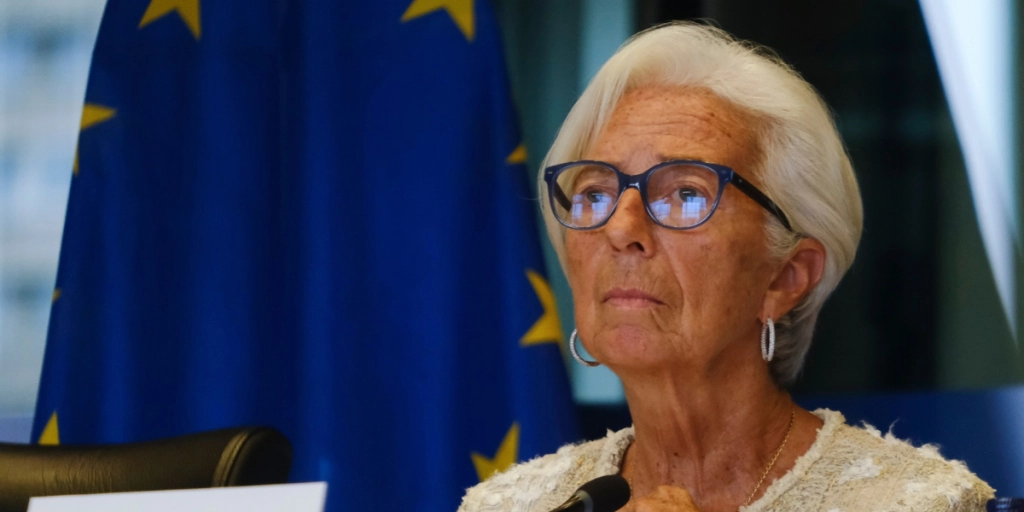
European Central Bank chief Christine Lagarde is stepping down nine months early to speak out on global issues.


The role of a central bank chief traditionally demands strict, technocratic neutrality. But for Christine Lagarde, the mandate of silence has run its course.
The European Central Bank president is stepping down next March—nine months before her eight-year term officially concludes—in order to reclaim her voice on the world stage.
The announcement came in the wake of Thursday’s rate-setting meeting in Frankfurt, where the ECB opted to hold its benchmark deposit rate at 2.5%, even as eurozone inflation climbed to 3.8%.
Speaking to reporters, Lagarde made no secret of the fact that presiding over monetary policy had become an intellectual straightjacket:


‘I want to have the freedom of speech, the freedom of expression and the freedom to engage on matters that are not monetary policy matters,’ Lagarde said, according to The Guardian.
A Stand Against Misinformation
The former French finance minister and IMF chief has been widely tipped in financial circles as a leading candidate to succeed Klaus Schwab, who stepped down last year as head of the World Economic Forum in Davos.
Lagarde framed her early exit around a desire to push back against a deteriorating public discourse filled with distortion and falsehoods, The Guardian reports.
The neutrality rules binding Frankfurt policymakers, she noted, had prevented her from taking a stand:
‘I’m interested in the truth, and I see the truth being very often damaged, contradicted by misrepresentation,’ she said, calling institutional silence ‘the price we pay for being independent.’
With more than two decades at the pinnacle of global finance and governance, Lagarde concluded that staying quiet was no longer the most constructive use of her voice:
‘There are things that I can say – whether people will listen or not is another story. But I feel that I should say those things and I cannot do so in my current position.’
Parisian Chess Game
Lagarde’s departure sets off a high-stakes diplomatic race for Europe’s top economic post, arriving just as the bloc contends with sluggish growth and persistent price pressures.
Early contenders include the Netherlands’ Klaas Knot, Spain’s Pablo Hernández de Cos, Germany’s Joachim Nagel, and European Investment Bank president Nadia Calviño.
Yet the timing also reflects deliberate political calculation. Observers note that French President Emmanuel Macron has an incentive to fast-track the transition.
Naming a successor ahead of schedule allows pro-European centrists to lock in the appointment well before the spring 2027 presidential election risks handing the Élysée Palace to Marine Le Pen.
‘The European Union is trying to guard itself,’ noted Holger Schmieding, chief economist at Berenberg Bank, pointing out that the next chief will be selected while Macron still wields decisive influence.
Seeking to reassure financial markets, Lagarde stressed that the transition is already underway and that the leadership bench is deep:
‘A process has already started to identify my successor,’ she said, according to The Guardian.



