
 Kathrine Frich

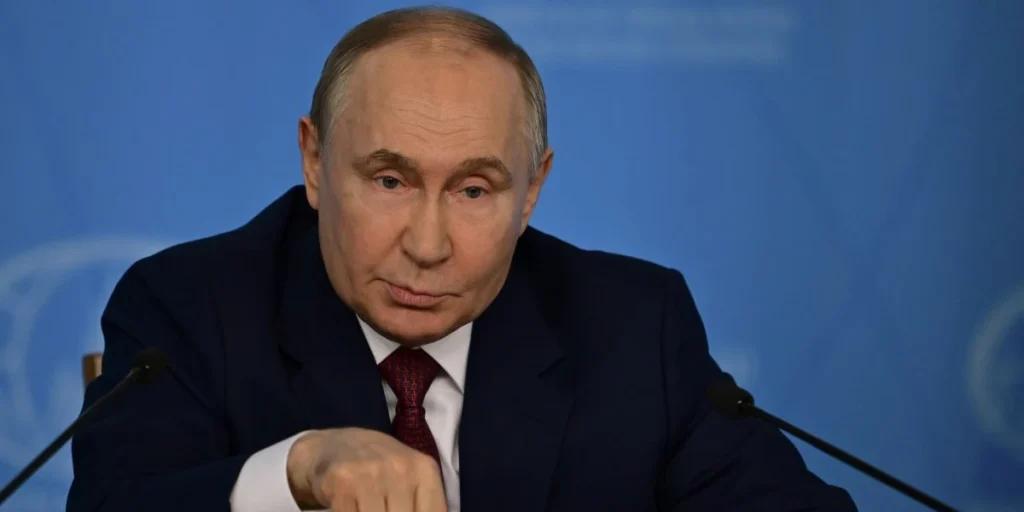
Rather than bringing stability, his sudden exit triggers a fierce battle for control inside the Kremlin.

When a major crisis dominates the headlines for years, it is easy to assume that a single sudden change at the top could fix everything.
For many people watching European security, that quiet hope has lingered in the background for a long time. Now, a detailed new war game from Washington suggests the reality could be far more dangerous.
A new leader rises
Analysts at the American think tank RAND have mapped out a timeline of what might happen if Russian President Vladimir Putin dies of natural causes in January 2027, according to the Latvian news outlet LA.lv and Dialog.ua.
Rather than bringing stability, his sudden exit triggers a fierce battle for control inside the Kremlin.


By March 2027, a former general from the FSB, Russia’s domestic intelligence agency, takes the presidency in theRAND simulation.
He quickly changes tactics. Just one month later, the new leader agrees to halt the fighting in Ukraine through a deal brokered by the United States, Britain, and European governments, trading a truce for partial relief from economic sanctions.
On the surface, the move looks like a step toward peace. In reality, Dialog.ua reports that Moscow keeps its original war goals while peace talks hit a wall, turning Ukraine into a frozen conflict while the Russian military quietly rebuilds its battered forces.
The Baltic trap
Behind the scenes, the new president spends early 2028 clearing out Putin’s old inner circle and installing his own loyalists, according to the RAND paper. Still, a weak economy and heavy war losses spark public anger across Russia.
To distract voters and tighten its grip, the Kremlin starts a hybrid campaign against NATO, spreading false claims that Eastern European states are mistreating Russian-speaking minorities.
Then comes a global distraction. In June 2029, a crisis in South America pulls Washington’s focus away, and the United States pulls back some of its troops from Europe. Pushed by top brass, Moscow plans a small attack in the Baltics to prove NATO will not stand together.
In May 2030, Russian agents stir up protests in Narva, an Estonian border city with a large ethnic Russian community, LA.lv reports. When Estonian police use force to stop the unrest, the Russian leader claims Tallinn cannot be trusted and sends troops across the border.
Targets across Europe
Moscow bets that Western allies will back down. That gamble fails immediately, as NATO triggers its mutual defense pact and a full-scale war breaks out in June 2030. Russian forces threaten northern Norway and the Arctic islands of Spitsbergen while submarines push into the North Atlantic.
According to the RAND report cited by Dialog.ua, the Kremlin picks Britain as its primary target, launching air strikes on UK air bases, ports, radar sites, and command hubs alongside cyberattacks and sabotage.
By November 2030, with a fast win out of reach, the Russian president claims the capture of Narva and nearby Ida-Viru County as a triumph and offers a truce that drags peace talks out for months.
The RAND authors stress that their timeline is only one possible scenario rather than a hard prediction. Even so, they warn British officials that the threat to Europe comes from the structure of Russia’s power system itself, not just one man in the Kremlin.



