
 Christine Drews Sieger

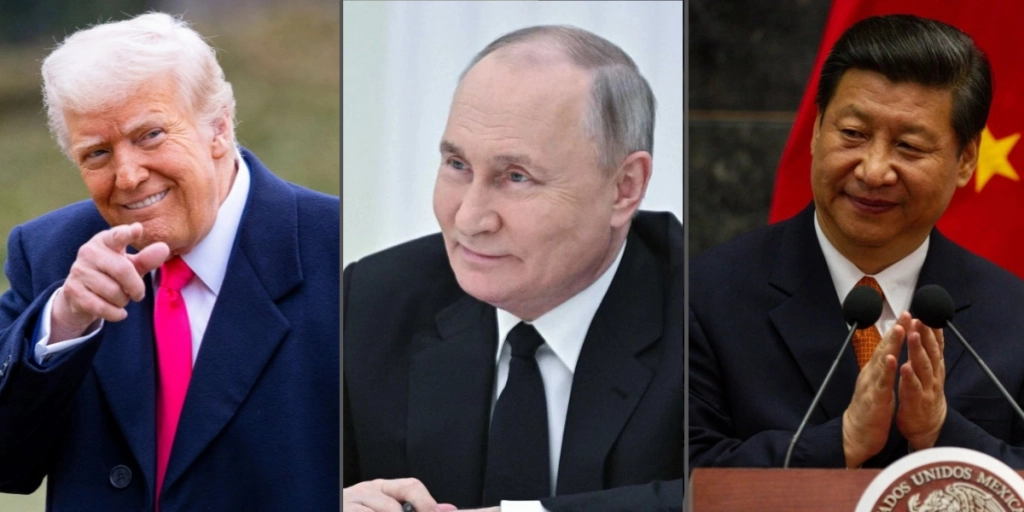
Trump, Xi, and Putin are expected to hold their first trilateral meeting in China next week, focusing on nuclear arms control while leaving the war in Ukraine off the agenda.

Next week in southern China, however, the sidelines of a regional economic gathering could host a rare diplomatic moment as the leaders of the world’s three largest military powers prepare to enter the same room.
US President Donald Trump, Chinese President Xi Jinping, and Russian President Vladimir Putin are expected to hold their first trilateral meeting in Shenzhen on November 18 or 19, alongside the Asia-Pacific Economic Cooperation (APEC) summit.
While Beijing has yet to formally confirm the sit-down, the White House says nuclear arms control will top Washington’s agenda.
“This proliferation, President Trump believes, is very dangerous,” White House spokesperson Olivia Wales told reporters, according to The Independent.


The push comes after the 2010 New START treaty—which capped US and Russian nuclear arsenals—lapsed in February.
Trump turned down a Russian offer to extend the pact, insisting instead on a modernized agreement that brings China to the table, according to Al Jazeera.
Beijing pushes back
China has firmly resisted the idea. Last month, its foreign ministry dismissed three-way disarmament talks as “neither fair, reasonable nor realistic,” pointing out that its nuclear stockpile remains far smaller than those of Washington and Moscow.
Even a senior US official acknowledged to Reuters that “we do not expect to get to any kind of agreement” in Shenzhen, though the administration maintains China must join the conversation.
Meanwhile, one of the world’s most pressing conflicts will likely remain off the table.
Washington plans to skip discussions on the war in Ukraine during the Shenzhen meeting, leaving the issue to a separate diplomatic track led by US envoys Steve Witkoff and Jared Kushner, a US official said.
“China is not really a part of that track, so it doesn’t seem appropriate to have the Ukraine discussion there,” the official explained.
According to Reuters, cited by The Independent, Moscow had lobbied to put Ukraine on the agenda, while Beijing blocked the move, leaving organizers without a finalized schedule.
Allies warn of a new ‘Yalta’
The prospect of Washington, Moscow, and Beijing meeting behind closed doors has unsettled key US partners.
Ukrainian President Volodymyr Zelensky warned last month against a repeat of the 1945 Yalta Conference, where Allied powers divided post-war spheres of influence.
“We really don’t want this to turn into ‘Yalta 2, 3, 4,’ with a redistribution of influence,” Zelensky said, according to The Independent.
Foreign policy analysts share those concerns. Ryan Hass of the Brookings Institution noted that the optics of the summit will “send a chill” through allies in Ukraine and Taiwan, particularly given that Xi and Putin have met more than 40 times since 2013.
Even without concrete policy breakthroughs, the political theater itself may dominate headlines.
Lancaster University professor Simon Mabon told Al Jazeera to expect “some pretty impressive photo-ops with a lot of really bombastic rhetoric from Trump.”
Alongside the three-way meeting, Trump and Xi are also slated to hold separate bilateral talks ahead of a January deadline for their current trade truce.



