
 Jens Asbjørn Bøgen


For months many of Ukraine’s long-range weapons have leaned on American satellite links, until a new workaround went into service this week.
In Kyiv’s military industry, a quiet project has been maturing: a way to steer a cruise missile all the way to its target without touching a SpaceX satellite.
The method had never been used in a real strike before November 17.
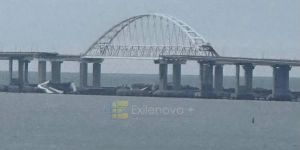
That changed when Ukraine brought down the road span of the Kerch Bridge. The attack used a new, operator-steered variant of the Fire Point FP-5 Flamingo cruise missile with live video, according to Euromaidan Press.
The details about how Ukraine managed to control the missile are still unconfirmed, but the Institute for the Study of War notes that a Ukrainian commander told The Times that Ukraine “conducted the strikes without SpaceX’s satellite internet network and instead relied on drones to relay radio signals to Ukrainian missiles.”


President Volodymyr Zelenskyy said the uplink stayed live through impact. “Using Flamingo, our warriors carried out a precision-guided strike, and the communications uplink worked flawlessly until the very last seconds,” he said in remarks carried by Euromaidan Press.
Click to display external content from x,
- You can always enable and disable third-party content.

You agree to display external third-party content. Personal data may be sent to the provider of the content and other third-party services.
A workaround built for a Starshield blackout
The timing was not accidental. On November 12, Zelenskyy said SpaceX’s Starshield service, the military-grade system that powers Ukrainian drone and missile links, was again being throttled over Ukraine, with a cap of about 161 kilometers per hour that knocked jet-powered platforms off the network, he wrote on X as quoted by Euronews.
Elon Musk has publicly maintained that Starshield is owned and controlled by the US government and that limits on its use are decided by the US military and the White House, placing the restrictions outside SpaceX’s hands.
The relay-drone mesh sidesteps that argument entirely. Operators sit inside Ukraine, the drones hold a chain of radio links out toward Crimea, and the missile talks to the chain, not to orbit.
Click to display external content from x,
- You can always enable and disable third-party content.
You agree to display external third-party content. Personal data may be sent to the provider of the content and other third-party services.
What the strike actually broke
The Security Service of Ukraine (SBU) and the General Staff ran a multi-stage operation carried out over several weeks, culminating in two consecutive nights of strikes on November 16 and 17, according to the General Staff in a statement carried by Interfax-Ukraine.
In the final wave, SBU Alpha operators used Palianytsia jet-propelled missile-drones against the road deck, while Neptune and Flamingo cruise missiles and Ruta drones worked other sections of the bridge.
The outcome was a collapsed arch and more than 270 meters of roadway gone into the Kerch Strait, according to reporting on the SBU and Fire Point statements. The railway section was damaged but still standing. The road link between mainland Russia and occupied Crimea is out of service to vehicles.
Kremlin spokesman Dmitry Peskov told reporters the span would be rebuilt, saying there was “no doubt that the bridge will be restored and will be even better than before,” as quoted by The Insider.
Fire Point has not disclosed the production rate of the operator-guided Flamingo variant, and the SBU has not said how many relay drones were in the air on the night of the strike.



