
 Jens Asbjørn Bøgen
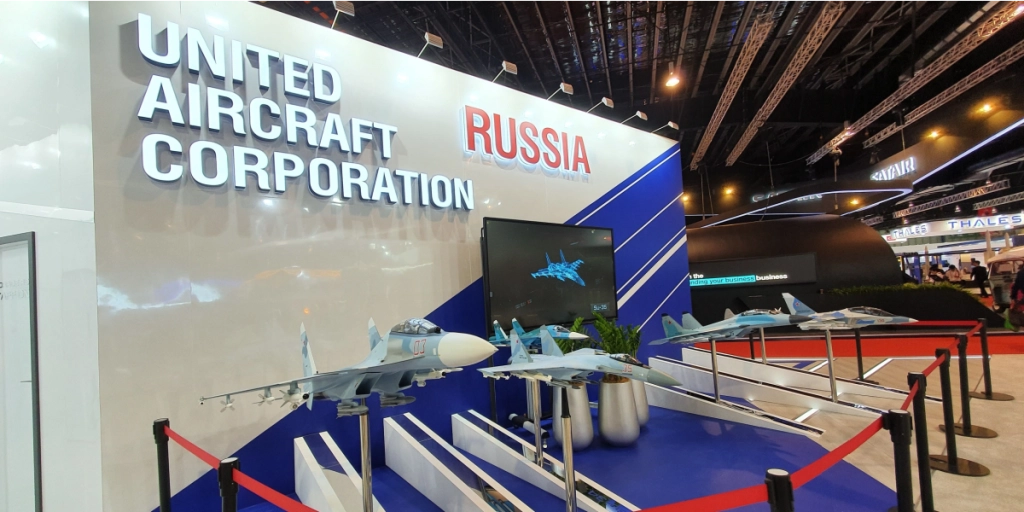
For the second year in a row, Russian companies are absent from the Singapore Airshow.


Russian defense firms are becoming harder to spot at major international exhibitions. Once a familiar presence, they are now missing from some of the industry’s most important stages.
Their absence is prompting questions among analysts about how Moscow’s arms-export business is changing, and where it is now focusing its efforts.
Absent from Asia
For the second year in a row, Russian manufacturers did not appear at the Singapore Airshow, Asia’s largest aerospace exhibition, held from Feb. 3–8, Defense News reports.
In previous years, Moscow maintained a high-profile presence. At the 2020 event, Russian Helicopters and United Aircraft Corporation shared joint pavilions, and several aircraft models were displayed alongside visiting officials.


“What we are seeing is not a strategic pivot away from Asia, but a forced reallocation under severe structural constraints,” said Francesco Schiavi, a research fellow at the Middle East Institute Switzerland according to Defense News.
“Russia’s absence from these key shows reflects the shrinking, regionalized and increased concentration of its arms-export profile that has been exacerbated by the war in Ukraine,” he added.
Past prominence
Russia’s arms exports to Asia peaked between roughly 2005 and 2011, when it secured large contracts with India and China.
According to the Stockholm International Peace Research Institute, China accounted for 60% of all Russian deliveries of major weapons in 2025.
At this year’s Singapore Airshow, the only reminder of that era came from the Malaysian Air Force, which flew modified Sukhoi Su-30 MKM jets during an aerial display. Separately, a Russian delegation led by Security Council Secretary Sergei Shoigu visited Myanmar this week to sign a military cooperation agreement.
Shifting focus
Over the past year, Russian defense companies have increasingly targeted the Middle East, particularly Gulf states.
That shift was evident at the IDEX and NAVDEX exhibitions in Abu Dhabi in February 2025, where more than a dozen Russian exhibitors showcased upgraded weapons systems.
Schiavi described Moscow’s outreach to the Middle East and Africa as “selective and compensatory,” pointing to Algeria’s Su-57 purchase and continued engagement with Mali, eastern Libya and Ethiopia.
Sources: Middle East Institute Switzerland, TASS, Defense News, Stockholm International Peace Research Institute


