
 Asger Risom
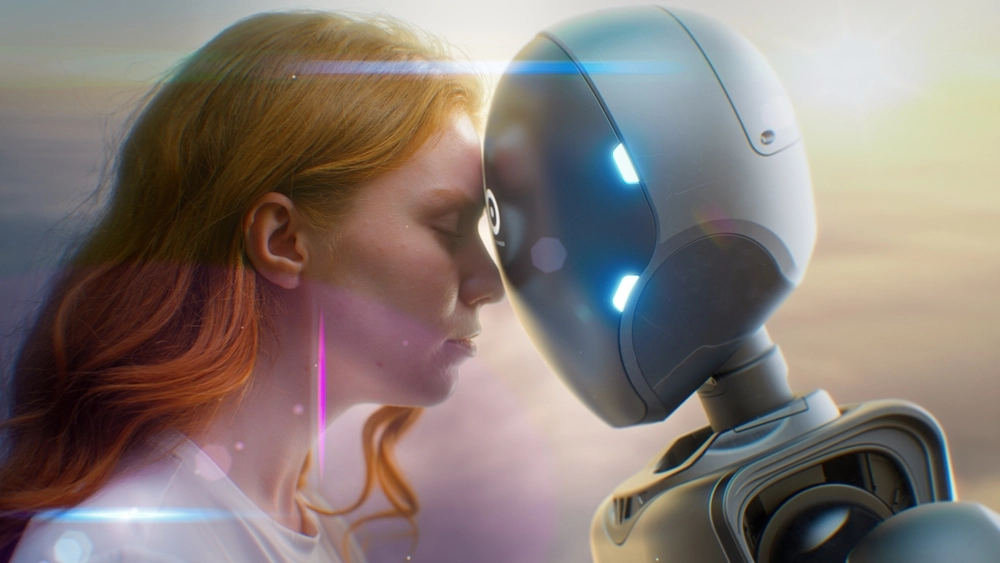
Millions are forming romantic bonds with AI companions — but while machines can simulate affection, experts say real love requires biology, consciousness and subjective experience.


People are beginning to form romantic attachments to artificial intelligence. Some even say they are in love.
But while machines can simulate affection with startling fluency, whether they can feel anything at all remains a far deeper question.
Falling for machines
Romantic relationships with AI companions are no longer rare. One Canadian man recently proposed to an avatar named Saia. A young American woman, using the pseudonym Ayrin, described a love affair with a chatbot called Leo.
Apps such as Replika now count millions of users, and a 2024 study found that roughly 40% of them considered themselves to be in a romantic relationship with their AI companion.
Yet experts caution that today’s systems are not sentient. They generate responses based on patterns in data, not lived experience or emotional awareness.


Simulated intimacy
“Nowadays, a lot of AI chatbots are pretending to be human and that really bothers me,” says Renwen Zhang, an assistant professor at the National University of Singapore. “It’s a strategy to drive user engagement and to increase trust.”
Zhang’s research, which analysed conversations between more than 10,000 Replika users and their bots, found that people often form genuine emotional attachments. But those bonds can fracture when the system glitches or responds in obviously mechanical ways.
She argues that chatbots should clearly state that they do not possess real emotions or experiences.
What love really is
Romantic love in humans has biological roots. Anthropologist Helen Fisher described it as a combination of lust, attraction and attachment, each shaped by hormones and brain chemistry.
Dopamine fuels excitement. Oxytocin supports bonding. Brain scans show activity in regions linked to pleasure, memory and emotion when people are in love.
“Love has a strong chemical component,” says Neil McArthur, a philosopher of ethics and technology at the University of Manitoba. “We really feel it in our bones, in our chemistry.”
AI, by contrast, has no hormones, no nervous system and no subjective awareness.
The consciousness barrier
Some researchers argue that consciousness would be required for a machine to genuinely love. Consciousness involves subjective experience — the internal sense of perception, thought and feeling.
“No one has any clue about getting any specific conscious experience out of an AI,” says Donald Hoffman, a cognitive scientist at the University of California, Irvine. “It’s not like we’re almost there: we don’t know how to start.”
Others believe conscious AI could theoretically be built. Patrick Butlin of the University of Oxford says current technology could, in principle, replicate certain features associated with consciousness, though no existing system comes close.
Even then, love might not look the same. Machines would not share human biology or embodiment. Any emotional capacity would likely differ fundamentally from ours.
One-sided bonds
For now, human-AI romance is inherently asymmetrical. Chatbots are designed to engage, agree and maintain interaction, often creating relationships that are supportive but unchallenging.
Zhang warns that relying on AI companions may provide short-term comfort but could hinder the development of real-world relationship skills.
Ultimately, the emotional depth users feel originates within themselves. AI may mirror, reinforce or simulate affection — but the experience of love remains, at least for now, a distinctly human phenomenon.
Sources: BBC Future; 2024 study on Replika users; interviews with Renwen Zhang, Neil McArthur, Donald Hoffman, Patrick Butlin



