
 Kenneth Glad
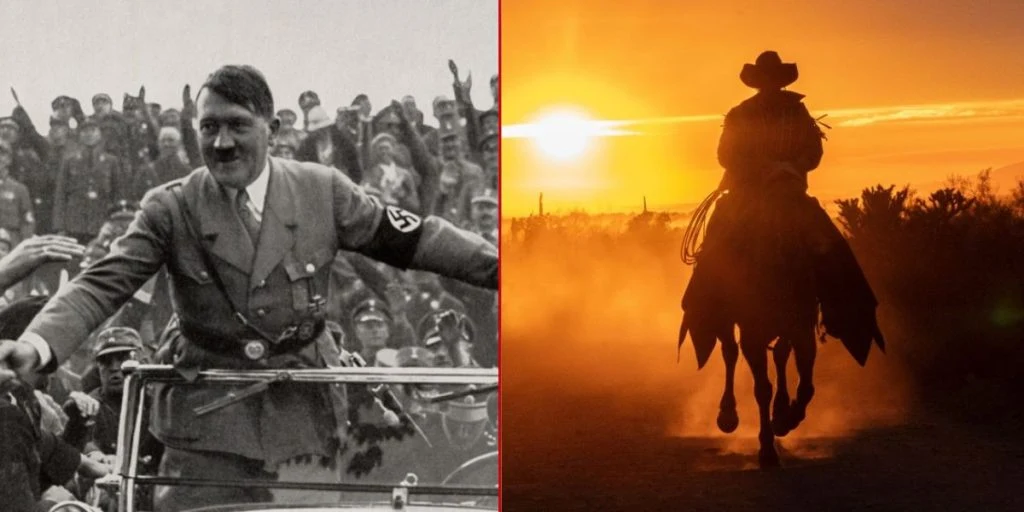
Long before the Third Reich marched across Europe, Germany was enthralled by tales of distant frontiers and heroic conquest. One of the regime’s most devoted readers had grown up inside those pages.


When Adolf Hitler invaded Poland on September 1, 1939, he framed the war as an historical necessity. Within weeks, German authorities began sealing Jewish communities into ghettos. Deportations and industrialized mass murder followed. Nazi ideology justified expansion under the banner of Lebensraum—“living space”—presenting conquest as destiny rather than aggression.
The intellectual and political roots of Nazism are well documented. Less often examined is the role of popular fiction in shaping the imaginative world of its leader. One of Hitler’s favorite authors was Karl May, the 19th-century adventure writer whose Wild West novels, according to All That’s Interesting helped define Germany’s romantic image of North America.
Germany’s invented frontier
By the late 19th century, Germany had developed what scholars call Indianertümelei—a term coined in 1985 by Hartmut Lutz, a scholar of German–Indigenous relations, to describe the country’s long-standing fascination with a stylized image of Native Americans. Karl May (1842–1912) was central to that phenomenon.
May’s works have sold an estimated 200 million copies. His best-known titles include Winnetou I–III (1893) and Der Schatz im Silbersee (1891), adventure novels narrated by the German frontiersman Old Shatterhand alongside the Apache chief Winnetou. He also wrote the popular “Orient Cycle,” featuring his alter ego Kara Ben Nemsi traveling through the Ottoman Empire.


May’s books were staples in many middle-class German homes well into the 20th century.
Biographical records indicate that May’s authority as a travel writer was largely constructed. He did not visit North America until 1908, decades after publishing his Western novels.
Earlier in life, he had spent years in imprisonment in the 1860s and early 1870s for fraud and impersonation before rebuilding himself as a writer in 1874. At the height of his fame, he blurred fiction and identity, at times presenting himself socially as Old Shatterhand or Kara Ben Nemsi.
Late in his career, May shifted tone. Works such as Und Friede auf Erden! (“And peace on Earth!” – 1904) and his 1910 autobiography Mein Leben und Streben (“My Life and Striving”) reflect a more allegorical and pacifistic outlook, a turn noted in literary scholarship.
The frontier novels themselves, however, combined admiration for Indigenous characters with a clear hierarchy. Winnetou is noble and brave, but the German narrator remains technologically and morally central. Expansion is often depicted as tragic yet inevitable.
That imaginative world proved durable. In the 1960s, a series of Karl May film adaptations became major box-office successes in West Germany, cementing Winnetou’s place in popular culture decades after May’s death.
Hitler as reader
Adolf Hitler was one of May’s many readers. According to biographers and historians of Nazi culture, Hitler admired May’s books from childhood and kept them prominently displayed in his personal library. He is reported to have recommended them to military officers and to have had special editions distributed to soldiers.
Albert Speer, Hitler’s architect and later armaments minister, wrote in Inside the Third Reich that “when faced by seemingly hopeless situations, he would still reach for these stories,” because they gave Hitler courage—“like works of philosophy for others or the Bible for elderly people.”
Speer’s recollection is frequently quoted in secondary reporting, though historians caution that his memoir must be treated critically and does not establish direct ideological influence.
The evidence for direct policy influence is thin. May’s novels were widely read across German-speaking Europe. Hitler was an extreme outlier though, not the typical reader. Still, the overlap between frontier myth and Nazi rhetoric has drawn sustained attention.
Documented fact – and interpretation
Karl May was a best-selling adventure novelist, Hitler admired his work, and Nazi cultural institutions continued to circulate May’s books.
The interpretive question is narrower. Cultural historians have argued that frontier myths can normalize hierarchy and providential violence. In May’s fictional world, European-coded heroes move through contested landscapes where Indigenous peoples are frequently portrayed as admirable but fading. Violence appears as part of historical momentum. Put plainly, the strong advance, and others are displaced.
There’s no evidence the novels dictated policy. But they were part of the imaginative environment in which one of their readers later acted.
Sources: All That’s Interesting; Albert Speer – Inside the Third Reich



