
 Kenneth Glad
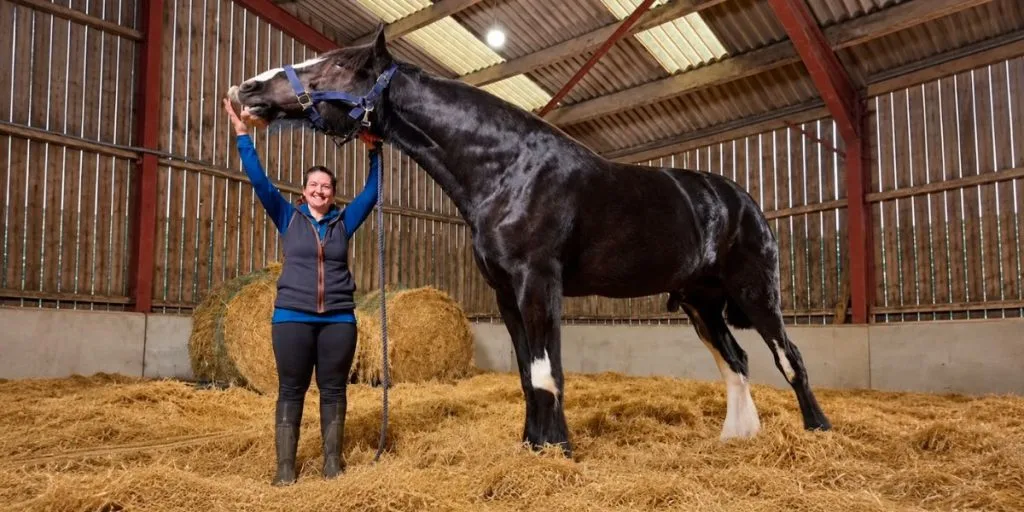
Taking care of a young pet often brings growing pains. But for one family in central England, keeping up with their animal requires looking way up just to see his face.
Hugo is officially the largest living equine on the planet. The four-year-old Shire horse recently secured a spot in the Guinness World Records 2027 book.
According to the BBC, a vet officially measured the animal at just over 198 centimeters. He stood barefoot to ensure total accuracy. The measurement was enough to secure the title of the world’s tallest living horse, although he is still shorter than the previous record-holder, Big Jake, who stood just over 210 centimeters tall.
The tallest horse ever recorded remains Sampson, later known as Mammoth, who reached around 219 centimeters.
Owner Brett Masters first bought him as a youngster. Back then, he never expected the animal to reach such a staggering height.


People reported that record officials actually contacted the owners first. Someone tipped them off by saying, “There is this really big horse, you need to speak to these guys.”
Despite his massive size, Hugo is nowhere near his final form. Male Shire horses typically continue developing for several more years.
“He’s still got three years of growing left, he won’t stop until he’s about eight and a half, he’s only a baby,” Masters told the BBC.
All this rapid expansion puts serious pressure on his body. Keeping him healthy requires a small army of equine specialists.
Top tier treatment
“He has a chiropractor, has regular massages, the dentist visits every six months, and the vet checks him all the time as his growing plates are hyperactive,” Masters said to People.
Along with his medical team, his owners make sure his diet matches his unique needs.
“He has lots of supplements and a careful feed regime,” Masters explained to the BBC. “He lives a five-star lifestyle, he wants for nothing.”
Whenever he steps outside, people regularly stop to marvel at his sheer scale. Yet his handlers insist he is completely docile.
Speaking to the BBC, co-owner Lisa Masters described the giant as “a big softie, like an oversized dog”.
These animals share a deep connection to British industrial history. Originally bred to pull heavy barges, they were the physical engines of the eighteenth century.
Modern machinery eventually pushed them out of work entirely. Today, only 212 Shire horses remain worldwide, according to the UK Rare Breeds Survival Trust.
For now, Hugo spends his time demonstrating traditional wagon pulling. The extra work builds an appetite. As Masters joked to the BBC, “If any carrot farmer wants to give him some carrots, he’d kindly have them.”
Sources: People, BBC, UK Rare Breeds Survival Trust



