
 Asger Risom
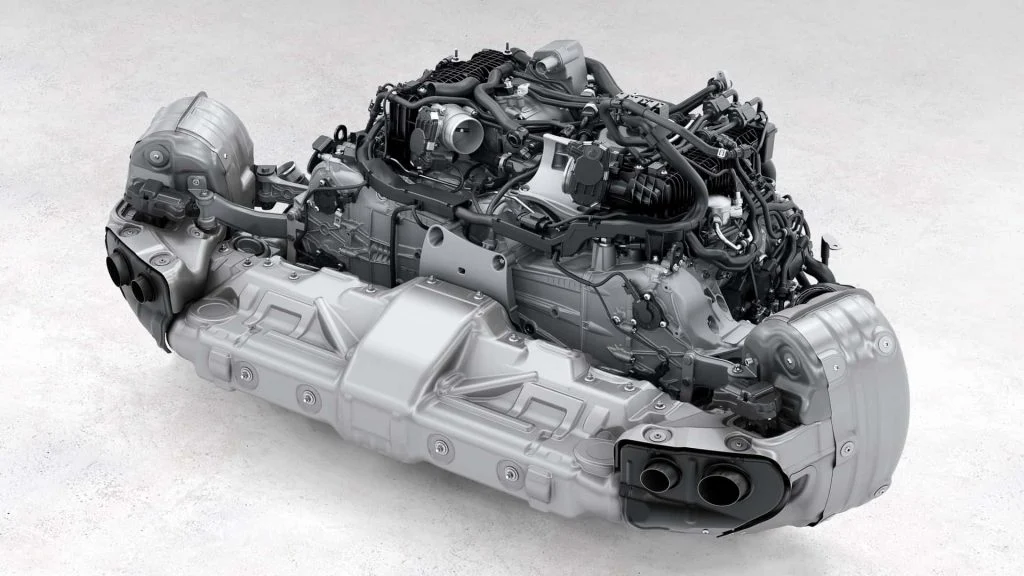
The standard EV battery skateboard ruins the low seating position of a true sports car. To fix this, Porsche is ditching the floorpan batteries for the upcoming electric 718 Boxster and Cayman, opting to stack them vertically right where the gas engine used to be.

If you want to build an electric vehicle, the standard industry playbook is essentially settled: you build a “skateboard.” You take a flat, heavy slab of battery cells, line the entire floor of the chassis with them, and put the seats on top. It works brilliantly for SUVs and family sedans because it lowers the center of gravity and opens up cabin space.
But if you are trying to build a low-slung, agile sports car, the skateboard is a nightmare. It physically forces the driver to sit higher off the road, completely ruining the driving position.
According to a new report from Motor1, Porsche has figured out a clever, highly unorthodox workaround for the upcoming electric 718 Boxster and Cayman. Instead of forcing you to sit on top of the batteries, Porsche is simply stuffing them right where the gas engine used to be.
The mid-engine battery stack
When the electric 718 debuts next year, it won’t have a traditional EV floorpan. Internal investor documents and engineering leads reveal that Porsche is taking the battery pack, splitting it into three modules, and stacking them vertically behind the driver’s seats.


This isn’t just a nostalgic nod to the 718’s mid-engine heritage; it is a strict physics calculation. By pulling the batteries out of the floorboards, Porsche can drop the seating position back down to the asphalt, preserving the exact cockpit feel of the old gas-powered models. Furthermore, this mid-mounted battery stack acts as a massive structural cross-member, increasing the car’s overall rigidity and doing double-duty as a crash structure.
The weight distribution actually improves, too. Porsche engineers state that the new electric layout puts 55.2 percent of the car’s weight over the rear axle, which is technically closer to an ideal sports car balance than the outgoing four-cylinder models.
The weight penalty and the fake gears
Of course, the batteries still weigh a ton—literally.
While Porsche hasn’t released official spec sheets, industry estimates point to the electric 718 weighing somewhere around 3,750 pounds. That is a massive jump from the previous gas-powered Cayman S, which weighed in at just under 3,000 pounds.
To help mask that weight and preserve the tactile engagement of a sports car, Porsche is throwing software at the problem. The new 718 will inherit the Taycan’s optional E-Shift system, meaning the car will actively simulate both engine sounds and the physical jolt of mechanical gear changes. Whether synthetic engine noise can actually satisfy a traditional Porsche purist remains to be seen, but the company is fully committing to the bit.
The gasoline-powered 718 is officially dead, and the electric replacements will not have gas equivalents. If you absolutely refuse to buy a Porsche without a combustion engine, the company has one final consolation prize: the flagship 911 isn’t going electric anytime soon.



