
 Jens Asbjørn Bøgen
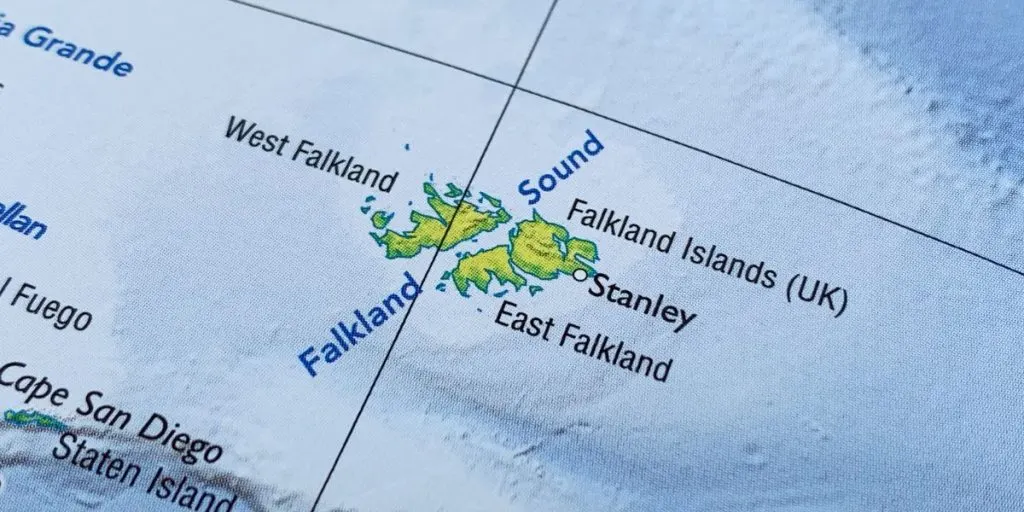
The small group of islands have seen settlements from several nations.

This article was first published on 17 July 2026 following the banner controversy after Argentina’s victory over England at the FIFA World Cup. It is being republished after Javier Milei reiterated Argentina’s claim to the islands in a speech to the nation.
In a late-night address to the nation, Argentinian President Javier Milei, commonly referred to as Argentina’s Trump, forcefully reasserted his country’s claim to the Falkland Islands.
He insisted there was “no other path” than recovering the territory, which Argentina calls Las Malvinas.
Milei pointed to shifting global politics to back his stance. He claimed “winds of change favourable” to Argentina were “blowing around the world”, citing recent hints from Washington.


Click to display external content from t.co,
- You can always enable and disable third-party content.

You agree to display external third-party content. Personal data may be sent to the provider of the content and other third-party services.
The historical tug-of-war over the Falkland Islands—known in Latin America as Las Malvinas—remains one of the world’s most enduring geopolitical disputes.
While the archipelago operates today as a British Overseas Territory, the question of whether Argentina ever truly held the islands depends on a complex history of brief physical control and competing colonial inheritances.
So grab a cup of coffee, and let’s get started.
Before Argentina existed
The first settlement established on East Falkland in 1764 was actually neither Argentine nor British. It was French.
The settlement was named Port Saint Louis, and the following year, Saunders Island (northwest of West Falkland) was claimed by Britain.
In 1766, the first actual British settlement, Port Egmont, was established on Saunders Island.
France ceded its colony to Spain in 1767, and in 1770 Spain and Britain nearly went to war when Spanish forces expelled the British from Port Egmont.
Spain eventually agreed to restore Port Egmont to Britain in 1771.
The British withdrawal
With the American Revolution brewing in the colonies, Britain withdrew its physical garrison from Port Egmont in 1774—two years before the United States declared independence.
However, the British left behind a lead plaque clearly stating that King George III retained sole sovereignty over the islands.
The Post-Independence Era: 1820–1833
Argentina’s primary historical claim rests on the decade following its independence from Spain.
Under the legal principle of “uti possidetis juris,” the newly formed government in Buenos Aires argued that it inherited all former Spanish colonial territories in the South Atlantic.
In 1820, Argentine commander David Jewett officially proclaimed Buenos Aires’ sovereignty over the islands. By 1826, merchant Luis Vernet had established a permanent settlement at Port Louis on East Falkland, and in 1829 he received an official appointment as political and military governor.
This period of Argentine administration was short-lived. Following a diplomatic dispute over sealing rights, a U.S. warship heavily damaged the settlement in 1831.
Seizing on the instability, a British naval force arrived in January 1833 to reassert British sovereignty, expelling the remaining Argentine military garrison and initiating a sequence of events that led to the establishment of a permanent British administration by 1834.
The 1982 Falklands War
For nearly 150 years, Argentina maintained a continuous diplomatic protest but held no physical presence on the islands. That changed on April 2, 1982, when Argentina’s ruling military junta launched an amphibious invasion, capturing the capital, Port Stanley, and establishing military rule over the archipelago.
The occupation lasted exactly 74 days. A British military task force dispatched by Prime Minister Margaret Thatcher fought a brief, intense war to reclaim the territory.
The conflict ended on June 14, 1982, with the surrender of Argentine forces, resulting in the deaths of 649 Argentine and 255 British service members.
The modern dispute
In a 2013 referendum, residents of the islands voted overwhelmingly—by 99.8 percent—to remain a British Overseas Territory, a position the UK government uses to argue that the islanders possess the right to self-determination.
Conversely, Argentina has never abandoned its constitutional claim to the islands.
So … were they ever Argentine?
Ultimately, whether the islands “ever belonged” to Argentina depends entirely on which chapter of history a government chooses to prioritize.
Argentina looks at the 1820s as a stolen inheritance; Britain looks at the last two centuries as a settled reality.
It is precisely because this question has no clean, universally accepted answer that the geopolitical wound remains so raw.
As long as those two conflicting historical timelines exist, the battle for the Malvinas/Falkland Islands will continue to be fought.



