
 Asger Risom

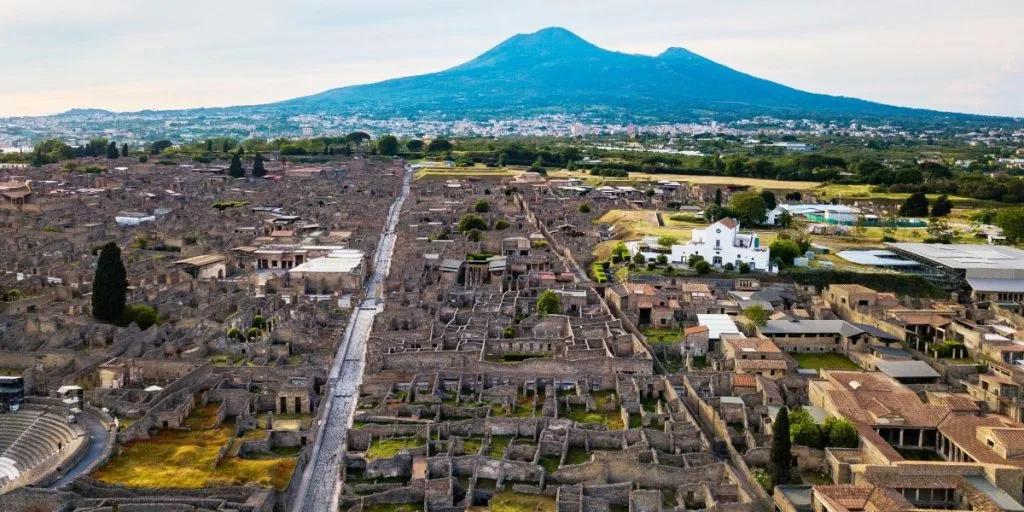
When Mount Vesuvius erupted in 79 AD, it flash-baked an entire philosophical library into brittle cylinders of charcoal. For centuries, trying to unroll the Herculaneum scrolls turned them into dust. By combining particle accelerator X-ray scans with machine learning algorithms trained to spot microscopic ink textures on carbonized fibers, researchers are now virtually unwrapping and transcribing lost classical texts without touching the fragile physical relics.


When Mount Vesuvius blew its top in 79 AD, it did something unusual to the seaside resort of Herculaneum. While Pompeii was buried under a blizzard of pumice, Herculaneum took the brunt of a superheated surge of volcanic gas and ash. Inside a sprawling private villa once owned by Julius Caesar’s father-in-law, a personal library of classical Greek and Roman texts was flash-baked at hundreds of degrees in an oxygen-starved environment.
The scrolls did not burn to ash. They carbonized. They turned into solid, brittle cylinders of pure charcoal.
For centuries, those scrolls presented a cruel archaeological puzzle. The only surviving intact library from the classical world sat right in our hands, but trying to unroll a single roll crumbled it into worthless black soot. Early attempts to slice or peel them open destroyed outer layers and left behind disjointed scraps.
Now, a blend of particle physics, 3D scanning, and machine learning is doing what human hands never could: unrolling and reading intact ancient books without laying a finger on them.


The black-on-black imaging problem
Taking an X-ray of an ancient papyrus roll sounds straightforward, but ordinary hospital CT scanners hit a physical wall immediately.
Medical X-rays work because bones and soft tissue have vastly different atomic densities; calcium blocks X-rays, while muscle lets them pass. Later medieval manuscripts are equally easy to scan because scribes used iron-gall ink, which contains heavy metal salts that light up under an X-ray beam like neon.
The scribes in Herculaneum had no iron in their ink. They wrote with a simple mixture of soot, gum, and water. When the volcanic eruption baked the library, the plant-based papyrus turned into pure carbon—and the soot-based ink was pure carbon to begin with.
To a standard scanner, the scrolls look completely uniform: black ink printed on black paper.
To see through that carbon camouflage, researchers transported the fragile rolls to the Diamond Light Source, a particle accelerator in Oxfordshire, England. By accelerating electrons near the speed of light, the synchrotron generates X-ray beams billions of times brighter than hospital gear.
Crucially, this setup uses phase-contrast tomography. Instead of just measuring how many X-rays pass through an object, it measures the microscopic deflection of X-ray waves as they graze different materials. That resolution is fine enough to capture the physical topography of the rolled sheet, down to individual papyrus plant fibers.
Tracing a crumpled 3D pancake
Getting an ultra-high-resolution 3D scan of a scroll is only the first step. The harder computational problem is that the scrolls are not neat, concentric spirals.
When the volcanic blast hit the villa, the scrolls were crushed, twisted, and folded in on themselves like papier-mâché dropped from a second-story window. If you slice through the 3D X-ray volume digitally, you do not see clean pages; you see thousands of squiggly, fractured lines running through a dense cylinder.
Computer scientists had to invent an entirely new processing pipeline called virtual unwrapping. First, algorithms crawl through the gigabytes of volumetric scan data to identify and segment the continuous 3D surface of a single wrapped layer of papyrus.
Once the software traces that winding, warped sheet through the interior of the roll, it runs a geometric calculation to virtually flatten it into a 2D digital image. Doing this by hand would take decades of clicking, so engineers built automated segmentation tools that treat the wrapped layers like a topological mesh, tracing the curves around fractures and voids.
Spotting soot on soot with code
Once a digital page is flattened out, the original challenge returns: the ink is still nearly invisible to the human eye.
This is where the Vesuvius Challenge—an open science competition launched to crack the scrolls—turned to machine learning. Competitors realized that even if the carbon ink does not cast a dark shadow on the X-ray, the physical act of writing left behind a physical signature.
When a scribe pressed a reed pen into the papyrus, the ink sat on the surface, soaked into the microscopic plant fibers, and dried into a faint, raised film. Neural networks trained on tiny, verified fragments of unrolled papyrus learned to spot those subtle surface variations—tiny changes in height, microscopic voids in the fiber grid, and subtle density shifts.
As the models scan the virtually flattened sheets, they highlight clusters of pixels that match the physical profile of dried ink, rendering Greek letters out of what looks like static noise.
Lost voices of antiquity walk out of the ash
The payoff arrived when researchers announced that an entire rolled scroll—cataloged as PHerc. 1667—had been completely mapped, unwrapped, and read from beginning to end without opening the roll.
The virtually recovered text spans roughly 1.4 meters of papyrus and contains over twenty columns of ancient Greek. Papyrologists reading the digital transcription identified it as a lost treatise on Stoic ethics dating back to the second century BC, discussing human nature, wisdom, and virtue.
Hundreds of these carbonized cylinders are stored in archives in Naples, Oxford, and Paris, untouched because everyone knew opening them meant destroying them. Beyond the scrolls already sitting in museum vaults, archaeologists believe the villa itself has only been partially excavated, with an entire lower library floor potentially still buried beneath tons of volcanic rock.
For two thousand years, the volcanic ash of Vesuvius kept a library hidden by turning it into stone. Now that code can see through charcoal, the lost literature of the ancient Mediterranean is finally walking back into the light.



