
 Kenneth Glad
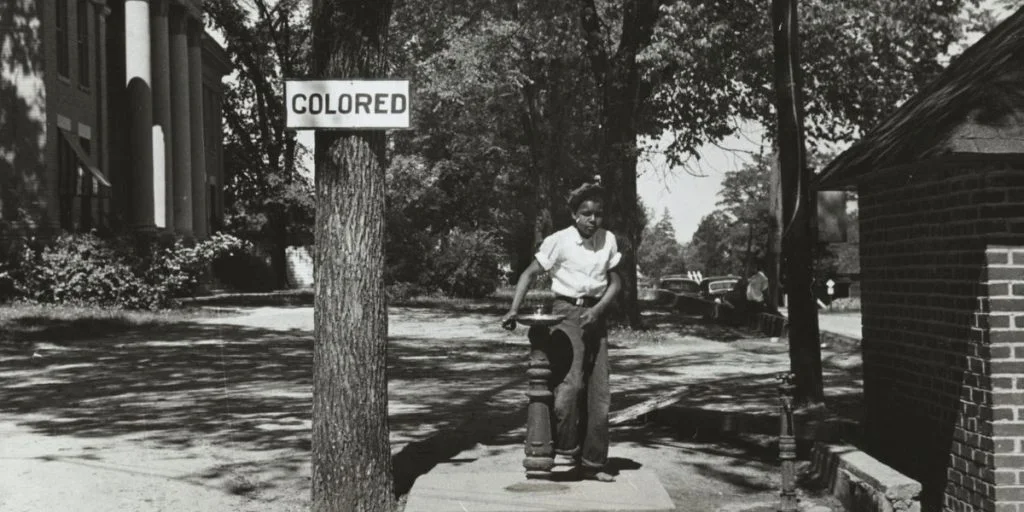
Racial discrimination had been written into law in different societies long before the Second World War. During the 1930s, Nazi policymakers considering their own racial system sometimes looked beyond Germany for legal precedents.


On June 5, 1934, German lawyers, officials and legal scholars met to consider the construction of a new racial legal order. Among the foreign legislation under discussion were laws from the United States.
American governments had already established numerous legal distinctions based on race and ancestry. States restricted interracial marriage, federal legislation controlled immigration according to national origin, and citizenship and political rights had not been extended equally across the population.
James Q. Whitman, a Yale Law School professor specializing in comparative and foreign law, investigated this connection in his 2017 book Hitler’s American Model: The United States and the Making of Nazi Race Law. His work found that American precedents formed part of Nazi legal discussions as officials developed their own racial legislation.
Nazi lawyers studied America
Interest in US policies preceded the 1934 meeting. Adolf Hitler had referred to aspects of American immigration and citizenship policy in Mein Kampf. Nazi legal specialists examined the country’s legislation in greater depth after the party took power in 1933.


One prominent federal measure was the Immigration Act of 1924. According to the US Department of State’s Office of the Historian, the legislation established restrictive national-origins quotas and further limited immigration from Asia.
Whitman found particularly strong interest among some of the Nazi regime’s most radical lawyers. In the United States, they saw a country where racial discrimination was already written into laws governing marriage, immigration and citizenship.
Citizenship offered one field for comparison. American history offered examples of people living under US authority without possessing the same political status or rights as other inhabitants.
German policymakers, meanwhile, were considering how Jews could be removed from equal membership in the national community.
Marriage became a focus
American restrictions on interracial marriage offered another body of law for examination. Numerous states prohibited marriages between people assigned to particular racial categories, though the definitions and restrictions differed across jurisdictions.
Heinrich Krieger, a German lawyer who studied at the University of Arkansas in 1933 and 1934, researched US racial legislation. He later published Das Rassenrecht in den Vereinigten Staaten, or Race Law in the United States, in 1936.
Whitman’s reconstruction of the June 1934 meeting shows that American examples had entered serious Nazi legal deliberations. Restrictions involving marriage and methods for defining racial status were among the subjects examined.
On September 15, 1935, the Nazi regime enacted the Nuremberg Laws. The Reich Citizenship Law established different legal statuses, while the Law for the Protection of German Blood and German Honor prohibited marriages and extramarital sexual relations between Jews and citizens classified as being of German or related blood.
Nazi antisemitism did not come from the United States. But American law gave Nazi lawyers working examples of how racial restrictions could be applied to citizenship, immigration and marriage.
Nazi lawyers rejected some US rules
Some American jurisdictions had developed ancestry-based classifications that included versions of the “one-drop rule.” Under particularly severe formulations, distant Black ancestry could determine a person’s legal racial classification.
Whitman found that some American racial definitions went further than many Nazi lawyers were prepared to go. They rejected those rules as too rigid and developed different criteria for deciding who would be classified as Jewish.
The Nazi regime eventually developed its own categories, using the religious affiliation of a person’s grandparents as a key legal marker of Jewish ancestry. Those classifications determined an individual’s status under racial legislation.
The disagreement over classification also shows that American precedents could be evaluated and rejected rather than adopted wholesale.
The connection went deeper
The American laws studied in Germany reached well beyond segregation in the South. Nazi legal researchers also examined federal immigration restrictions, citizenship rules, bans on interracial marriage and the ways American authorities classified people by race and ancestry.
The United States offered examples at both state and federal level. Different laws could determine who was permitted to enter the country, who could marry whom and who qualified for citizenship or political rights. Discriminatory policies affected Black Americans as well as Asian Americans, Native Americans and other groups.
For Nazi lawyers trying to build a racial system of their own, this made the United States particularly useful to study. They could examine laws that had already been written, enforced and tested in practice rather than dealing only with racial theories on paper.
Whitman’s research shows that they did not agree with everything they found. Some American racial classifications were considered too rigid, while other legal approaches attracted serious attention. The value of the American example lay partly in the range of possibilities it presented.
That makes the story more revealing than the simple claim that Nazi Germany copied Jim Crow. Nazi lawyers were comparing different American laws, deciding what might work in Germany and rejecting what did not fit the system they wanted to create.
By the time the Nuremberg Laws were enacted in 1935, those discussions had helped shape the legal environment in which Nazi racial policy developed. The disturbing historical connection is straightforward: When Nazi jurists searched abroad for examples of how race could be turned into law, the United States was one of the countries they studied most closely.
Sources:
- James Q. Whitman – Hitler’s American Model: The United States and the Making of Nazi Race Law
- US Department of State
- Office of the Historian
- Adolf Hitler – Mein Kampf
- Heinrich Krieger – Race Law in the United States



