
 Kenneth Glad
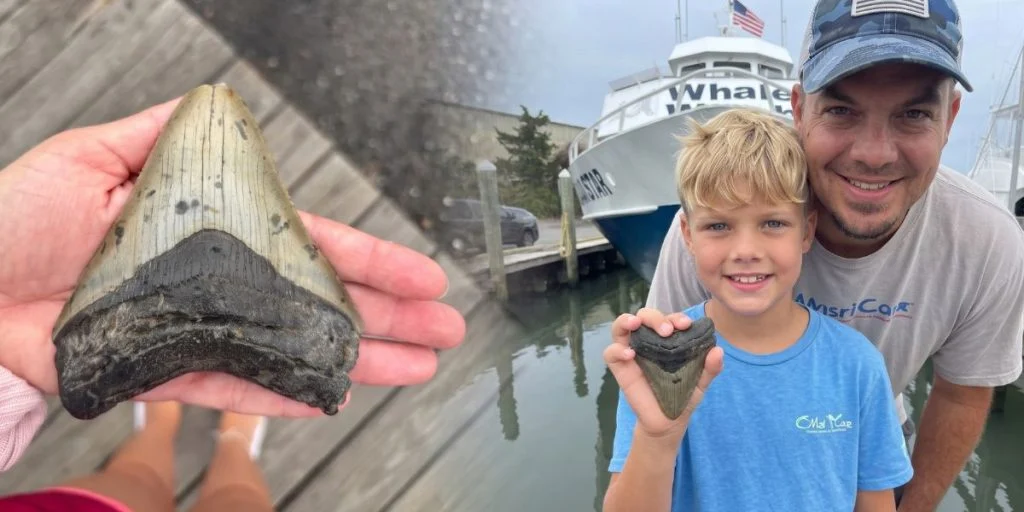
Experts have authenticated an unusual fossil recovered during a family visit to the New Jersey coast. Recent shoreline work may help explain how it reached the beach.


A rare megalodon tooth recovered in Sea Isle City has been confirmed as a fossil from a shark species that disappeared about 3.6 million years ago.
Michael Bowers, 42, and his 11-year-old son, Bo, found the tooth near a jetty while visiting from Pennsylvania, according to the New York Post. Bowers could not reach the object through the narrow opening where it was lodged, but his son was able to remove it.
“I always seem like I find crazy stuff in the water,” Bowers told NJ.com. “I never in a million years would have guessed that we would have found something like this. My son was speechless.”
The family later brought the specimen to the Cape May Whale Watch and Research Center, which confirmed that it came from a megalodon.


Dana Ehret, curator of Natural History at the New Jersey State Museum, was independently identified through the museum. The New York Post writes that she said fewer than five megalodon teeth have been found in New Jersey.
Why the tooth survived
According to Smithsonian Ocean, megalodons lived from roughly 23 million to 3.6 million years ago. Their skeletons consisted mainly of cartilage, which rarely survives long enough to fossilize, so teeth and preserved vertebrae provide much of the available evidence about the species.
Like modern sharks, megalodons continually replaced lost teeth. That process produced large numbers over a lifetime, increasing the chances that some would eventually become fossils. Some known megalodon teeth exceed seven inches.
A recent U.S. Army Corps of Engineers beach replenishment project offers one possible explanation for the Sea Isle City find. Official project information says work there ended on July 13, 2026, after about 479,000 cubic yards of sand were placed along the shoreline.
The sand came from offshore borrow areas, including one about three miles from Sea Isle City. That material could have carried the fossil ashore, although there is no proof that the replenishment project was responsible.
“If the sand came from a few miles offshore, it is very possible the tooth came with it,” Melissa Laurino, research director at the Cape May center, told NJ.com. “It’s a once-in-a-lifetime beach find that the Bowers family will treasure for a lifetime.”
Sources: New York Post, NJ.com, Smithsonian Ocean



