
 Noah Romsdal Hallundbæk Sørensen
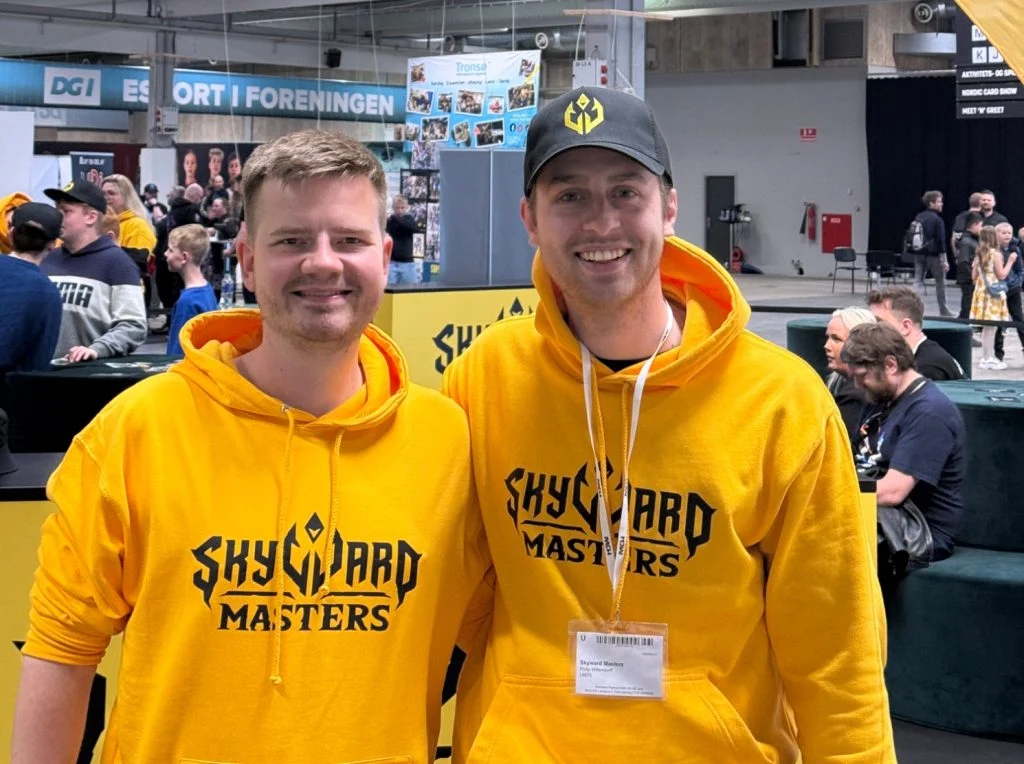
Three years without pay. A dream born in Minecraft. And now players are lining up for hours. Skyward Masters is turning heads.


Skyward Masters did not begin as a large studio project with investors, esports names, and a massive booth at GameBox. It began with a frustration over a game format that was fun, but quickly ran out of depth.
For Philip Wittendorff, director and creator of Skyward Masters, the idea emerged around 2019 while he was playing BedWars in Minecraft with some friends.
“Well, it came about back around 2019. I was sitting there playing BedWars in Minecraft. And I thought it was really fun to play with some friends.”
But like many other game mods, the format had its limitations.


“There are just a lot of things you could change if you had the ability to do so. But you only have these tools, so you’re kind of put in a box, and you can’t really do much.”
He describes it as building with LEGO bricks, where you can combine them but not change their shape or color. That frustration became the beginning of something bigger.
From idea to three years without pay
Philip began talking to players from the BedWars community to find out if others felt the same. According to him, he spoke with more than 100 players from around the world, and the answer was more or less the same: the gameplay was fun, but something was missing.
“I love the gameplay, but there’s just something more missing.”
From there, Skyward Masters began to take shape. The game builds on elements such as teams, strategy, resources, building, and the fight to protect your own base while attacking others.
But Philip did not come from the gaming industry.
“I don’t have any background in game development at all. Even today, I still can’t write a single line of code.”
Instead, he had a financial and business background. His first major task was to understand the industry and find the right people. It took about a year and a half to find partners who could see the potential.
In January 2023, the team took the leap and began working full-time on the project.
“So we started working full-time on this project in January 2023.”
What followed was a period that sounds almost like a classic startup story. The team sat in a living room for just over a year, working on the game from morning to night.
“So we basically just sat in Bjarke’s living room for a bit over a year and worked nonstop.”
They applied for support from various funding programs, but did not quite fit into public funding schemes for game development. Skyward Masters was too commercially focused for some of the places they applied.
“We were told by the Danish Film Institute’s game scheme that we lacked originality.”
Only later did they manage to secure Innofounder support through EIFO and Innovation Fund Denmark. But even with an office in Rødovre and more structure around the project, the journey was far from easy.
“We’ve actually worked three years without pay on this project.”
When Peter and Frederik came into the picture
An important turning point came when Philip, through his network, got in touch with Peter Rasmussen, also known as dupreeh, the most decorated former professional Counter-Strike player, and Frederik Byskov, former manager of Astralis. At that time, the timing made sense.
“Frederik had just stepped away from AceZone, and Peter had just ended his career and tweeted that he wanted to make video games. So it was very natural to start a conversation.”
Frederik stopped by the office for a meeting that was originally supposed to last about an hour. It ended up taking several hours.
“The plan was that he would just stop by and talk for about an hour, but he ended up staying for three hours.”
For Philip, it was a sign that there was something in the project that resonated.
“You could just feel that he saw something here. Both in the team, but also in the project.”
Shortly after, Peter also became more closely involved in the project. Philip describes this moment as a point where the journey began to change character.
“We finally got the validation we had been fighting for for three years.”
For the team, it wasn’t just about money. It was about what the two names could bring to the project.
“For us, it wasn’t about how much money they brought. It was just about getting them on board, because that opportunity wouldn’t come again.”
GameBox became the big test
At GameBox, Skyward Masters was not just showcased. It was tested in front of real players, in real matches, with a setup that had to hold up all day.
The reaction made a clear impression on Philip.
“I almost shed a tear yesterday on my way home.”
People stood in line to try the game, and some came back again the next day.
“People are standing in line for over an hour to play, and half of them get back in line to play again. This morning, when we opened, people came running to the booth.”
According to Philip, they almost doubled the number of preorders in a single day compared to three days at a previous event at Bella Center. At the same time, their Discord grew by more than 200 new members.
“Just yesterday, we got over 200 new members in our Discord.”
Technically, GameBox also became an important milestone. Nearly 400 players went through in a single day, and according to Philip, they ran 26 matches without a single crash.
“I think we ran 26 games yesterday, and not a single crash.”
For a new multiplayer game in pre-alpha, that means a lot and is a major achievement.
“That shows that the infrastructure behind the game holds up.”
A Danish project with big ambitions
Skyward Masters is not only presented as a new game, but also as a Danish project. Philip highlights both the team, the investors, and the partners behind the booth.
“It’s all just a big group of Danish brands supporting Skyward.”
The Danish angle matters to the team.
“I think it’s great to run with the Danish angle. A Danish game, Danish developers, Danish funding, and Danish partners.”
The ambition, however, is not small.
“We want to build the next Danish global game success, like Ghost Ship Games did with Deep Rock Galactic.”
Philip mentions Danish successes such as Ghost Ship Games, Deep Rock Galactic, SYBO, and IO Interactive as benchmarks. But Skyward Masters is also trying to hit an area where, according to him, there have not been many Danish titles in recent years.
“Realistically, as far as I can think, we’re probably the only ones currently working on a Danish multiplayer FPS.”
Therefore, the game also requires a larger setup when being showcased. A multiplayer game cannot just be demonstrated on a single computer.
“We can’t just set up one computer. We need a full setup.”
Philip’s role: Creating space for the game
Philip describes his own role as director as the one who handles everything around the project so the developers can focus on the game itself.
“I take care of the boring stuff so the team can focus 100 percent on developing the game.”
This includes everything from fundraising and presentations to partners, events, and the GameBox booth.
“I basically handle everything, from cleaning the office to fundraising and talking to investors.”
Peter contributes especially to the gameplay experience.
“Peter helps a lot with the game itself. He’s in constant dialogue with our developer about how to create a good shooting experience. What feels good? What’s fun and what’s not?”
Frederik acts more as a commercial sparring partner and helps with networking, events, and logistics.
“Frederik is one of my commercial sparring partners. He uses his network a lot and activates it.”
This gives the team a structure where the creative and technical forces can work in a focused way, while the commercial and practical side is handled alongside.
A game that wants to find its own place
When it comes to the game itself, Skyward Masters is not trying to become the next Counter-Strike or Fortnite. The ambition is instead to create its own space.
“We want to create our own space.”
The game does not focus heavily on lore. Instead, the team works with gameplay, style, and accessibility.
“We call it stylized realism.”
This means a graphical style that feels modern but can still appeal broadly.
“We’re trying to find our own style while making something that looks good. And something everyone can be part of.”
An important part of the vision is that the game should be playable by both younger players and adults.
“It should be something where young kids under 10 can play with their parents. And the parents feel comfortable with that.”
At the same time, Philip distances the project from the idea of being a “Counter-Strike killer.”
“Some of the bigger media outlets were quick early on to say we were aiming to be a Counter-Strike killer because Peter was involved. And we distance ourselves from that.”
Instead, it’s about combining elements from different game traditions: arena shooters, BedWars, Minecraft, Roblox, Fortnite, and classic titles like Unreal Tournament and Quake.
“We feel it’s a good combination of many things, allowing us to create our own place in the arena-shooter genre.”
No pay-to-win, and players should be part of the journey
Philip explains that Skyward Masters will not be built around loot boxes or pay-to-win.
“There won’t be loot boxes and things like that.”
The game will cost money, but the ambition is to keep the price low.
“The game will have an upfront cost. We haven’t set it exactly yet, but it will probably be around 200 DKK.”
There will be cosmetic purchases, but nothing that gives gameplay advantages.
“There’s no pay-to-win. You buy the game, and everyone can participate equally.”
At the same time, the team is open about the game still being in an early stage. That’s why they use GameBox and other events to gather feedback.
“We are very open and transparent about what we’re developing and what we want, and we take feedback back with us.”
For Philip, it’s important not to develop in isolation.
“You see a lot of game startups and tech startups that sit at home developing for years without talking to customers. Then they launch something the market never wanted.”
Variation, strategy, and replayability
Going forward, Skyward Masters needs to offer more than one game mode. The team is first focusing on a four-team format because it feels unique in the shooter genre.
“We’ve chosen to focus on the four-team format first because we think it’s quite unique.”
A duo mode is also being explored.
“We’re also looking at a duo mode with eight teams of two players.”
At the same time, the team is working on maps that are fundamentally recognizable but change through different biomes and zones each match.
“The map is essentially always the same, but with different biomes.”
These zones can give tactical advantages like damage boosts, shields, or healing.
“So there will be tactical elements in controlling zones to gain advantages.”
This should create variation without making the game overwhelming.
“There will be a lot of strategy and constant adaptation.”
Building is also an important part of the game, but it should not take over. Players can build between islands, but only if they have resources.
“You can’t just build endlessly. You have to manage your resources.”
Philip is clear that building should never overshadow shooting.
“It must never become like Fortnite.”
A Danish game players are already embracing
Skyward Masters is still early in development. Weapons, characters, modes, and details may change, and the team actively uses player feedback to adjust direction.
But the reaction at GameBox shows the project has already hit something.
People line up. They come back the next day. They give feedback. They join Discord. They preorder. They start following development.
These are the moments that turn a project into something bigger than a prototype.
Skyward Masters began with frustration over the limitations of a Minecraft mod. Today, it stands as a Danish multiplayer project with big ambitions, strong people behind it, and a growing group of players who already want to be part of the journey.



