
 Nicolai Haugsted
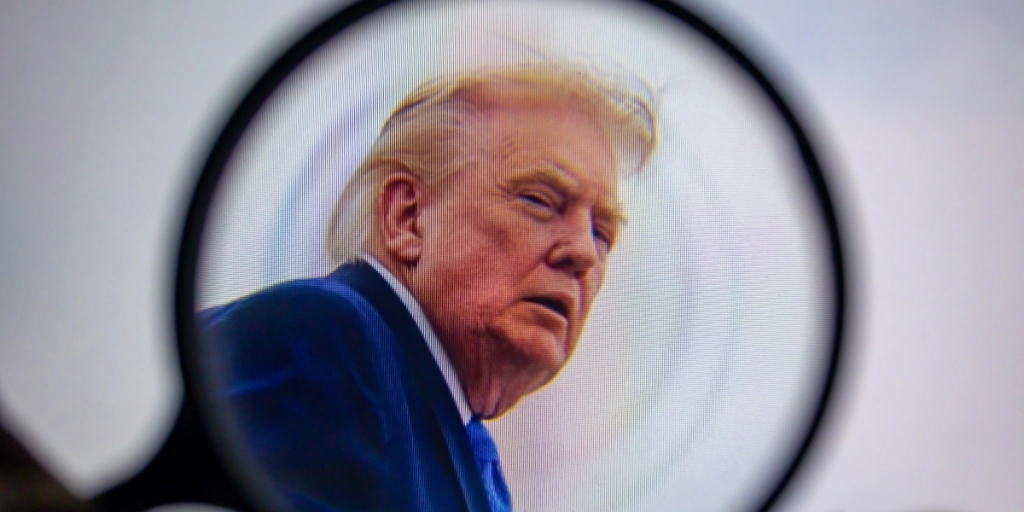
Thomas Massie says Trump’s political comeuppance could arrive when Americans head to the polls in November.


Donald Trump spent much of the Republican primary season demonstrating just how dangerous it could be for members of his own party to cross him.
November presents a very different electorate.
Republican Rep. Thomas Massie, who knows better than most what happens when a GOP lawmaker falls out with the president, believes that distinction is about to become painfully important.
Speaking with CNN’s Kaitlan Collins, the outgoing Kentucky congressman argued that Republican candidates who embraced Trump during their primaries are now discovering that the same relationship can become considerably more complicated during a general election.


Massie’s prediction for what comes next was hardly subtle.
He expects Republicans to take a “shellacking.”
Republicans suddenly need some distance
Massie pointed to Republican candidates who spent their primaries closely associating themselves with Trump but are now attempting to establish greater independence ahead of the November 3 midterms.
“[Republican candidates] have to find some way to get away from this president,” Massie said.
“He’s not out there campaigning for them. They don’t want him in their districts. They’ve got to put space between them and him…they’re about to take a shellacking here in the general election, so they’re running from him on [immigration] and on other issues like the war.”
His comments amount to a political warning rather than a prediction supported by any certainty about individual races.
Current national polling does, however, show a difficult environment for the president.
Trump’s job approval has fallen to 32 percent in the latest Reuters/Ipsos survey, the lowest level recorded for him by the pollster during his political career. His approval stood at 47 percent shortly after beginning his second term in January 2025.
Support among Republicans also slipped from 82 percent to 73 percent within a week.
Massie has already felt Trump’s political power
Few people delivering such a warning have a more complicated relationship with Trump than Massie.
The Kentucky Republican repeatedly broke with the president over issues including government spending, the Iran war and the release of records connected to Jeffrey Epstein.
Trump eventually decided that Massie needed to go.
Ed Gallrein, a former Navy SEAL backed by the president, defeated Massie in Kentucky’s Republican primary in May after a ferocious campaign that became the most expensive House primary on record.
Gallrein received roughly 55 percent of the vote to Massie’s 45 percent.
Massie therefore will leave Congress after his current term unless circumstances change.
Primary voters had delivered Trump exactly the result he wanted.
Massie now argues that November could tell a very different story about the president’s broader political appeal.
The economy is becoming particularly painful
Pocketbook concerns provide some support for Massie’s argument that Republicans face a tougher general-election environment.
Only 17 percent of respondents in the latest Reuters/Ipsos poll approved of Trump’s handling of the cost of living.
Republican opinion has also shifted noticeably. For the first time in the Reuters/Ipsos polling cited, more Republicans disapproved than approved of Trump’s handling of living costs, by 51 percent to 44 percent.
Massie’s own assessment was considerably harsher.
He said he would give Trump an “F on the economy, an F on no new wars.”
War with Iran has added another politically difficult issue for Republicans heading toward November.
Only 34 percent of respondents in the Reuters/Ipsos survey approved of the strikes on Iran, while 82 percent expected the conflict to continue for an extended period.
Trump returned to office promising to curb inflation and end foreign wars.
Those two subjects are now among the areas creating some of his weakest polling numbers.
Immigration remains different
Massie did not argue that Republican voters have abandoned Trump’s agenda across the board.
Immigration remains a substantially stronger issue for the president within his own party.
Reuters/Ipsos found 79 percent of Republicans approved of Trump’s approach to immigration, although nationwide support stood at 36 percent while 55 percent disapproved.
Massie said most Republicans would still give Trump a “B” on immigration.
Still, he argued that some GOP politicians are beginning to put distance between themselves and particular elements of the administration’s enforcement strategy.
Massie described some tactics used by ICE as “not appropriate.”
Such distinctions matter as candidates move beyond Republican primaries and try to appeal to a wider group of voters.
Massie says Trump is ‘in denial’
Collins also asked whether Trump understands the political problems facing his party.
Massie did not sound optimistic.
He described the president as “unrepentant” and “in denial” about his political standing.
Then came his most pointed warning.
“I think his comeuppance will happen on election day, and the day after I think there’s going to be a reckoning,” Massie said.
National polling currently gives Democrats an advantage on the generic congressional ballot.
Registered voters in the Reuters/Ipsos survey preferred Democratic congressional candidates over Republicans by 43 percent to 35 percent, the largest Democratic advantage measured by Reuters/Ipsos this year.
Such figures provide a national snapshot rather than a forecast of who will control Congress after November 3.
House races are decided individually across 435 districts, while only a portion of Senate seats are contested during each midterm cycle.



