
 Nicolai Haugsted
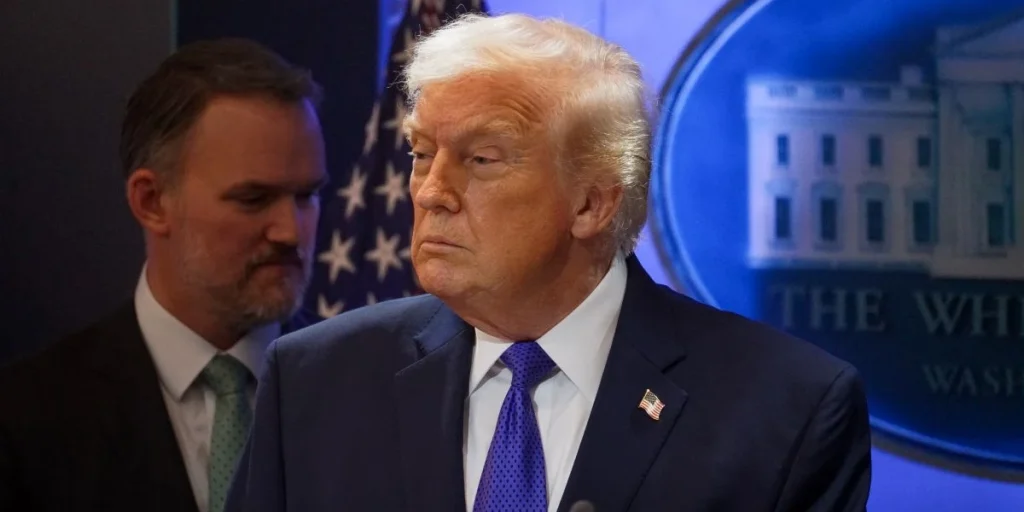
Trump’s numbers fall off a cliff as Americans fear his war will drag on.


Donald Trump is facing his weakest public support since returning to the White House, adding another problem for Republicans less than three months before voters decide control of Congress.
A new Reuters/Ipsos poll puts the president’s approval rating at 33 percent, the lowest recorded during his second term. Disapproval has climbed to 64 percent.
Public anxiety surrounding the US war with Iran appears to be contributing to the decline, with a large majority of Americans expecting American involvement to continue far longer than Trump initially suggested.
Trump returned to office in 2025 with approval from just under half of Americans. His numbers have since fallen considerably, with the latest result also matching the lowest rating recorded during his first presidency in December 2017.


Military action against Iran has become an increasingly difficult issue for the administration.
Trump initially indicated that the conflict would last only weeks after the United States joined Israel in strikes against Iran. Months later, Tehran has remained resilient, while disruption around the Strait of Hormuz has restricted a major artery for global oil supplies.
According to the poll, 80 percent of Americans believe US involvement will continue for an extended period. Concern crosses party lines, with 87 percent of Democrats and 71 percent of Republicans expecting a lengthy commitment.
Only 16 percent believe the conflict is likely to end within a few weeks.
Public support for the war itself is also limited. Roughly one in five Americans believes the conflict has been worth its costs, while only about half of Republican respondents share that view.
Higher fuel prices add to political pressure
Economic consequences from the conflict have created another challenge for Trump.
Disruption to oil shipments through the Strait of Hormuz has contributed to higher gasoline prices, putting additional pressure on household budgets after Trump campaigned on controlling inflation and lowering living costs.
Trump acknowledged the issue during a rally in Garden City, New York, on Friday, arguing that Americans paying “a tiny little bit more for your gasoline” was justified by efforts to prevent Iran from acquiring a nuclear weapon.
Voters appear increasingly dissatisfied with Republican economic management more broadly.
Recent Reuters/Ipsos polling has given Democrats an advantage on the economy for the first time in roughly a decade. According to the latest survey, 38 percent of voters believe Democrats have the better approach, compared with 35 percent who favor Republicans.
Democrats also hold an advantage when voters are asked which party is better positioned to handle the cost of living.
Immigration has remained one of Trump’s strongest political areas throughout his second term, supported by a sharp reduction in border crossings and his administration’s nationwide enforcement campaign.
Republicans’ advantage on the issue, however, has narrowed dramatically.
Forty percent of registered voters now prefer the Republican approach to immigration, compared with 38 percent who favor Democrats. The two-point difference represents the smallest Republican advantage recorded during Trump’s current presidency.
Republicans held a 26-point lead on the same issue in January 2025.
Recent controversies surrounding immigration enforcement, including deadly confrontations and growing numbers of detainees, have accompanied that erosion in public support.
Midterms loom over Republicans
Trump’s declining numbers arrive at a difficult moment for his party.
Republicans are preparing to defend their narrow House majority in the November 3 midterm elections, while Democrats increasingly view control of the Senate as potentially within reach.
Concerns over Iran, gasoline prices and household expenses now leave Republican candidates campaigning alongside a president whose approval rating has fallen from just under 50 percent at the beginning of his second term to 33 percent.
Trump has repeatedly alternated between suggesting that an agreement with Iran could be close and threatening further military escalation. Most Americans surveyed by Reuters/Ipsos, however, now expect the US commitment to last well beyond the timeframe originally presented by the president.



