
 Kenneth Glad

Modern tech firms constantly promise that smart software will soon take care of all our daily tasks. We hand over our writing chores, expect instant answers, and trust hidden systems to do the heavy thinking for us. Yet this bold dream of effortless brilliance is far older than Silicon Valley.


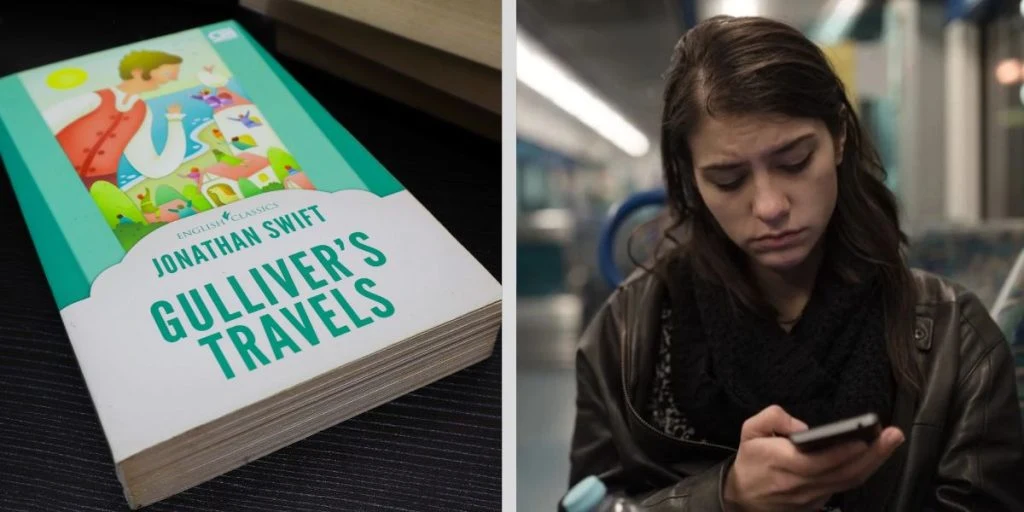
In an essay in The Conversation, Daniel Carey, a professor of English at the University of Galway and a specialist in early modern literature and intellectual history, points out that satirist Jonathan Swift predicted the rise of generative text three hundred years ago in his classic novel Gulliver’s Travels.
Carey highlights how Swift captured our current tech dilemmas long before digital computers existed. Published in 1726, the landmark book is best known for tiny islanders and towering giants, but its lesser-known third voyage directly satirizes the scientific ambitions of Swift’s contemporaries.
Gulliver’s often overlooked third journey features a fictional think tank called the Academy of Lagado. During this stop, the explorer tours a workshop where an eager professor oversees forty assistants operating a bizarre twenty-foot wooden frame.
The contraption was strung with wires and hundreds of dice-sized blocks, each pasted with snippets of vocabulary. When helpers spun forty iron handles, the words reshuffled at random, and workers scrambled to copy down any readable phrases.


Cheating hard study
The goal was simple. According to Swift’s text, the inventor claimed the machine let “the most ignorant person” easily write works of philosophy, poetry, politics, law, and theology without any talent or study. The creator even begged for cash to build five hundred more frames.
Carey argues this setup closely mirrors modern large language models. The eighteenth-century engine mechanically shuffled words to simulate deep thinking, churning out heaps of nonsense until an occasional useful phrase popped up.
Human scribes were stationed on site for six hours a day to throw out the garbage text. In that sense, early satire spotted a safeguard that today’s runaway tech often skips: Dedicated fact-checkers who catch digital hallucinations before they spread.
Swift saw through the illusion that random data could magically produce wisdom. In the end, we may have traded hand-cranked wooden dice for digital code, but the old shortcut remains entirely unchanged.
Echoes across centuries
Gulliver also witnessed other absurd experiments in Balnibarbi, including schemes to trap sunbeams from cucumbers and turn sewage back into fresh dinner. Swift drew direct inspiration from the quirky real-world scientists of the Royal Society of London.
While contemporary systems process vast digital databases instead of spinning physical dice, Carey notes the underlying illusion remains identical. Both operations rely on the passive belief that shuffling words together can miraculously replace human intelligence.
Modern users can ask specific prompts, a luxury missing from Swift’s hand-cranked frame. But whether guided by algorithms or mechanical levers, the core fantasy of avoiding intellectual toil endures.



