
 Jens Asbjørn Bøgen

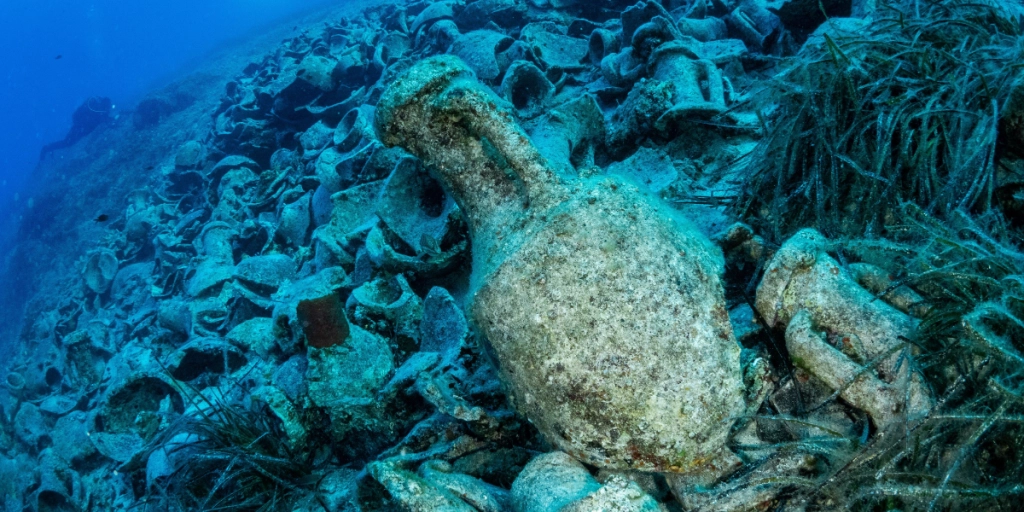
The ship is believed to have transported olive oil, wine and tree resin, but laboratory results are still pending.

Off a stretch of southern Turkey where limestone cliffs have swallowed ships for millennia, divers have surfaced with something unusual.
The wreck lies off Kekova, west of the resort city of Antalya, where Associate Professor Hakan Öniz of Akdeniz University first located it during a 2024 survey. No wooden hull has survived.
What remains on the seabed, roughly 100 feet below the surface, is a scatter of large storage jars and three heavy stone anchors, although the anchors are not yet confirmed to belong to the new-found wreck.
The pottery is what has turned the find into a potential rewrite of early seafaring. Writing in The Conversation, Macquarie University archaeologist Karin Sowada tentatively dates the wreck to between 2700 and 2400 BCE, roughly 4,500 years ago. That places the ship in the Early Bronze Age, contemporaneous with the builders of the Great Pyramid at Giza.


If the date holds, the Kekova vessel predates the wreck off Dokos in Greece, long considered the earliest known shipwreck at about 4,200 years old.
The cargo that gave it away
More than 20 of the amphorae have been studied so far, from a field of more than 30 flat-based jars with two handles. Many feature a raised horizontal clay belt around the widest part. Sowada told The Weekly Times that she believes the find is without peer: “I do think that we can say that this is the oldest shipwreck.”
The breakthrough came when Öniz’s team matched the amphora shapes to vessels pictured in Egyptian archaeological reports. “We later became excited when we saw the same amphora forms in a publication on Egyptian archaeology and returned to the site. Indeed, they were similar to those found at the Giza pyramids in Egypt,” he told the BBC.
Residue inside some jars points to olive oil, wine or tree resin, Archaeology magazine reported. One vessel carries nine markings and two drilled holes whose purpose is still being worked out.
Where it was headed
The team believes the roughly 30-foot ship was sailing from a Levantine port, in what is today Lebanon, Syria or Israel, bound for northwestern Turkey or Crete, when its crew tried to shelter in Kekova’s lee during a storm and was driven onto the rocks.
Sowada and Öniz have cautioned that dating and residue work is still unfinished. A full academic publication is expected after further seasons of excavation.



