Jens Asbjørn Bøgen

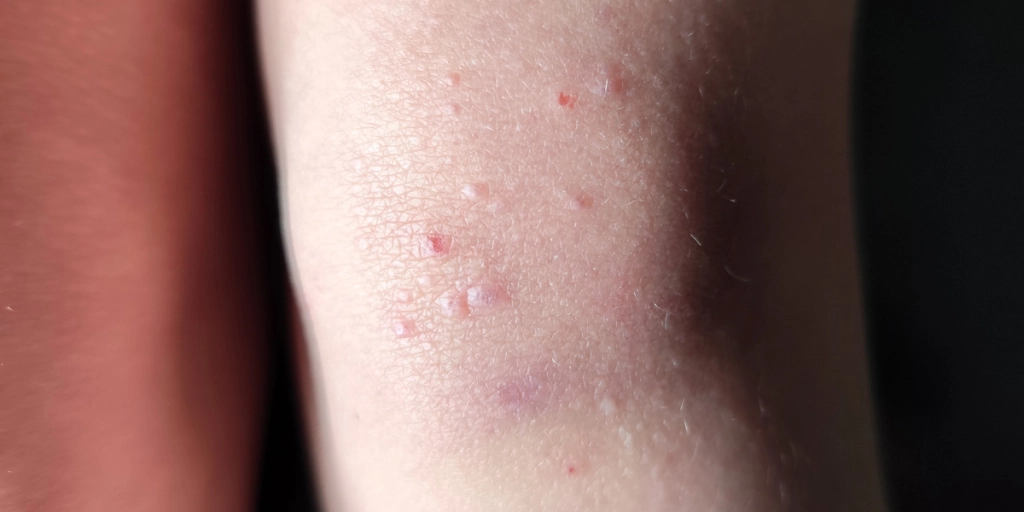
Of all the places a gene active in human neurons could end up, a common virus that causes childhood skin bumps is near the bottom of the list.


For decades, biologists have treated gene traffic between humans and viruses as a mostly one-way street, with viral DNA creeping into our genomes and sometimes sticking around.
The opposite direction, a human gene jumping out and settling into a virus, is far rarer, and when a research team went looking at a familiar skin pathogen, they did not expect to find what they found.
A gene normally active in the human brain has been detected inside the genome of molluscum contagiosum virus, the poxvirus behind the small, firm bumps that millions of children pick up each year.
The finding was published in Science on September 24, 2026, by researchers at Cornell University, Capital Normal University in Beijing and the University of Texas at Arlington.


The gene is BC200, which is expressed mainly in neurons and helps fine-tune protein production in the brain. According to the Cornell announcement of the study, the team identified two separate BC200 insertions in the virus, and traced each one to a different transfer event over primate evolution.
A gene that both works and still jumps
BC200 is unusual on its own. It descends from an ancient transposon, a so-called jumping gene, that integrated into a primate ancestor roughly 40 million years ago. Transposons that get domesticated for a cellular job normally lose the ability to move around.
That is what makes this one strange.
“BC200 was itself created from a mobile element but has retained its mobility and yet it is also clearly serving a cellular function,” senior author Cedric Feschotte, a professor at Cornell, explains. “Genes that come from transposable elements and that are repurposed for cellular functions are typically no longer transposable.”
In other words, the gene appears to be doing two things at once: holding down a role inside human cells, and still slipping into new addresses in the genome, including, at least twice, into the DNA of a human virus.
A childhood virus with a surprise inside
Molluscum contagiosum is familiar to most parents. The CDC describes it as a very common infection in the United States that mostly occurs in children ages 1 to 10, producing small raised bumps the size of a pinhead to a pencil eraser.
The lesions usually clear within six months to a year without scarring, and the virus spreads through skin contact or shared items like towels and toys.
That ordinary pathogen now looks a little less ordinary. The researchers suggest BC200 likely slipped into the virus while it was infecting skin cells, since those are the only cells the virus is known to infect, Cornell said.
Both insertions happened recently in evolutionary terms, within roughly the last 100,000 years, placing them inside the span of modern Homo sapiens.
Why biologists are paying attention
The result cuts against a standard assumption in molecular biology: that once a jumping gene is tamed into a day job, it stops jumping. BC200 appears to have kept both skills, and used one of them to escape its host.
There are health reasons to care, too. BC200 is abnormally active in some tumors and overexpressed in the brains of people with Alzheimer’s disease, according to Cornell.
If a gene with that kind of profile can still move between cells and between organisms, the mechanics of where it ends up become a biomedical question, not just an evolutionary curiosity.
The team’s paper, led by graduate student Pu Gao with Feschotte, Cheng Sun of Capital Normal University and Ellen Pritham, is titled “Escape of the BC200 gene to a human poxvirus reveals its persistent transposition in primates” and appears in the September 24 issue of Science.