
 Nicolai Haugsted

Trump faces ridicule after suggesting that his latest audience was considerably smarter than the crowds he usually addresses.
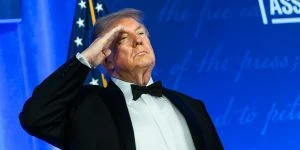

Donald Trump has never been particularly shy about discussing intelligence, especially when the subject is his own.
The president has repeatedly boasted about his intellectual abilities, frequently comparing himself favorably with political opponents and other public figures.
But during a ceremony honoring some of America’s most influential technology executives, Trump offered a compliment that quickly raised an awkward question about the people who usually attend his events.
His praise for the audience at the US Institute of Peace came with a qualification that social media users were quick to notice.


Trump praises audience with a questionable compliment
Thursday’s ceremony brought together prominent figures from the American technology industry as Trump presented medals to six business leaders.
The president appeared particularly impressed by the people gathered in the room.
“But we have an extremely high IQ audience for a change. For a change. It’s very nice,” Trump declared according to The Mirror.
The repeated phrase “for a change” immediately attracted attention.
Although Trump did not identify which previous audiences he was comparing with the gathering, critics interpreted his remarks as an unflattering reference to the crowds he regularly addresses at political rallies.
Social media users wasted little time pointing out the possible implication.
“Wow. And all of his supporters that he’s implying are low IQ will prove he’s correct by continuing to support him and still vote for him,” one X user wrote.
Another commenter drew a direct comparison with the president’s recent campaign appearance in Texas.
“Unlike the audience he spoke to in San Antonio,” the user remarked.
A third offered a similarly pointed interpretation.
“Trump complimented the room by insulting every other room he’s been in lately,” the person wrote.
The remarks did not explicitly describe Trump’s supporters as unintelligent, but the wording provided critics with an opportunity to question what the president thought of his usual audiences.
Elon Musk receives extraordinary praise
The event itself was intended to celebrate prominent figures whose work Trump credited with benefiting the United States.
Among the six recipients were Elon Musk, Dell Technologies founder Michael Dell, Google co-founder Sergey Brin, Microsoft CEO Satya Nadella, AMD chief executive Lisa Su and Nvidia CEO Jensen Huang.
Trump reserved some of his strongest praise for Musk, who previously headed the administration’s Department of Government Efficiency.
“Few Americans in history have done more to advance America’s national interest than Elon,” Trump said.
The president also described Musk as “our modern-day Thomas Edison.”
The comparison placed the billionaire entrepreneur alongside one of America’s most famous inventors.
Musk’s appearance was particularly notable given his previous role in the Trump administration and his prominence in the technology industry.
Trump’s own intelligence claims return to the spotlight
The controversy surrounding Thursday’s remarks also revived attention to Trump’s longstanding habit of discussing IQ.
During a separate campaign appearance in Ohio, the president again presented himself as exceptionally intelligent.
The rally was held as Trump promoted Republican candidates, including Senate hopeful Jon Husted and gubernatorial candidate Vivek Ramaswamy.
Trump urged supporters to “pretend I’m running” as he encouraged them to turn out for the midterm elections.
His speech also included another declaration about his intellectual abilities.
“I said, ‘Wow’. Nobody saw it but me. I’m very proud of it. It was very intelligent, very. I’m a high-IQ person, unlike some other people I can tell you about. Very,” Trump told the audience.
The president then introduced a number that created further confusion.
“Among the highest IQs anywhere in the world: 1775. And I said, you know, if we can scrape up $1 more, we’ll be at 1776. And that’s what we did.”
The figures appeared to refer to a financial amount rather than an actual intelligence test result.
Trump did not provide a verifiable IQ score in the remarks quoted by the report.
Commentators question bizarre numerical claim
The president’s comments subsequently attracted attention from commentators on The Daily Beast’s podcast.
Host Joanna Coles questioned the numerical reference, observing that “1775 is not an IQ score.”
Her co-host, David Rothkopf, responded with sarcasm.
“Well, it is for Donald Trump. If you’re the smartest person out there and your uncle went to MIT, you could have any score you want. No, you can’t,” Rothkopf said.
He continued by challenging the idea that the number could represent a conventional IQ test result.
“Actually, to be specific, you can’t have an IQ score above 160. The tests don’t actually go above 160. So this is, you know, more than 10 times that.”
That description was broader than the reality of IQ testing, since different tests use different scoring ranges and some allow scores above 160.
Coles characterized the president’s remarks as “insanity.”
Rothkopf suggested that Trump might instead have been referring to the $1,776 “Warrior Dividend” announced for approximately 1.45 million American service members in December 2025.
The commentator then offered a considerably less charitable assessment of the president’s remarks.
“All the synapses in his brain no longer connect. And so, you know, what you’ve got is a guy who, between his ears, has, like a bubbling cauldron of Campbell’s, you know, of Campbell’s cream of idiot soup,” Rothkopf said.
“And you never know what it’s going to bubble up,” he added.
Those comments were Rothkopf’s personal criticism, rather than a medical assessment of Trump’s cognitive health.



