
 Asger Risom

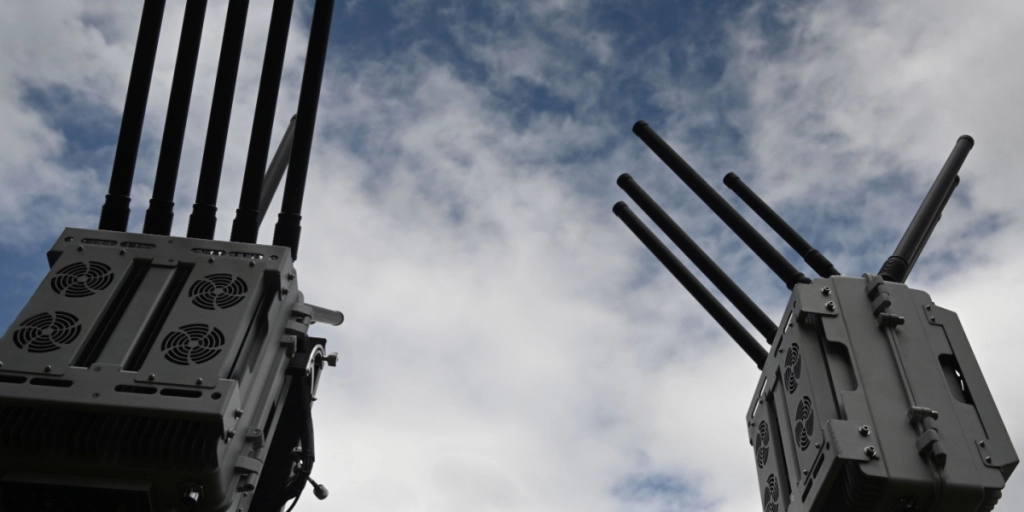
The entire modern world relies on GPS, but the satellite signals are surprisingly weak and easily jammed by electronic warfare. To solve this critical vulnerability, the defense sector is prototyping “quantum compasses.” By using lasers to cool atoms near absolute zero and measuring their microscopic wave shifts during movement, physicists are creating a self-contained, completely unjammable navigation system that operates entirely independent of satellites.


We take the global positioning system for granted. You pull out your phone, type in a destination, and a network of satellites orbiting 12,000 miles above the Earth instantly pinpoints your exact location. The entire modern world runs on this invisible grid. It tracks our cargo ships, guides commercial airplanes, and coordinates global banking transactions.
The terrifying problem is that GPS is incredibly fragile. The radio signal beaming down from space is surprisingly weak by the time it reaches the surface. Anyone with a cheap, commercially available radio jammer can easily drown it out. In modern conflict zones, adversarial militaries regularly spoof these signals, beaming fake coordinates to confuse incoming drones or send ships wildly off course.
To fix this massive vulnerability, the defense sector is trying something radical. Instead of launching better satellites, physicists are building quantum compasses. They are creating a foolproof, self-contained navigation system that does not need to look at the sky to figure out exactly where it is.
The problem with space-based directions
To understand why we need a quantum alternative, you have to look at how a standard GPS actually works. Your phone does not send a signal to space; it just listens. It picks up time-stamped radio pulses from multiple satellites and calculates how long those pulses took to arrive. By triangulating the difference, it figures out your location.


Because the system relies entirely on external communication, it has a glaring single point of failure. If you block the signal, the system goes blind. For a civilian, a dropped signal means missing a highway exit. For a military operation, a severed GPS connection means autonomous vehicles crash, precision munitions miss their targets, and naval ships lose their bearings.
The defense industry realized they could not win the electronic warfare battle by just boosting satellite power. They needed a way for a vehicle to know its own location without ever talking to the outside world.
Navigating with cold atoms
The solution sounds like pure science fiction, but it relies on basic quantum mechanics. A traditional compass uses the Earth’s magnetic field to find north. A quantum compass uses ultra-cold atoms to measure physical acceleration.
Inside one of these devices, a vacuum chamber holds a small cloud of atoms. The system fires highly calibrated lasers at these atoms to slow them down, dropping their temperature to just a fraction of a degree above absolute zero. At that extreme temperature, atoms start behaving strangely. They act as both solid particles and waves.
If the vehicle carrying the compass moves even a millimeter, that physical acceleration alters the wave properties of the freezing atoms. By continuously measuring those microscopic quantum changes, the onboard computer knows exactly how fast the vehicle is moving and in what direction. Because the system is entirely self-contained inside a sealed box, there is no radio signal to hack, jam, or spoof. It is mathematically immune to electronic warfare.
Shrinking the laboratory
Until very recently, this technology was restricted to massive university physics labs. The equipment required to cool atoms to absolute zero historically filled an entire room and required immense amounts of power. But a massive engineering push is currently shrinking that hardware down to a deployable size.
As outlined in a recent roadmap from Lockheed Martin, defense contractors are aggressively prototyping quantum inertial sensing to act as a resilient baseline for military operations. When GPS goes down, the quantum system instantly takes over, providing pinpoint accuracy in highly contested environments.
This is already moving out of theoretical development and into active field testing. This year, the quantum technology firm Q-CTRL successfully demonstrated a GPS-free quantum navigation system on a maritime vessel, proving that the hardware can withstand the harsh, chaotic movement of the open ocean.
We spent the last few decades looking up at the sky to figure out where we were going. Now, the future of navigation is looking inward, relying on a box of freezing atoms to keep the world moving.



