
 Asger Risom

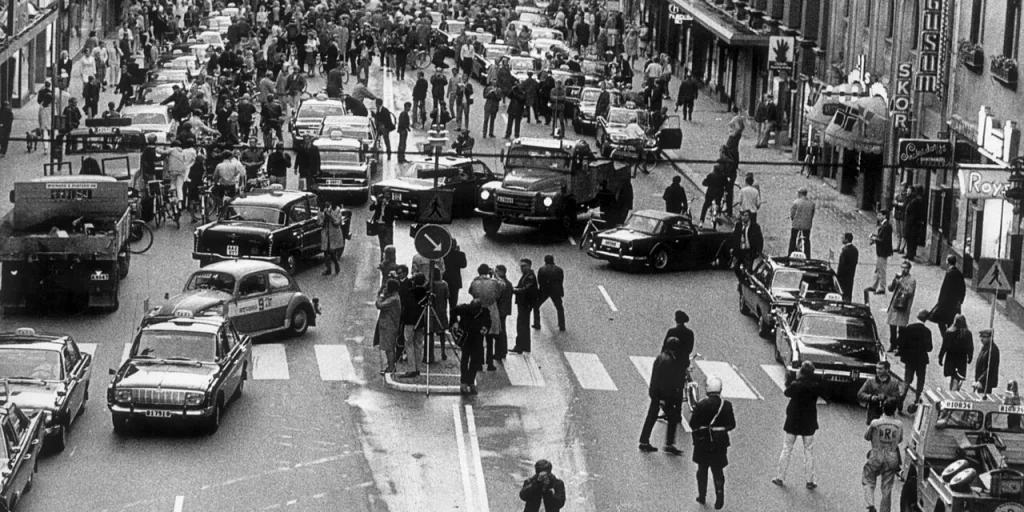
On September 3, 1967, Sweden pulled off one of the most audacious logistical feats in automotive history by switching the entire country from driving on the left to driving on the right in a single morning. Known as Dagen H, the transition required reconfiguring hundreds of thousands of road signs, replacing bus fleets, and executing a five-hour driving freeze that briefly ended decades of blind overtaking accidents.


Driving down the road requires an invisible layer of muscle memory. You turn the wheel, glance at your mirrors, and trust that oncoming traffic will stay on its side without having to consciously think about it. In 1967, Sweden decided to wipe that muscle memory clean for an entire nation between midnight and breakfast.
The dangerous paradox on Swedish roads
For decades, Sweden was an oddity in continental Europe by insisting on driving on the left side of the road. That setup became increasingly hazardous as post-war travel boomed and border crossings with Norway and Finland surged into the millions each year. Foreign motorists would cross an unmarked boundary and suddenly find themselves staring down oncoming traffic in the wrong lane.
The domestic fleet made the problem even more dangerous. Nearly ninety percent of Swedish motorists drove cars with the steering wheel positioned on the left, whether bought from abroad or built locally by Volvo. That meant when a driver wanted to overtake a slow lorry on a narrow two-lane road, they had to edge almost the entire car into the oncoming lane just to see past it.
Head-on collisions climbed steadily, yet the voting public wanted nothing to do with a change. In a 1955 national referendum, more than eighty percent of Swedish voters rejected a proposal to switch to right-hand traffic. Eight years later, parliament recognized the mounting road toll, ignored the referendum, and set a firm deadline for the autumn of 1967.


The four-year logistical build-up
Pulling off the transition required an unprecedented peacetime mobilization of civil engineers, psychologists, and local councils. As reported by the BBC, work crews had to swap or reconfigure roughly 360,000 road signs across the country. Road crews installed brand-new signs months in advance, covering them with heavy black plastic until the changeover hour arrived.
Public transit posed a far more expensive mechanical headache. Municipal buses were built with passenger doors on the left, which would have dumped riders directly into traffic lanes once the switch took place. Transit agencies spent millions ordering replacement fleets with right-side doors and retrofitting thousands of existing buses before the deadline.
Meanwhile, government planners launched a massive public relations campaign to reprogram the instincts of every citizen. The official Dagen H logo appeared everywhere from milk cartons and coffee cups to packs of men’s socks. Pop musicians even recorded catchy radio tunes to remind drivers to stick to the right side of the road when the day arrived.
Five hours of standstill
The actual transition was scheduled for the early morning of Sunday, September 3, 1967. To keep the streets clear for work crews, the government banned all non-essential driving nationwide starting at one in the morning. For five hours, the only vehicles on Swedish roads were emergency services, military trucks, and municipal crews peeling black tape off traffic signs.
The few drivers permitted on the road faced an exact mechanical sequence at ten minutes to five. Every moving vehicle had to come to a complete halt on the left side of the street and wait. At precisely five in the morning, drivers slowly steered across the centerline to the right side and paused again for another ten minutes.
At six in the morning, the general driving ban lifted, and regular motorists ventured onto the redesigned streets. In central Stockholm, crowds of cyclists, pedestrians, and curious drivers created brief gridlock as they navigated the new intersections. Yet despite the initial confusion, the catastrophic pileup critics had predicted never materialized.
The paradox of cautious driving
Insurance companies and hospital wards had braced for a surge in severe injuries on the morning of the changeover. Instead, the country recorded only 157 minor traffic accidents on the day of the switch, none of them fatal. Police departments across Sweden reported that driving behavior was dramatically calmer than on an ordinary weekend.
The explanation came down to basic human psychology and heightened risk perception. Because drivers could no longer rely on autopilot, they slowed down, left wider gaps, and paid intense attention to their surroundings. Accident rates remained substantially below historical averages for several months following the switch.
Eventually, as the new driving pattern became second nature, collision rates climbed back toward normal levels. But the physical restructuring permanently eliminated the hazard of overtaking blind in left-hand-drive cars. Five hours of coordinated logistics had cured one of Europe’s strangest automotive contradictions.



