
 Asger Risom

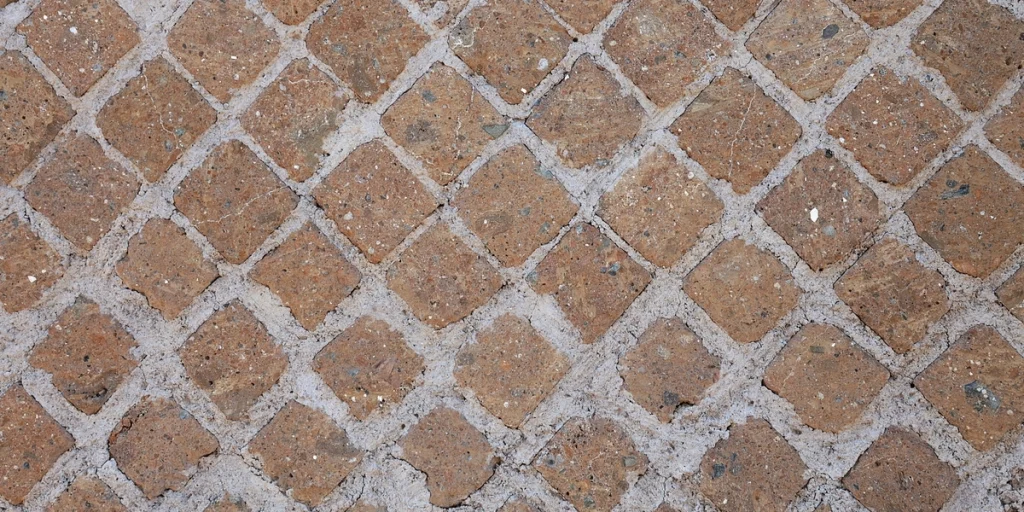
For generations, the white mineral flecks scattered throughout ancient Roman concrete were dismissed as the sloppy mistakes of careless laborers. Chemical mapping reveals those lumps were deliberate: by using a violent “hot mixing” technique with dry quicklime, Roman builders left reactive calcium reservoirs inside the mortar that dissolve and recrystallize when water enters a crack, automatically sealing damage before it spreads.

Walk into the Pantheon in Rome, look up at the massive coffered ceiling, and you are staring at a structural impossibility. Cast nearly two thousand years ago, it remains the largest unreinforced concrete dome on Earth. Roman sea walls and harbor piers have spent two millennia submerged in corrosive saltwater, yet they are structurally sounder today than when workers first poured them.
Compare that to modern infrastructure. Highway overpasses, seawalls, and apartment towers built with state-of-the-art Portland cement routinely crack, pit, and shed concrete within fifty to one hundred years.
Geologists and archaeologists spent generations arguing over what made ancient Roman mortar so absurdly resilient. Many pointed to volcanic ash imported from the Bay of Naples, while others credited careful compaction. But whenever engineers examined Roman mortar under a magnifying glass, they noticed ubiquitous, millimetric white mineral chunks scattered throughout the gray paste.
Those white flecks were long dismissed as sloppy craftsmanship—the ancient equivalent of cutting corners and failing to stir the mix properly. It turns out those lumps were not a mistake. They were a built-in automated repair system.


The myth of the sloppy mason
To make modern concrete, plants bake limestone and clay in massive kilns to create Portland cement, grind it into a fine powder, and blend it with water, sand, and gravel. The mixing process is strictly monitored: raw ingredients must be perfectly uniform, free of clumps, and precisely hydrated to ensure an even cure.
Because modern standards treat lumps as structural flaws, historical scholars assumed Roman builders were simply careless. The prevailing consensus was that Roman masons made mortar using “slaked lime”—calcined limestone that had been pre-mixed with water to form a smooth, paste-like calcium hydroxide before being added to volcanic pozzolana ash and aggregate. Under that theory, the chalky white chunks, known as “lime clasts,” were just leftover bits of limestone that never dissolved.
The math did not sit right with materials scientists. The Romans were meticulous record keepers and obsessive engineers who codified exact mortar recipes and built infrastructure designed to endure. It made little sense that every surviving structure across the empire would feature the exact same mixing mistake.
The violence of hot mixing
Researchers at MIT, Harvard, and laboratories across Italy analyzed mortar samples from a 2,000-year-old city wall in Privernum using high-resolution multiscale imaging and chemical mapping. As detailed by MIT News, the chemical composition of those white clasts told an entirely different story.
The white pebbles were not unmixed slaked lime. They were formed at blistering, scorching temperatures.
Instead of taking the safe route and pre-slaking their lime with water, Roman crews engaged in a technique called “hot mixing.” They dumped dry, unslaked quicklime (calcium oxide) directly into a slurry of volcanic ash, sand, and water on the construction site.
Quicklime reacts violently with water. The moment the dry minerals hit liquid, a fiercely exothermic chemical reaction kicks off, generating immense heat that boils the water and drives the internal temperature of the paste past 200°C (392°F).
This extreme thermal burst fundamentally alters the chemistry of the mortar. It forces the formation of rare, high-temperature compounds that cannot form at ambient temperatures. More importantly, because the reaction happens so quickly, not all of the quicklime dissolves. Small pockets dry out into brittle, porous, calcium-rich white reservoirs that remain permanently distributed throughout the hardened concrete.
How water turns a crack into a scab
In modern concrete, a hairline fracture is a slow death sentence. Ground settlement, freeze-thaw cycles, and heavy traffic inevitably crack the surface. Water creeps into those fissures, freezes, expands, and widens the gap. If the concrete is reinforced with steel rebar, moisture rusts the metal, causing it to expand and blow the surrounding concrete apart from the inside out.
Roman concrete operates under the exact opposite rule: water is the trigger that fixes the damage.
Because the embedded lime clasts have a fragile, porous structure, any microscopic crack that begins to spread through the concrete naturally takes the path of least resistance. It travels straight through the brittle white clasts, splitting them open.
The moment water enters that newly opened crack, it comes into contact with the freshly exposed calcium inside the clast. The clast immediately begins to dissolve, saturating the water with calcium ions.
As this calcium-rich solution meets carbon dioxide in the air or water, it triggers a fast recrystallization process. The dissolved minerals transform into solid calcium carbonate (calcite), sealing the fissure shut like a mineral scab.
The reaction happens fast. In laboratory stress tests, researchers deliberately cracked blocks of hot-mixed concrete, ran water over the fractures, and observed the fissures sealing completely within two to three weeks. The repaired blocks regained full structural strength, stopping the flow of water in its tracks.
Rethinking modern infrastructure
Modern builders spent the better part of two centuries optimizing concrete for short-term compressive strength and rapid assembly, treating cement as a disposable skin to wrap around structural steel.
The cost of that design choice is catching up with us. Concrete production accounts for roughly eight percent of global greenhouse gas emissions, largely because the world constantly has to demolish and repour aging bridges, dams, and highways.
By looking back at the deliberate chemical chaos of Roman job sites, materials engineers are beginning to formulate self-healing cements for modern construction. Instead of fighting moisture and structural cracks with chemical sealants and eternal patching, the smartest way forward may simply be embedding the cure right into the stone.



