
 Asger Risom

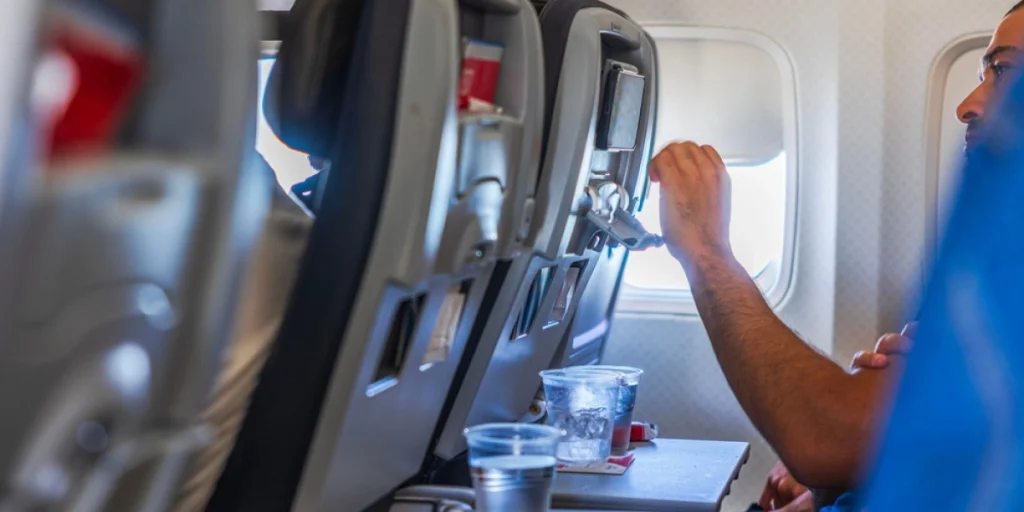
Airline food has a reputation for tasting bland and rubbery, but the real failure happens inside the passenger’s own sensory biology. The combination of desert-dry cabin air, low barometric pressure, and eighty-five decibels of background engine roar cuts sweet and salty taste perception by thirty percent while amplifying savory umami.


You settle into your window seat, the beverage cart rolls into the aisle, and people who would never touch a can of tomato juice on the ground suddenly order a cup on ice. That quirk is backed up by passenger research, which found that nearly a quarter of travelers who order tomato juice in flight never drink it on the ground. What looks like an unprompted craving is actually an involuntary biological reaction to an environment that scrambles how human senses process flavor.
The desert inside the cabin
At cruising altitude, commercial jet cabins are pressurized to simulate an elevation of roughly six to eight thousand feet above sea level. That drop in atmospheric pressure expands gases and slightly reduces oxygen saturation in your bloodstream, dulling your sensory receptors. At the same time, the plane’s environmental control systems pump in freezing outside air that contains virtually zero moisture.
By the time an aircraft reaches cruising altitude, cabin humidity regularly plummets below twelve percent, making the air drier than most deserts. Your body loses moisture rapidly through respiration and skin evaporation, drying out your tongue and throat. Because taste buds rely on saliva to break down food molecules and wash them into receptor pores, your palate cannot register flavors with its usual precision.
The bigger casualty of that dry air is your sense of smell. Up to eighty percent of what humans interpret as complex flavor is actually aroma traveling through the back of the throat to olfactory receptors. When nasal mucus membranes dry out in the arid cabin breeze, those receptors go offline, reducing even a well-seasoned dish to a flat, muted paste.


Losing a third of your palate
The sensory breakdown at high altitude is not an across-the-board collapse. In a landmark study commissioned by German airline Lufthansa, researchers at the Fraunhofer Institute placed volunteers inside a pressurized test fuselage to measure how flavor perception shifts at altitude. The results explained why standard restaurant recipes taste entirely hollow the moment the cabin doors seal.
As reported by BBC Future, the mix of low pressure and desert-dry air cuts your sensitivity to saltiness and sweetness by roughly thirty percent. That means an entrée seasoned to perfection on solid ground tastes under-salted and bland by the time it reaches your seat. To compensate, in-flight kitchens must heavily oversalt and sweeten their sauces just to make them register as normal.
Sour, bitter, and spicy notes, on the other hand, barely suffer any decline at altitude. Sharp vinegar dressings, pungent mustard, and fiery chili compounds cut through the thin air with their original intensity intact. That uneven drop creates an awkward imbalance where delicate herbs and subtle seasonings disappear, leaving only harsh acidity or raw heat behind.
Engine noise messes with your tongue
The environment working against your dinner is not just atmospheric; it is also acoustic. A cruising airliner generates a steady mechanical drone hovering around eighty-five decibels, driven by turbofan engines, airflow over the fuselage, and roaring air conditioning packs. That constant wall of background sound does more than cause fatigue; it actively interferes with how your brain decodes flavor.
Multisensory perception studies reveal that loud background noise acts as an auditory distraction that muffles basic tastes. When people eat while exposed to loud white noise through headphones, they consistently report that sweet and salty dishes taste significantly weaker than in quiet rooms. The brain expends so much cognitive bandwidth filtering out the persistent roar that it ignores subtle gustatory cues.
Yet engine drone does something entirely different to one specific taste receptor: it actually highlights umami. The deep, savory taste triggered by glutamates—found in soy sauce, aged hard cheeses, mushrooms, and slow-simmered meats—stands up remarkably well against loud background sound. While sweetness and saltiness fade into the white noise, savory flavors hold their ground and punch through clearly.
Why tomato juice wins at altitude
That acoustic and atmospheric shift explains the sudden appeal of the drink cart’s most polarizing option. Ripe tomatoes are packed with naturally occurring glutamates, giving tomato juice a powerful hit of savory umami that does not depend on refined sugar to taste good. On solid ground, many people find plain tomato juice thick, heavy, and unpleasantly acidic.
Thirty thousand feet in the air, the dry cabin air smooths over that harsh acidity while the background noise emphasizes the rich, savory notes. Lufthansa famously discovered that its passengers consumed roughly 1.8 million liters of tomato juice annually, nearly matching its onboard beer consumption. Travelers were not having an unprompted craving; their altered biology was simply finding a drink that actually tasted flavorful under pressure.
Airline catering teams have gradually stopped trying to fight the cabin environment and started cooking around it. Instead of delicate pan sauces and subtle seasonings that dry out and vanish into cardboard, modern long-haul menus lean heavily on curries, braised stews, and citrus marinades. Until aircraft fuselages can sustain sea-level humidity without rusting, the sky will always belong to bold spices and tomato cans.



