
 Nicolai Haugsted

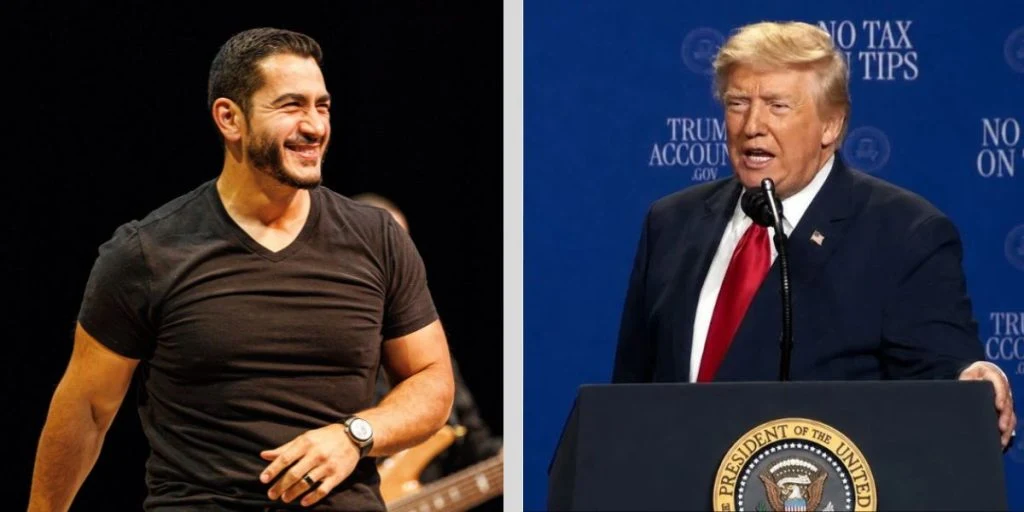
Trump gets a surprising offer from the newly elected senator he previously branded a jihadist.

Donald Trump has spent much of the midterm election campaign attacking his Democratic opponents, but the results have left him facing a very different political landscape. With Democrats securing control of both chambers of Congress, the president will have to navigate a divided Washington during the remaining two years of his presidency.
Finding common ground with his political opponents could become increasingly important, particularly on controversial foreign policy issues. And one newly elected Democratic senator has already identified an area where he believes cooperation with Trump might be possible.
The surprising part is that the president recently accused the same politician of having ties to Islamic extremism. Abdul El-Sayed, Michigan’s newly elected Democratic senator, has expressed support for Trump’s proposal to eliminate $4 billion in American assistance to Israel.
According to The Independent, El-Sayed is even prepared to work directly with the president to make it happen.


The unexpected agreement comes just days after an election campaign during which the two men exchanged particularly personal attacks.
Democratic senator offers to work with Trump
El-Sayed, who defeated Republican Mike Rogers in Michigan’s Senate race, has been a vocal critic of Israel’s military campaign in Gaza.
The Democrat has repeatedly described Israel’s actions as genocide, an accusation that the Israeli government strongly rejects.
During an appearance on MS NOW’s Morning Joe on Thursday, El-Sayed was asked about Trump’s recent announcement that the United States would stop providing $4 billion in assistance to Israel.
Despite their political differences, the senator-elect welcomed the proposal.
He said he would “love to work with him on doing that.”
El-Sayed went on to explain why he believes Washington should reconsider its military relationship with Israel.
“I don’t think we should be continuing to subsidize a foreign military that has done the worst things with our money,” he said.
“In fact, I don’t know that we should be continuing to sell weapons to a country that is, again, using our weapons to do awful things.”
His comments reflect his longstanding opposition to American military support for Israel during the Gaza conflict.
However, El-Sayed’s willingness to cooperate with Trump does not suggest a broader political alliance.
The two politicians remain sharply divided on numerous issues, and their recent exchanges demonstrate just how contentious their relationship has been.
Trump claims Israel no longer needs American assistance
The president announced his proposal during an appearance on Fox News’ Fox & Friends on Tuesday, as Americans were voting in the midterm elections.
Speaking with host Brian Kilmeade, Trump argued that Israel no longer required the financial assistance it had previously received from Washington.
“Why? Because they don’t need it, Brian. I mean, I asked them, because they don’t need it. And because why should we suffer the slings from lunatics like El-Sayed when they don’t need it,” Trump said.
The president also suggested that continued assistance had become politically difficult to defend.
“It is a bad talking point. Because when you say, ‘Why don’t we give everybody $4 billion?’ Israel is our number one. We give them more than anybody else, and they no longer need it.”
Trump maintained that the decision had been discussed with Israeli Prime Minister Benjamin Netanyahu.
According to the president, Netanyahu himself suggested that Israel should no longer receive the assistance.
“He brought it up, he said, ‘I think it would be appropriate if we do not receive aid,'” Trump explained.
The comments represent a potentially significant change in Washington’s approach to financial assistance for one of its closest Middle Eastern allies.
However, the precise implementation of the proposal remains unclear.
American assistance to Israel involves established funding arrangements and congressional authority, meaning the president’s announcement does not necessarily settle every legal or budgetary question surrounding the proposed reduction.
With Democrats preparing to control Congress, any legislative changes could require negotiations between lawmakers and the White House.
El-Sayed’s support suggests that the proposal could attract backing from at least some Democrats who have criticized Israel’s conduct in Gaza.
El-Sayed draws a distinction between Israel and Jewish people
During his television appearance, the senator-elect also addressed the broader debate surrounding criticism of Israel.
El-Sayed emphasized that his opposition to the Israeli government’s military actions should not be confused with hostility toward Jewish people or Judaism.
“We have to separate between Judaism and the Jewish people and Israel and its actions. We have to,” he said.
The distinction has become an important part of political discussions surrounding the war in Gaza.
Criticism of Israeli government policy, allegations of antisemitism and concerns about the treatment of Palestinians have generated heated disagreements across American politics.
El-Sayed argued that the ultimate objective should be a future in which both Palestinian and Israeli children can live without fear of violence.
“We have broken our own principles when it comes to Israel time and again. And I want to have a conversation; I’ll stop here, where a Palestinian child and a Jewish-Israeli child growing up in the Holy Land can look forward at their life and say, ‘my life is not going to be curtailed by somebody’s violence,'” he said.
He concluded by asking, “How do we get there?”
His remarks placed the proposed aid reduction within a broader discussion about American foreign policy and the prospects for peace.
El-Sayed has accused Israel of genocide, but Israel denies that its military campaign amounts to genocide and disputes the allegations against it.
The disagreement remains central to international debates over the conflict.
Trump previously accused El-Sayed of extremism
The prospect of cooperation between the two politicians is particularly striking given Trump’s rhetoric during the election campaign.
While supporting Republican candidate Mike Rogers in Michigan, the president repeatedly attacked El-Sayed.
At one campaign event, Trump described the Democrat as a jihadist and accused him of belonging to the Muslim Brotherhood.
“I’m here to keep a Jihadist Muslim Brotherhood member from becoming a United States senator,” Trump declared.
The president also suggested that El-Sayed should be required to pass through metal detectors when entering the US Capitol if elected.
El-Sayed has strongly denied having any connections to the Muslim Brotherhood.
The allegations were presented without substantiated evidence, and Trump’s comments attracted attention because of their focus on the candidate’s Muslim identity.
The Michigan Democrat nevertheless won the election, securing a Senate seat despite the president’s attacks.
His victory will also carry historical significance.
When El-Sayed takes office in January, he is set to become the first Muslim to serve in the United States Senate.
That milestone adds another dimension to the political confrontation between the president and the senator-elect.
El-Sayed had a message for Trump after winning
The Michigan Democrat did not ignore Trump’s campaign attacks during his election-night celebrations.
Following his victory over Rogers, El-Sayed used his speech to address the president directly.
His response was considerably shorter than Trump’s campaign accusations, but it carried a pointed message.
“I know you struggle with my name, so after [Vice President] JD [Vance] swears me in in January, you can just go on and call me senator,” he said.
The remark drew attention to Trump’s repeated criticism of his candidacy while emphasizing that voters had elected him despite those attacks.
Just days later, El-Sayed was publicly expressing a willingness to cooperate with the same president.



