
 Nicolai Haugsted

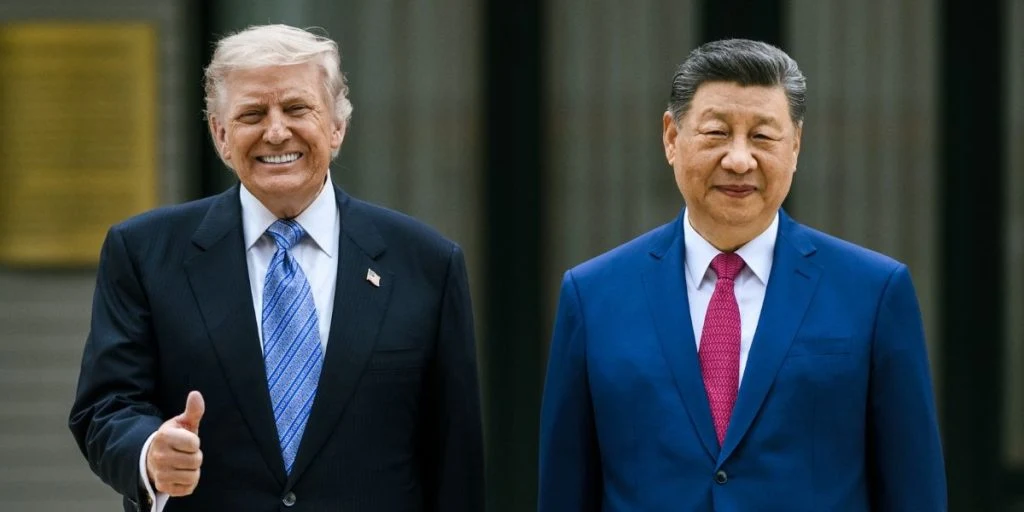
Trump’s weakened political position may hand Beijing valuable leverage over Washington.


Beijing has spent much of Donald Trump’s second presidency trying to manage an unpredictable relationship with Washington.
Trade disputes, threats of new tariffs and disagreements over Taiwan have repeatedly tested relations between the world’s two largest economies. Yet despite the tensions, Chinese officials have also found opportunities to negotiate with an American president who appears increasingly interested in maintaining a working relationship with President Xi Jinping.
The political landscape in Washington has now changed considerably. Following the Republicans’ sweeping defeat in Tuesday’s midterm elections, Democrats are preparing to take control of both chambers of Congress, leaving Trump with a significantly more complicated domestic political situation.
For China, the consequences could be substantial. According to Reuters, analysts believe Trump’s weakened political position may give Beijing additional leverage in upcoming trade negotiations, potentially allowing Xi to secure concessions that would previously have been more difficult to obtain.


But the apparent opportunity comes with a catch.
China may have more room to negotiate with Trump over the next two years, while simultaneously facing the possibility that his eventual successor will adopt a much tougher approach toward Beijing.
China could benefit from Trump’s political troubles
The Republican defeat has raised questions about how aggressively Trump can pursue his trade agenda during the remainder of his presidency.
American voters have expressed growing frustration with living costs, an issue that analysts say has been aggravated by the administration’s tariffs and trade disputes.
Trump’s trade policies have been particularly confrontational toward China.
After returning to the White House in 2025, he imposed tariffs reaching triple-digit levels on Chinese goods, arguing that the trade imbalance between the two countries was harming American interests.
The president described the situation as “killing” the United States.
However, his approach has become noticeably less confrontational in recent months.
High-profile meetings with Xi in Beijing and Washington have helped stabilize diplomatic relations, although the summits produced relatively few substantial economic agreements.
With Democrats now controlling Congress, analysts believe Trump may be even more reluctant to jeopardize that fragile stability.
Beijing could interpret his domestic political difficulties as evidence that Washington has more to lose from another trade confrontation.
Craig Singleton, a senior fellow at the Foundation for Defense of Democracies, told Reuters that Chinese negotiators may conclude Trump needs an agreement more urgently than Xi does.
Such an assessment could encourage Beijing to demand larger tariff reductions and additional concessions.
However, Singleton also warned that excessive confidence could lead to a “miscalculation that unsettles the very stability Xi is trying to preserve.”
In other words, China could find itself holding a stronger negotiating hand without necessarily being able to play every card.
Xi Jinping has two important meetings ahead
The next major test of the relationship is approaching quickly.
Trump and Xi are expected to meet later this month during the Asia-Pacific Economic Cooperation summit in Shenzhen.
Another meeting is planned for December, when the leaders are scheduled to attend the G20 summit in Miami.
Both gatherings will take place before the current US-China trade truce expires in January.
The agreement helped prevent a potentially severe disruption to the global economy last year, providing both countries with breathing room after a period of escalating tariffs.
Maintaining that arrangement has become an important priority for businesses and investors exposed to trade between the two economic powers.
The midterm results could complicate Washington’s negotiating position.
Trump faces pressure to demonstrate that his economic policies are delivering benefits to American households, particularly after an election dominated by concerns about affordability.
Xi, meanwhile, may see an opportunity to obtain more favorable terms without provoking another costly confrontation.
Wu Xinbo, a professor at Shanghai’s Fudan University who advises China’s Foreign Ministry, believes the election result could make Trump particularly cautious about disturbing the relationship.
The president’s remaining time in office also creates incentives to pursue diplomatic achievements that he can present as successes.
For Beijing, that could open the door to negotiations extending well beyond tariffs.
China knows Trump will not remain president forever
Despite the potential short-term benefits, Chinese officials and analysts are also considering what happens after Trump’s presidency.
The next American administration could prove considerably less accommodating toward Beijing.
Shen Weizhong, a former Chinese Foreign Ministry official who now works at the Beijing-based Global Governance Institution, emphasized that Chinese policymakers are aware of the uncertainty.
“The Chinese are very realistic that a new president might be very different (from Trump),” Shen told Reuters.
He suggested that even a temporary period of predictable relations would be valuable for China.
“But if we can have two more years of stability, that’s already a good thing for China … The more time we have, the better prepared we might be towards a final showdown on Taiwan or maybe another trade war,” he added.
His comments highlight an important consideration for Beijing.
A relatively stable relationship with Washington would provide additional time to strengthen China’s economic position, expand commercial partnerships and prepare for possible future confrontations.
Trump’s eventual successor could take a more confrontational approach on issues ranging from trade restrictions to Taiwan.
Former President Joe Biden repeatedly criticized China over human rights and pledged that the United States would defend Taiwan if Beijing attacked.
Some Republicans viewed as possible future presidential contenders are also considered more hawkish toward China.
Secretary of State Marco Rubio, for example, has long advocated a tougher American approach to Beijing.
For Chinese policymakers, the challenge is therefore not simply securing favorable terms from Trump.
It is also preparing for a political environment in which the current president’s willingness to negotiate may no longer be available.
Democrats could create a major problem over Taiwan
China’s potential economic advantage could be offset by a much more difficult political situation in Congress.
Democratic lawmakers are expected to increase scrutiny of Chinese investments, raise concerns about human rights and push for stronger American support for Taiwan.
The self-governing island remains one of the most sensitive issues in relations between Washington and Beijing.
China claims Taiwan as part of its territory and opposes foreign military assistance to the island.
The United States, meanwhile, maintains unofficial relations with Taiwan and provides defensive weapons under its longstanding policy framework.
A particularly contentious issue involves a proposed $14 billion arms package.
According to Reuters, Trump has withheld the package while using it as a “negotiating chip” in discussions with Xi.
A Democratic-controlled Congress could increase pressure on the administration to release those weapons.
That would create a direct conflict between Trump’s desire to preserve diplomatic stability and lawmakers seeking a firmer stance toward China.
Shen identified the Taiwan issue as the most immediate danger following the election.
“The Chinese will definitely react strongly against that,” he warned.
He described the prospect as “risk number one” for Beijing after the midterms.
The dispute illustrates why China’s apparent advantage may prove more complicated than the election results initially suggest.
A weakened president might be more willing to negotiate, but an increasingly assertive Congress could make some compromises politically difficult.
Trump’s search for foreign policy victories could help Beijing
Trade negotiations may not be the only area where China gains influence.
With Democrats controlling Congress, Trump could increasingly focus on foreign policy, where the president generally has greater freedom to act without securing new legislation.
Analysts believe he may pursue diplomatic achievements that could strengthen his political legacy before leaving office.
Potential priorities include efforts to end the war between Russia and Ukraine or arranging another meeting with North Korean leader Kim Jong Un.
China maintains important economic and diplomatic relationships with both Russia and North Korea.
Those connections could give Beijing a useful role in facilitating discussions.
Chinese officials might be willing to offer assistance in exchange for concessions from Washington on trade or other bilateral disputes.
However, such arrangements would depend on the interests of the other countries involved and would not guarantee a diplomatic breakthrough.
The possibility nevertheless demonstrates how Trump’s domestic political difficulties could influence negotiations far beyond the US-China trade relationship.
The Iran war could threaten China’s economic security
Not every consequence of the midterm elections necessarily favors Beijing.
Some analysts believe Trump could respond to domestic political constraints by pursuing more assertive foreign policy initiatives.
Chim Lee, a senior China analyst at the Economist Intelligence Unit, warned that the president still possesses considerable room to act internationally.
“There are more foreign policy actions that Trump can take that are unconventional and untold,” Lee told Reuters.
“The broad direction of US-China policy isn’t necessarily going to change, but I think that the concern is around less conventional foreign policy issues that would have unexpected ramifications for China,” he added.
The war involving Iran is among the most significant concerns.
A wider regional conflict could drive global oil prices sharply higher and threaten energy supplies.
China is particularly exposed to disruptions in international energy markets because of its substantial dependence on imported oil.
Prolonged instability in the Middle East could also damage Beijing’s commercial relationships across the region.
For Chinese leaders, a more unpredictable American foreign policy could therefore outweigh some of the advantages gained in trade negotiations.
Beijing faces a narrow window of opportunity
Trump’s midterm defeat has created an unusual diplomatic situation.
The president may have stronger incentives to preserve economic stability with China, while Beijing has reasons to seek concessions before the political landscape changes again.
At the same time, Democratic control of Congress introduces new obstacles involving Taiwan, human rights and Chinese investments.
The approaching trade negotiations will provide an early indication of how both governments intend to respond.
Xi may calculate that Trump’s weakened domestic position gives China additional bargaining power.
Trump, meanwhile, must balance the political benefits of reaching an agreement against the risk of appearing too accommodating toward Beijing.
Neither government can ignore the possibility that renewed tensions would damage its own economic interests.
The next two years could therefore offer China valuable time to strengthen its position internationally, but the opportunity comes with considerable uncertainty.



