
 Lauge Risom Koch

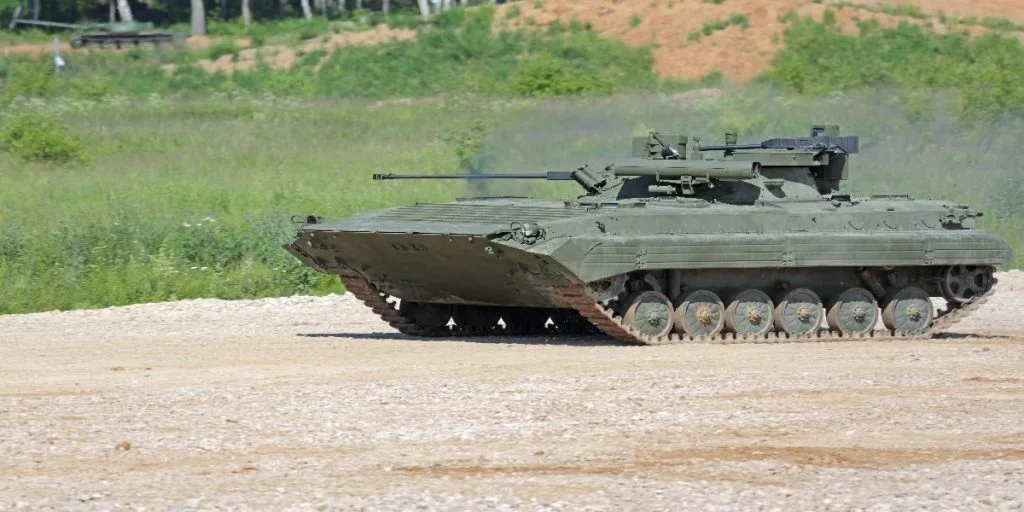
Russia deploys land-mounted naval autocannons and BMP-2M combat vehicles in occupied Crimea to counter recurring Ukrainian drone strikes.


Russian forces are expanding improvised air defense networks across occupied Crimea, deploying BMP-2M infantry fighting vehicles alongside land-mounted naval artillery. According to United24 Media, open-source footage showed an AK-306 six-barrel naval autocannon positioned on the Crimean coast next to a BMP-2M. Recurring Ukrainian long-range drone strikes against military installations and logistics across the peninsula have prompted Moscow to supplement standard air defense systems with unconventional weapon combinations.
Defense Express reported that the recorded footage likely depicts a training drill rather than an active combat interception. Audio from the recording captured personnel discussing the need for a target to hover in a specific area, suggesting the use of a quadcopter during the exercise. Neither weapon system showed clear evidence of successfully hitting the target in the released video.
The deployment highlights ongoing adaptations by Russian units attempting to defend coastal assets from persistent unmanned aerial attacks. Ukrainian forces regularly launch long-range strikes against radar stations, airfields, and naval vessels across Crimea. These sustained operations have stretched Russian air defense capacity, leading to improvised solutions on the ground.
Technical limitations of improvised naval artillery
The AK-306 is a six-barrel 30mm automatic cannon originally designed for maritime vessels. In the footage, the system was mounted on a reinforced ground emplacement and powered by an audible nearby generator. The mount rocked noticeably during firing bursts, raising questions regarding its accuracy and recoil control when fired from an improvised land position.


Stability limitations have historically affected the AK-306 aboard naval platforms, and ground installations encounter similar mechanical challenges without dedicated naval damping systems. Operating the weapon without integrated radar fire-control systems significantly limits its capability to track and intercept small, fast-moving drones. The adaptation reflects Russian efforts to repurpose surplus naval inventory to establish coastal defense lines.
Despite high rates of fire, manually aimed or stationary rotary cannons often fail to provide reliable hit probability against unmanned aerial vehicles. Defense analysts noted that without synchronized tracking sensors, point-defense guns remain largely limited to visual range engagements. The setup serves primarily as a last-resort barrier against low-altitude threats.
BMP-2M integration and domestic infrastructure defense
The modernized BMP-2M infantry fighting vehicle presents a more technically viable anti-drone platform due to its Berezhok combat module. The turret features a multichannel optical sight and an automated fire-control system capable of tracking moving targets. Combined with a 30mm 2A42 autocannon, the vehicle can theoretically engage low-flying aerial targets.
In October 2026, the Russian Defense Ministry claimed BMP-2M units shot down fixed-wing drones using 30mm programmable airburst ammunition. However, analysts noted that the ammunition visible in the latest footage resembles standard 3UOR6 fragmentation-tracer rounds rather than specialized airburst munitions. There is also no objective confirmation that standard Berezhok modules possess the fire-control programming hardware required to detonate airburst shells at specific ranges.
The deployment of armored vehicles for facility defense has also expanded into Russia’s domestic energy sector. Russian oil refineries previously posted job advertisements seeking BMP-2M crews to protect facilities from Ukrainian long-range strikes. Heightened concern over infrastructure vulnerabilities was further demonstrated in the Arctic Yamalo-Nenets region, where local authorities offered mobile fire teams $12,000 for each intercepted drone to safeguard remote oil and gas facilities.



