
 Jens Asbjørn Bøgen

When Ukrainian drone operators scan the front for high-value Russian targets, they are increasingly scanning for lies.

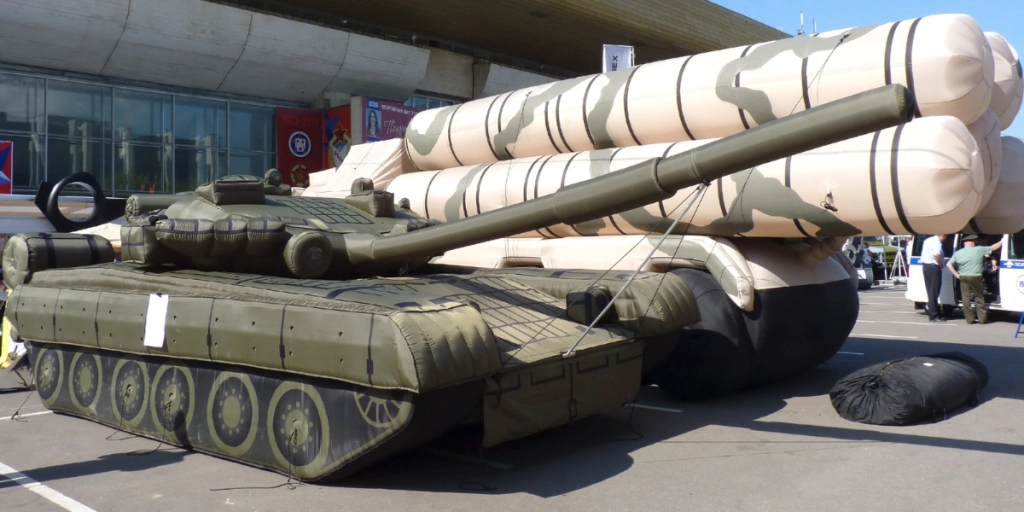
Russia’s deception program on the battlefield has grown into an industrial-scale operation, and much of its supply chain runs through a single foreign country. A new trade-data investigation now puts a dollar figure on it.
Since the full-scale invasion began in February 2022, Russia has imported at least $120 million in goods from China under a customs code used by inflatable military decoy manufacturers, according to data compiled by the analytics platform Import Genius and reviewed by The Telegraph.
The imports cover materials for inflatable replicas of fighter jets, helicopters, tanks, air defense systems, artillery and rocket launchers.
Chinese manufacturer Gauss, which operates under several brand names and runs a production facility covering 16,000 square meters, is one of the main suppliers feeding the trade, according to the reporting. The decoys are advertised online for only a few hundred dollars apiece.


Decoys built to mimic radar and heat
The replicas are more than air-filled shells.
Some models are engineered to imitate the thermal signatures and radio-frequency emissions of real military hardware, making them harder to distinguish from genuine equipment in the sensor feeds Ukrainian reconnaissance drones rely on.
That is the point. The decoys are built to pull Ukrainian strikes away from actual weapons systems and onto worthless targets, burning through Kyiv’s finite stockpile of precision-guided munitions.
Robert Tollast, a research fellow at the Royal United Services Institute in London, told The Telegraph that the decoy pipeline is likely to keep growing. “This is not high-tech military production, so the scope for such supplies is very large,” he said.
A cheaper option than the Russian factory
Chinese supply has one obvious appeal: price. Russia’s own long-standing inflatable-decoy maker, Rusbal, has supplied the Defense Ministry for years but sells at significantly higher costs than the Chinese alternatives now flowing across the land border.
The $120 million figure comes with a caveat. The customs category also captures civilian inflatables such as swimming pools and sports equipment, so not every dollar represents a military decoy. Analysts say the sheer volume, however, is consistent with large-scale deliveries of military mock-ups.
The tactic cuts both ways. In January 2026, a Russian BM-35 loitering munition flew roughly 200 kilometers across the front and struck what Moscow’s Rubicon drone unit celebrated as a Ukrainian F-16 at Kanatove airfield in the Kirovohrad region. It was a decoy.
For Washington, the shipments feed an increasingly concrete debate over whether Chinese “dual-use” exports to Russia amount to material military support. Beijing has consistently rejected that framing, saying its trade with Russia is normal commercial activity.



