
 Christine Drews Sieger

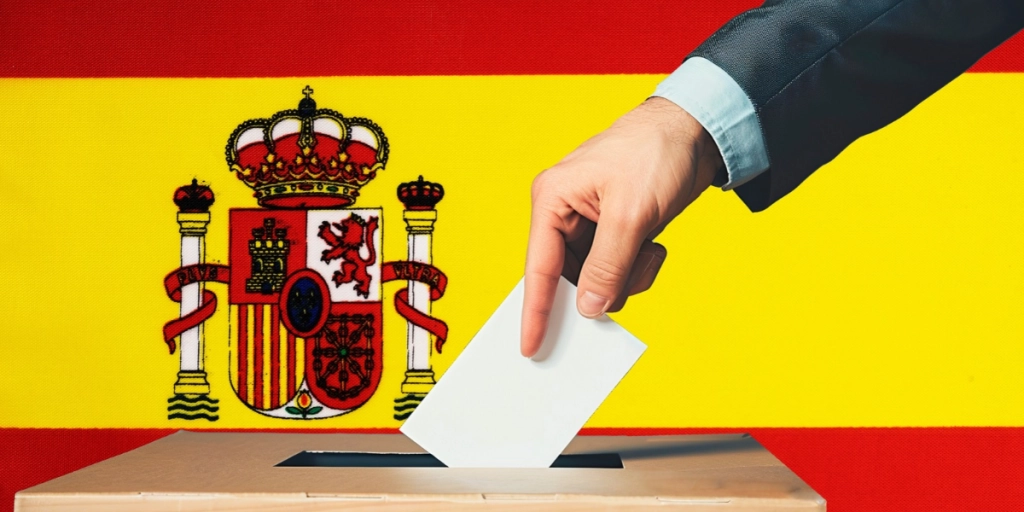
As Spaniards vote in the country’s general election, allies and critics alike are watching closely to see whether Prime Minister Pedro Sánchez can hold on—or whether a coalition led by the conservative People’s Party (PP) and Vox takes over.


An election in Spain rarely stays confined to Spain. As Spaniards vote in the country’s general election, allies and critics alike are watching closely to see whether Prime Minister Pedro Sánchez can hold on—or whether a coalition led by the conservative People’s Party (PP) and Vox takes over.
Earlier this year, roughly 6,000 politicians, analysts, and activists gathered in Barcelona to exchange progressive strategies as a counterweight to the advance of the right. There, Sánchez welcomed guests including Brazil’s Lula and Mexico’s Claudia Sheinbaum, declaring:
“We’re proud to be leftwing parties, socialists, democrats and progressives.”
Progressive International has called Spain “living proof that another path is possible,” while European left-wing figures—including Raphaël Glucksmann and Elly Schlein—warned in an op-ed that the outcome carries consequences far beyond Spain’s borders for the welfare state and Europe’s place in an uncertain global order.


Sánchez has also taken sharp stances abroad, criticizing the war in Iran, pushing back against demands for higher defense spending, and adopting a tougher line toward Israel over Gaza.
To supporters, he represents a social democratic leader willing to take on major political battles, The Guardian reports.
Housing pressure at home
Beyond the political debate, housing has emerged as one of the biggest concerns for Spanish voters.
According to a recent poll by Spain’s Centre for Sociological Research (CIS), 55.7 percent of respondents named housing as one of the country’s main problems, well ahead of immigration and the general economic situation as house prices have outpaced average wages over the past decade.
EuroNews reports that this affordability pressure has become a major challenge for Sánchez’s government.
Economist Isabella Weber notes that since 2018 the government has raised the minimum wage by 75 percent, introduced free or discounted train travel on certain routes, and expanded renewable energy, according to The Guardian.
Even so, surging housing costs have sent hundreds of thousands into the streets and turned many voters against the government, while political scientist Paolo Gerbaudo points out that growth has only partly lifted living standards amid rising inequality.
A test for the right
On the other side is the prospect of Spain’s first national governing coalition between the PP and Vox since the end of Francisco Franco’s dictatorship.
According to Chatham House adviser Nic Lawley, bringing Vox into national government in the eurozone’s fourth-largest economy would test what happens when Europe’s center-right lowers its barrier to the far right at the national level, The Guardian reports.
With the right-wing Vox party—which advocates stricter immigration policies—floating steep spending cuts and denouncing the Gibraltar treaty as “illegal and illegitimate,” the vote could shape not only Spain’s political direction but also the balance of power between the country’s center-right and far-right forces.



