
 Asger Risom

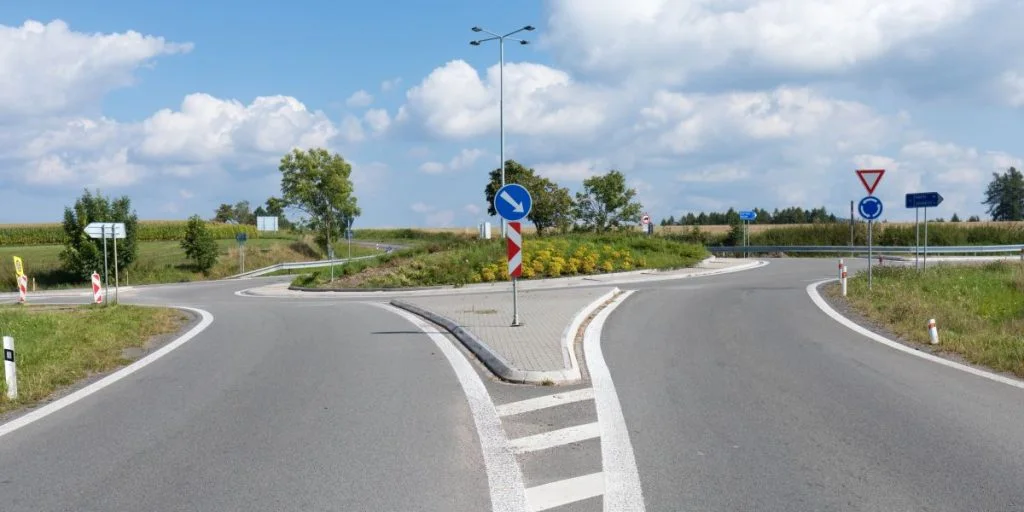
By forcing motorists to slow down and merge at shallow angles, modern roundabouts cut fatal and serious injury crashes by roughly 90 percent while reducing fuel consumption and municipal maintenance costs.


Mention a new roundabout at a town hall meeting and you will almost certainly hear complaints about confused motorists, awkward merges, and tight turns. Yet traffic engineers treat circular intersections as the gold standard of street design because they move more cars with fewer delays than traditional stoplights. More importantly, replacing a standard four-way intersection with a modern roundabout cuts fatal and serious injury crashes by roughly ninety percent.
The geometry that stops T-bone collisions
Traditional four-way intersections are built around crossing paths at ninety-degree angles. When someone runs a red light or misjudges a left turn, vehicles slam into each other at full cruising speed. Those perpendicular impacts strike doors and windows directly, hitting the exact part of a car with the least structural crumple zone.
A modern roundabout removes those crossing trajectories entirely by bending every approaching lane into a one-way curve. Drivers must yield to traffic already inside the ring and merge at a shallow angle rather than cutting across oncoming lanes. If two cars do make contact, the result is almost always a low-speed sideswipe instead of a catastrophic head-on or T-bone impact.
Traffic engineers measure this safety gain through conflict points, which are the specific spots where vehicle paths cross, merge, or diverge. A standard four-way intersection creates thirty-two distinct vehicle conflict points, each one a potential collision site. Replacing that junction with a single-lane roundabout drops the number of conflict points down to just eight.


Ninety percent fewer fatal crashes
The crash data behind circular intersections is dramatic enough that safety researchers consider them one of the most effective road upgrades available. According to research compiled by the Insurance Institute for Highway Safety, converting a signalized or stop-controlled intersection into a roundabout cuts fatal and incapacitating injury crashes by about ninety percent. Total injury crashes drop by roughly seventy-five percent, while overall collisions fall by nearly forty percent.
Much of that improvement comes down to basic physics and forced speed control. Traffic lights accidentally encourage drivers to accelerate toward yellow bulbs in hopes of beating the red, raising kinetic energy right before a crash. A roundabout’s tight curvature makes high-speed entry physically uncomfortable, forcing motorists to brake down to fifteen or twenty miles per hour before entering the circle.
That built-in speed limit also makes intersections far safer for people on foot. Pedestrians cross only one direction of slow-moving traffic at a time, pausing on raised splitter islands halfway across rather than sprinting across four or five wide lanes. Even when severe weather knocks power out across an entire neighborhood, a roundabout keeps regulating traffic without a single flashing signal.
Less waiting, less idling, and lower bills
Beyond keeping people out of emergency rooms, circular intersections move cars through busy corridors faster than traffic lights. Conventional signals force drivers to sit idling at empty intersections while waiting for a green timer to cycle through. At a roundabout, traffic flows continuously whenever a gap opens up, eliminating pointless stops during off-peak hours.
The IIHS estimates that converting just ten percent of signalized intersections in the United States to roundabouts would prevent more than fifty thousand crashes and save over one billion hours of vehicle delay each year. Fewer stops and starts translate directly into lower fuel consumption and reduced tailpipe emissions. Municipal budgets benefit too, since concrete curbs last roughly twenty-five years compared to the ten-year lifespan and constant electricity bills of traffic signals.
Many drivers confuse modern roundabouts with older mid-century traffic circles, which earned a terrible reputation for chaotic, high-speed merging. Massive rotaries like the Place de l’Étoile in Paris or Dupont Circle in Washington, D.C., often prioritized entering vehicles or packed multiple lanes together without clear yield rules. Modern roundabouts are much smaller, strictly require entering cars to yield to traffic inside the ring, and use painted lane dividers to prevent erratic weaving.
Why people complain until the concrete dries
Despite the overwhelming safety and traffic flow numbers, proposals to build a new roundabout routinely trigger fierce pushback from local residents. Motorists worry about unfamiliar rules, trucking companies complain about tight turning radii, and business owners fear construction will drive away customers. The unfamiliarity alone makes drivers feel like they are losing control compared to the binary simplicity of red and green lights.
That skepticism almost always evaporates once drivers actually start using the finished intersection. In an IIHS survey tracking two intersections in Bellingham, Washington, public support for roundabouts sat at just thirty-four percent before construction began. Six months after the circles opened, approval jumped to fifty-one percent, and after more than a year of daily use, seventy percent of local drivers backed them.
The shift happens because people quickly realize their daily commute gets smoother and faster without long red-light backups. Once muscle memory replaces initial hesitation, navigating a yield sign becomes second nature. Drivers may still grumble whenever city planners announce a new circle, yet few communities ever ask to tear one out and put the stoplights back up.



