
 Kenneth Glad

Sometimes a thriving community vanishes in the blink of an eye, leaving only scorched earth behind. For centuries, people walk past the empty fields without realizing what lies beneath their feet. When the ground finally gives up its secrets, the finds can change everything we know.


Hedeby was a settlement in southern Denmark that stood as the absolute center of Nordic trade for 350 years. Merchants travelled from afar to swap goods by the water. The town sat safely next to a fjord, guarded by a massive semicircular wall.
But that protection failed. According to Historienet, researchers uncovered a thick layer of burnt earth at the site. This dark soil tells a brutal story of fire and ultimate ruin.
The physical evidence lines up perfectly with historical texts. Both the Icelandic sagas and the German monk Adam of Bremen wrote about vicious attacks hitting the town.
Museum director Matthias Toplak from the Viking Museum Haithabu in Busdorf near Schleswig in Northern Germany noted that these strikes happened in 1050 and 1066. “Archaeologists have confirmed that the city was destroyed in the middle of the 11th century,” Toplak told Historienet. After the second attack, locals abandoned all hope of rebuilding.


Starting over nearby
Those who survived packed up what little they had left. They walked away from the ruined settlement and looked for a safer place to call home.
They found it across the water. The refugees moved to the northern bank of the Schlei fjord. There, they laid the groundwork for a new community.
This fresh start grew into the modern town of Schleswig. The locals upgraded their building methods to match the medieval era. They swapped wooden walls for sturdy stone houses, built a royal palace, and placed a church right in the center.
Hedeby was not the only Viking hub to relocate. Other major trading posts, like Birka and Kaupang, shifted down the road to become Sigtuna and Oslo.
Places like Ribe were exceptions that stayed put. It is the oldest town in Denmark and is the home of 8,400 people today.
A lucky escape
Because Hedeby was completely abandoned, no one ever built over it. This quirk of history turned out to be a massive stroke of luck. An archaeologist finally rediscovered the forgotten site in the late 1800s.
Since then, teams have pulled hundreds of thousands of objects from the dirt. The settlement sits on a damp underground layer. That wet earth perfectly preserved organic materials that normally rot away.
Leather, textiles, and wood survived in the mud for a thousand years. Toplak emphasized how rare and valuable this pristine preservation is.
“Hedeby has been our key to understanding everyday life in the Viking Age,” he said.
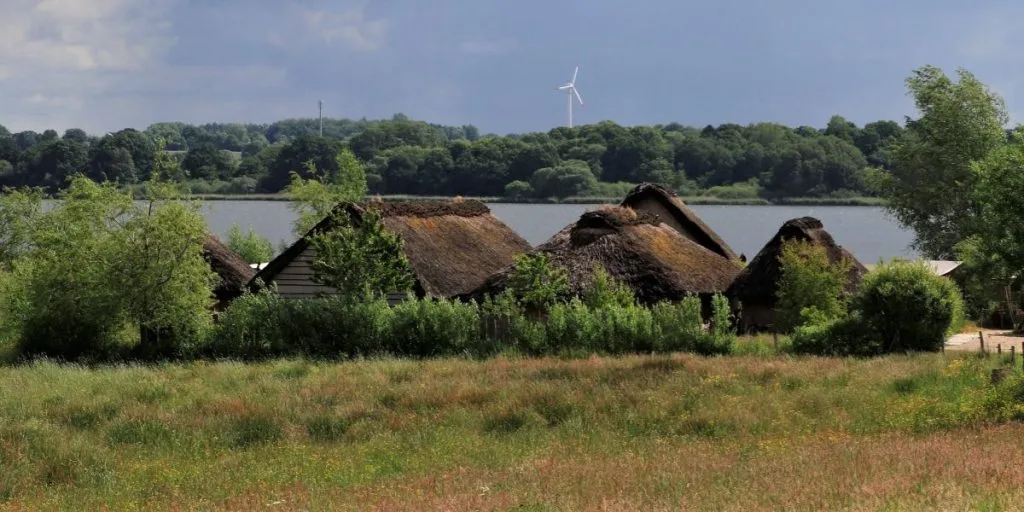
Thanks to these finds, experts recreated Viking houses with incredible accuracy. Only the roof construction poses a slight mystery.
Still hiding secrets
Despite decades of hard work, the site holds onto its secrets. Barely five percent of the area inside the old semicircular wall has been excavated.
However, researchers know what the rest of the town looks like. They used geomagnetic analysis to scan the entire area. This technology allowed them to map the hidden streets without turning a single spade of dirt.
The scans proved that more than 90 percent of Hedeby remains untouched underground. Because the area is now a protected UNESCO World Heritage site, no further major digs are planned.
Still, Toplak holds out hope for one specific discovery. “I am particularly curious whether we will one day be able to find the missionary Ansgar’s first church, which was built around 850 AD,” he told Historienet.



